The Chief Executive Officer of AskRaf International Shipping Company Limited, Madam Anita Soatuo Kontuo, has pledged to invest in the construction of a Graduate School Building for the Regional Maritime University (RMU) to strengthen postgraduate education, research and professional development in the maritime sector.
She made the pledge at the RMU-AskRaf Annual Blue Economy Public Lecture in Accra on Wednesday, November 25, 2026, where she also called on African countries to reposition the Blue Economy as a strategic driver of wealth creation, employment and sustainable development.
Madam Kontuo, who was also the Chief Patron of the event, observed that Africa’s oceans offered enormous economic opportunities beyond their environmental significance, particularly in international trade, transportation, food security, energy, employment and investment.
She identified the RMU as a strategic institution in this endeavour, noting that its contribution to maritime education and professional development placed it in a strong position to support Africa’s ambitions for a sustainable and competitive maritime industry.
“It is important to renew our commitment to translating ideas on the utilisation of ocean resources into concrete actions, opportunities and strategic initiatives that will drive lasting national and continental development,” she stated.
She consequently urged stakeholders in the maritime and environmental sectors to intensify investments and collaborative efforts towards harnessing ocean resources for sustainable economic growth.
Madam Kontuo underscored the critical role of RMU in advancing this vision, describing the University as an important center for maritime education and professional development, with a track record of producing skilled professionals who serve the African continent and the global maritime industry.
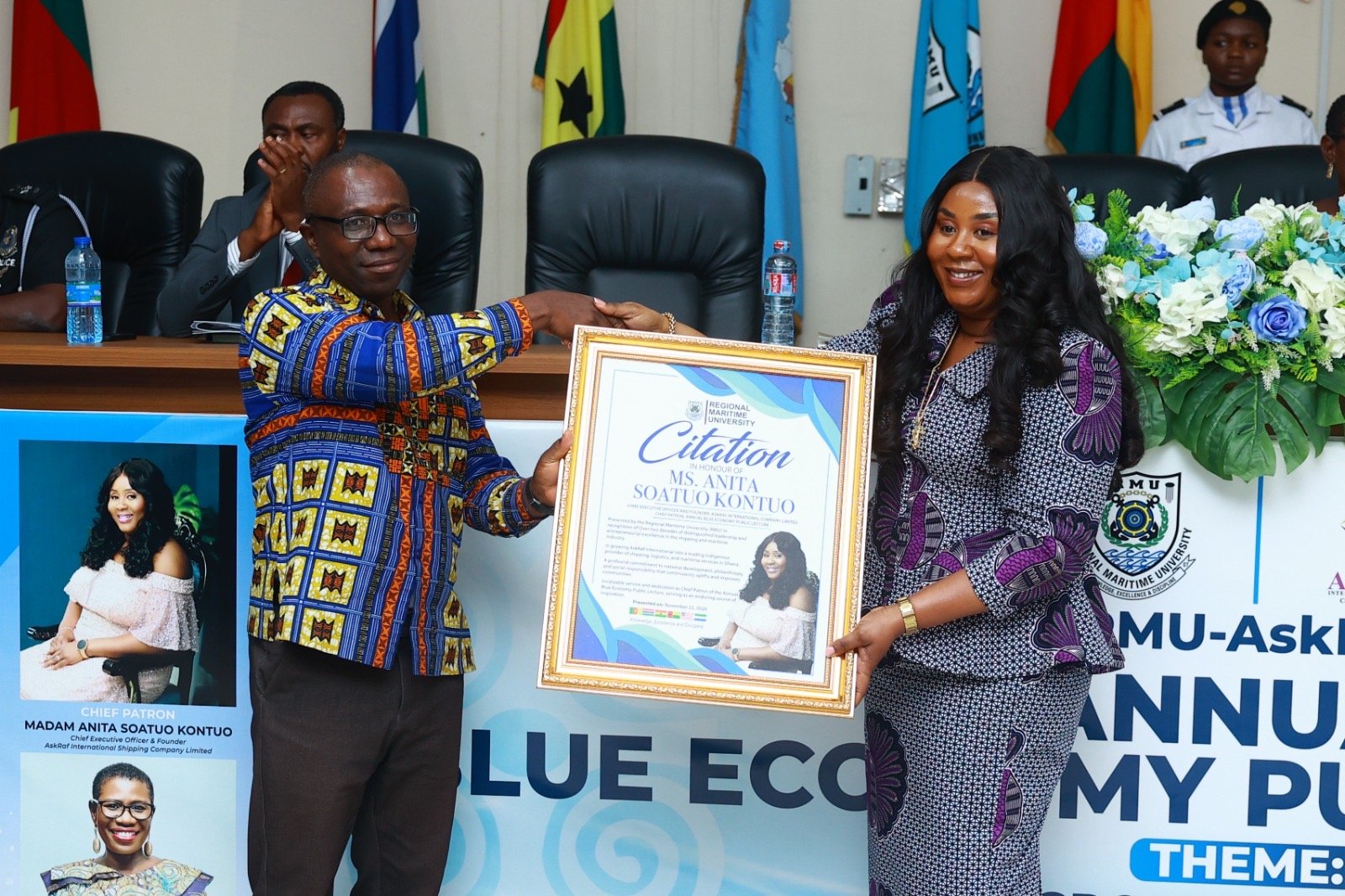
The lecture, held under the theme, “Blue Growth for Africa: Investing in Oceans, Empowering People for National Development and Sustainability,” brought together key stakeholders to examine how Africa’s ocean resources could be harnessed to accelerate sustainable development and economic growth.
It provided a platform for deliberations on emerging opportunities and challenges within the continent’s Blue Economy, with particular emphasis on practical strategies for utilising marine and coastal resources to promote inclusive economic growth, job creation and environmental sustainability.
The Annual Blue Economy Public Lecture is one of RMU’s flagship initiatives aimed at promoting scholarly dialogue, research, innovation, policy engagement and knowledge exchange on the sustainable development and responsible utilisation of Africa’s marine and coastal resources.
Delivering the keynote address, the Mayor of Freetown, Sierra Leone, Madam Yvonne Aki-Sawyerr, also called for strategic investments to unlock the full potential of the Blue Economy across the continent.
She observed that achieving the African Union’s (AU) target of generating $405 billion and creating 57 million jobs by 2030 would require Africa to move beyond policy intentions towards practical, actionable and bankable investments.
These, she explained, should include direct financing for municipal and coastal infrastructure, measures to de-risk and scale up circular and ocean-based small and medium-sized enterprises (SMEs), as well as the institutionalisation of inclusive ocean governance.
“Africa’s oceans are not merely trade routes or extraction zones, they are the lifeblood of our coastal communities and the anchor of our continent’s sustainable future,” she stated.
She further urged stakeholders to work towards building a Blue Economy that protects marine ecosystems, empowers young people and women, and delivers inclusive prosperity for coastal communities.

“Let us build a Blue Economy that cleans our waters, restores our marine ecosystems, empowers our youth and women, and delivers true, inclusive prosperity from the shoreline up,” she added.
In a speech delivered on his behalf by the Academic Registrar, Mr Jones Addai-Marfo, the Acting Vice Chancellor of RMU, Dr Jethro W. Brooks Jr., acknowledged the oceans as longstanding sources of economic livelihoods but cautioned that their sustainability was increasingly threatened by population growth, urbanisation, overexploitation, pollution, ocean acidification, marine plastic litter, underwater noise, declining biodiversity, climate change and the expansion of global trade.
He noted that these challenges placed mounting pressure on marine resources, increasing the risk of depletion and potentially irreversible environmental damage.
Dr Brooks stressed that unlocking the full potential of the Blue Economy required deliberate and forward-looking investments, particularly in marine science, green ports, sustainable fisheries, aquaculture, maritime security and clean coastal energy.
He further called for a shift from traditional maritime practices towards a modern and sustainable ocean-based economy, supported by strategic investments in technology, research and human capital development.
“It is also important to equip the youth with cutting-edge maritime skills, support local fisherfolk with modern technology and fair market access, while ensuring that coastal communities are active stewards and primary beneficiaries of ocean conservation,” he emphasised.

Other speakers at the lecture included Senior Lecturer at the University of Ghana School of Law and Coordinator of the event, Dr Godwin Djokoto, Commander of the Ghana Marine Police, Chief Superintendent Charles Osei, Head of the Department of Sociology and Anthropology at the University of Cape Coast, Prof. Georgina Yaa Oduro and Prof. F.K.E. Nunoo of the Department of Marine and Fisheries Sciences, University of Ghana.