Studies show that a substantial share of Africa’s regional trade is informal, on the order of 30% to 40%. This informal trade is pervasive for agricultural goods as well as many industrial goods – most of which are imported from Asia, North America and Europe.
Ghana’s president H.E Nana Akuffo Addo, has impressed on the need for Ghana to build a factory in every district, ensuring production of Made in Ghana products at each turn.
The recently concluded Made in Ghana fair held by Ghana’s Ministry of Trade and Industry, encouraged Ghanaian entrepreneurs to build Ghanaian brands and take ownership of them.
Kenya’s drive for value addition has seen an influx of made in Kenya products in all supermarket shelves in Kenya. For many years, Kenyan tea was sold in Bulk at the Mombasa Auction to external markets. Buyers from these markets would then enhance and package the tea as they saw fit. I suppose this is one of the reasons the phrase ‘English Tea’ is so famous – yet England does not make the list of top tea growers globally. For a long time Kenyans knew only one homemade tea brand – Ketepa. Shortly after we saw Kericho Gold and now we have more than 6 brands including Eden Tea, Melvin’s Tea, Siret Tea, Ngorongo Tea and more.
With a population of over 178 million, and home for the largest consumer market in Africa, Nigerian Government’s value addition and industrialization effort includes notably the setting up of the Nigerian Export Processing Zone Authority (NEPZA), with the mission of spearheading the diversification of the Nigerian economy by expanding and increasing non-oil exports for sustainable and inclusive growth. Industries in the Free Zone include those producing electrical and electronic products, wood products and handicrafts, rubber and plastic products, among others.
As manufacturing and industrial output remain the drivers of economic growth, the need for African economies to give more attention to value addition cannot be overemphasized.
However, African exports often face excessively strict standards to enter global markets. So chances are, these high quality – value added products, will only go as far as their national and perhaps regional boundaries will take them.
According to research giant McKinsey & Company, the working-age population in Africa is growing at a clip of 2.7 percent each year (compared with 1.3 percent in Latin America and 1.2 percent in Southeast Asia). By 2025, nearly two-thirds of the estimated 303 million African households will have discretionary income. This massive expansion of the consumer pool—an addition of almost 90 million consumers in just ten years—will help fuel the continent’s GDP growth from 4.9 percent today to 6.2 percent in the next decade, far outpacing the global GDP growth rate of 3.7 percent. What’s more, African consumers are young and willing to spend. Fifty-three percent of income earners in Africa are between 16 and 34 years old—an age group that tends to be more aware of and eager to try new products. These consumers will contribute to more than $400 billion in total consumption growth in the next decade.
The logical next step therefore, would be to ensure that African products can reach this growing African consumer base.
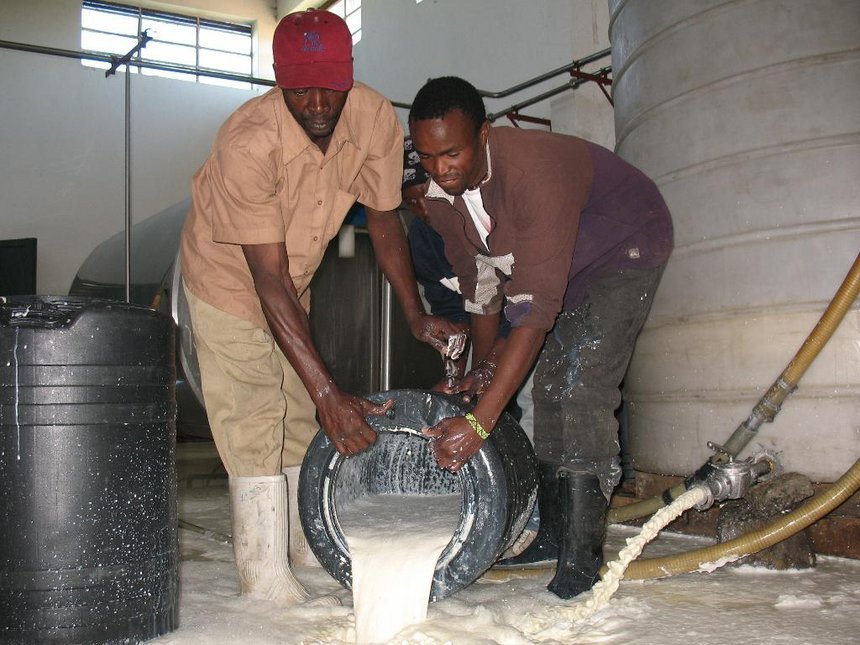
In 2016, Kenya’s Dairy sector regulator, spoke of lobbying the government to initiate incentives such as seeking new markets, particularly in the African continent. This came on the back of a milk glut that saw thousands of liters of milk poured down the drain as a result of oversupply.
Kenya and Ghana have existing instruments of cooperation signed in December 2014. One of these is a Memorandum of Understanding on cooperation in Agriculture. In the MOU, it states under Article II point 3, that: “The parties agree to promote agricultural trade and technology transfer and shall endeavor to create favorable conditions for import and export of important products without prejudice to their respective commitments under existing bilateral and multilateral arrangements.”
How is it that till today, Kenyan milk is not on Ghanaian retail shelves?
The African Union’s enactment of the Africa Continental Free Trade Area seems to be our best option yet. Forty-nine of Africa’s 55 countries have signed the framework for the African Continental Free Trade Agreement (AfCFTA) to create a single continental market for goods and services, with free and unfettered movement of businesspeople and investments. When at least 22 countries ratify it, the AfCFTA will officially come into force, potentially making the continent the largest trading bloc in the world.
To date, nine countries have deposited their instruments of AfCFTA ratification with the Chairperson of the African Union Commission: Ghana, Kenya, Rwanda, Niger, Chad, Guinea, eSwatini (former Swaziland), Uganda, and Ivory Coast.
South Africa, Sierra Leone, Mali, Namibia, Senegal, Congo, Togo, Mauritania, and Djibouti have received parliamentary approval for ratification, bringing the total number of ratifications (deposited and pending) to 18.
While this is definitely laudable, the ratification of the 22 countries might be a long way coming, given all the bureaucratic protocols needed.
What about existing regional trade blocks? While the establishment of Regional Economic Communities (RECs) was a step toward integration, the lack of implementation strategies and the non-binding nature of multiple and overlapping instruments hinders progress. Additionally, countries within each region tend to produce the same value-added products. This then leads to protectionism.
For value addition to yield profitability, governments have to consider special concessions of trade with each other. Documentary requirements can be simplified by the alignment of standards. Import tariffs can be significantly lowered. Customs clearance can be expedited. Access to Trade Financing can be made easier.
Where special vehicles or instruments of cooperation exist, the partner countries must, as a matter of urgency, activate them.
By: Leah Nduati-Lee