


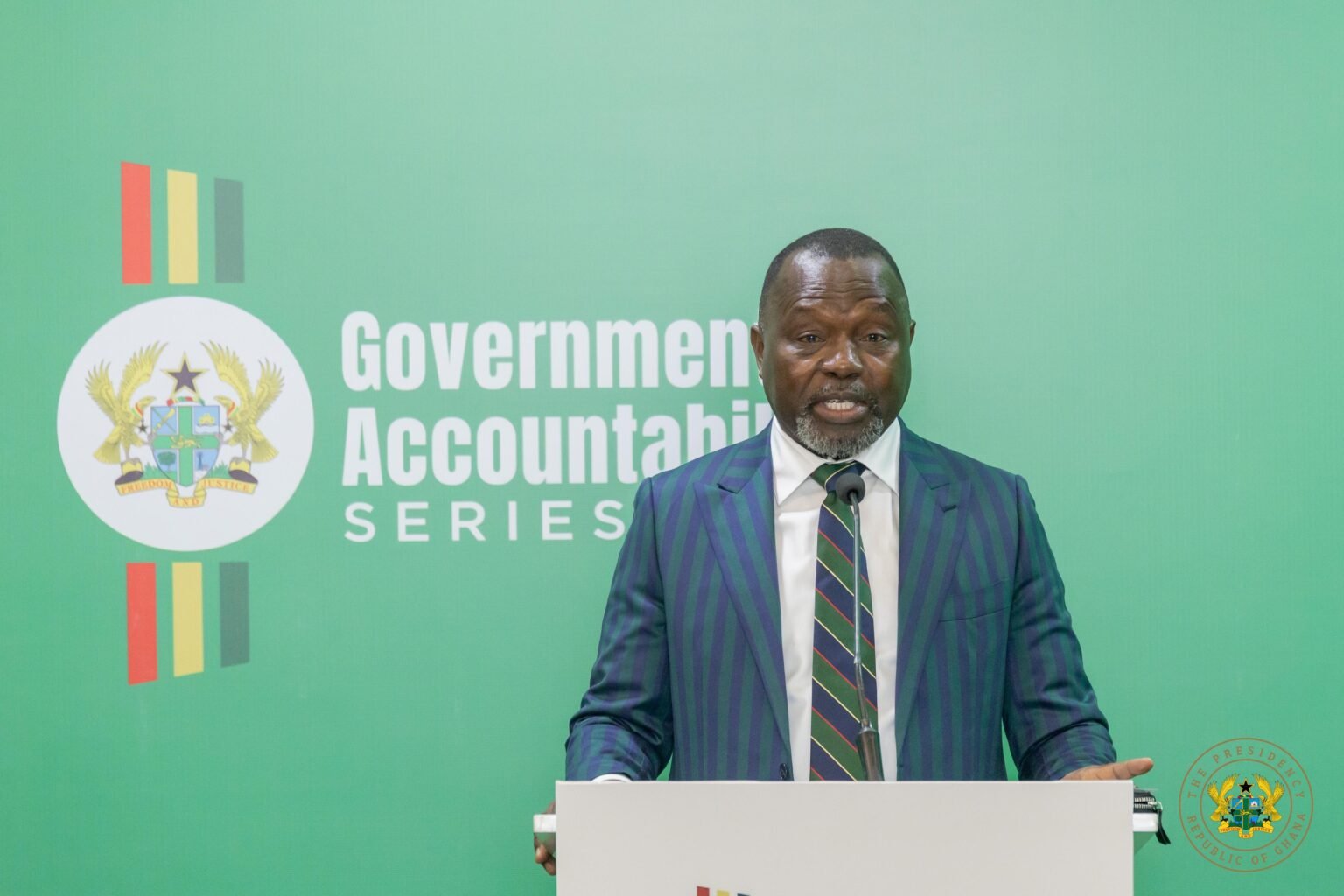
Attorney General and Minister for Justice, Dr. Dominic Ayine, has taken aim at the previous administration over its handling of the Unibank crisis, describing its decisions as missed opportunities that worsened the bank’s collapse and undermined efforts to recover outstanding debts.
Speaking at the Government Accountability Series on Monday, July 28, 2025, Dr. Ayine contrasted the approach of the former Minister for Finance with that of the current one, claiming the latter has shown “wisdom in governance” by using state resources to revive distressed banks rather than shut them down.
Referencing a key moment prior to Unibank’s collapse, the Attorney General revealed that the bank had proposed a solution to keep itself afloat by requesting that government settle debts owed to contractors through Unibank. This, they argued, would allow the bank to recover GH¢2.9 billion in receivables and strengthen its balance sheet. However, the former Minister for Finance “flatly rejected” the proposal, leading to a situation that contributed to Unibank being placed under official administration by the Bank of Ghana.
“Our current Finance Minister could have put NIB through the same process,” Dr. Ayine said. “But instead of using money to collapse a bank, Honourable Atuk Olsen has used the money to revive it, for it to keep jobs and then continue to operate in the banking sector. That is what is called wisdom in governance.”
In defending his controversial decision to enter a nolle prosequi (discontinuance of prosecution) in the criminal trial of former Bank of Ghana Governor Dr. Kwabena Duffuor and seven others, Dr. Ayine said the move was necessary to pursue a realistic asset recovery strategy.
He noted that contrary to public perception, the criminal charges; largely based on causing financial loss, falsification of accounts, and related offences; were legally contestable and did not allege that the accused personally stole or looted funds. He emphasized that even if convictions had been secured, meaningful recovery would still have been elusive without a deliberate strategy to trace and recover assets.
Dr. Ayine criticized his predecessors for failing to undertake asset tracing or secure freezing orders before initiating prosecution, a gap he believes put the state at a disadvantage. “By the time I assumed office… no asset tracing had been undertaken and no freezing orders had been obtained,” he said. “I could have been faced with a situation where the thief would have eaten four of the goats, thus leaving me with only one possibility to recover only two goats.”
Under the settlement agreement reached with the accused, landed properties valued at GH¢824 million have been transferred to the state, and efforts are underway to recover an additional GH¢1.2 billion from third parties, including contractors who benefitted from transactions with Unibank. The Attorney General assured that the recovery process will be monitored quarterly, with oversight from his office, the Bank of Ghana, and the Ministry of Finance.
READ: NSA Scandal: Eight suspects seek plea bargain, ready to testify — AG
The Attorney General concluded that while the public’s desire for punitive measures is understandable, his focus remains on ensuring realistic and substantial recoveries for the state, adding that convictions and recoveries are not mutually exclusive but must be balanced with pragmatism.
Source: Starrfm.com.gh


