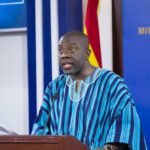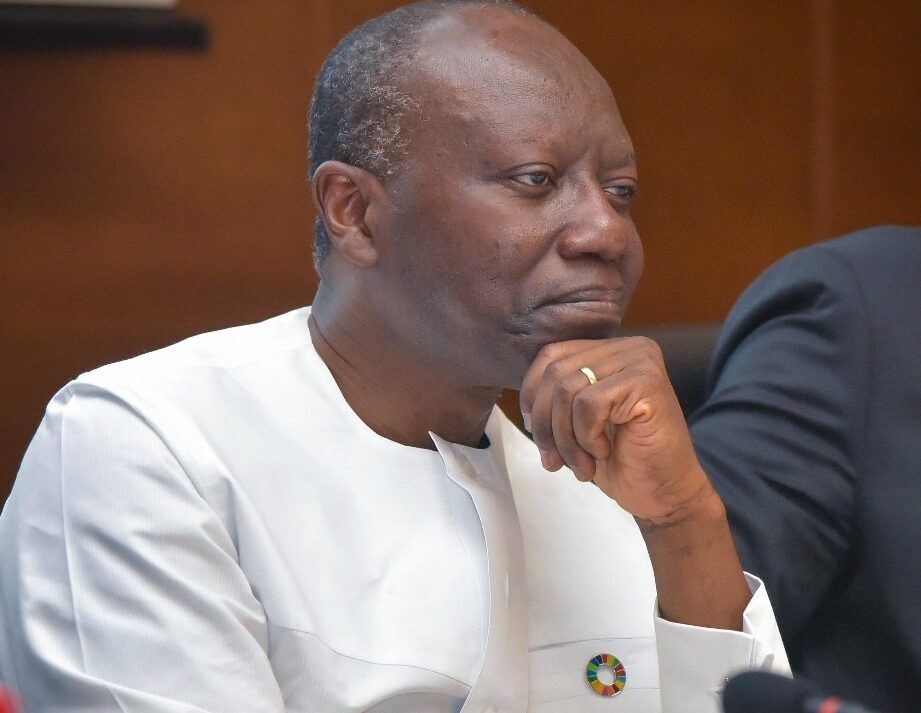
In a crisp, historical speech given yesterday, March 28, by the Minister for Finance in Parliament, Honourable Minister Ken Ofori-Atta explained Ghana’s successful completion of the Extended Credit Facility (ECF) programme, or bailout, of the International Monetary fund (IMF). Ken Ofori-Atta explains why Ghana applied for it, how it failed under the Mahama Administration, how the Nana Akufo-Addo Administration put it back on track, and how it has now been completed with brio.
“I am glad to announce that it [the ECF ] is now a mission accomplished!” Ken Ofori-Atta, Minister for Finance told parliamentarians on March 28.
The March 28 announcement demonstrates political will to respecta promise made in section 12 of the 2019 Budget Statement and Economic policy that Ghana was on course to completing the ECF with the IMF, which it had applied to in 2014.
Before Ghana went to the IMF for the bailout (Credit Facility), the country was the poster child of Africa’s emergence as the last economic and finance frontier, having begun producing oil in commercial quantities in 2011.
That was until the economy came crashing down under the Mahama administration, having registered extraordinary budget overruns beginning four months to the 2012 elections. The economy never recovered under the Mahama Administration.
Describing the Mahama Administration’s failure on the economy, an August 2014 article by the UK’s Financial Times (FT) was headlined: “Ghana Seeks IMF Help After Currency Falls 40%.”
Ghana, which had regained its position as a beacon of hope for the continent, was failing, fast. And that strongly-worded August 2014 FT article described the international community’s disappointment with Ghana’s fall from grace: “Ghana, the country that epitomised the ‘Africa rising’ narrative of strong economic growth and improved governance, is to seek help from the International Monetary Fund.”
In economic and financial dire straits,local analysts warned that it would only take a disciplinedgovernmentin the application of the IMF’s credit facility toput the country back on track. The Credit Facility from the International Monetary Fund (IMF), which came with an expiration date, was expected to end in 2017.
But no sooner had the Mahama Administration started the Credit Facility programme than that too started failing. Left without a choice, the Credit Facility programme was extended in 2017 after it derailed in what beggared an obvious mismanagement, or even misunderstanding, of the economy under the previous administration.
When the AddoAkufo-Addo administration came to office, it was left with two choices: abandon the programme or continue with it. But the country’s credibility with investors, what with the poor state of the inherited economy, would have been on the line shouldthe new Akufo-Addo administration have opted for the first choice.
The current administration’s decision meant making choices that would not be politically favourable in the short term. For Ghana to regain its economic fortitude, short-term political gratification had to be abandoned.
Two years following President Nana AddoAkufo-Addo’s administration’s steering of the economy, the programme was not only put back on track, it was sped through in what has been described by the international community as unprecedented.
In only 8 months, between August 2017 and April 2018, the country completed three reviews compared to the three reviews in 2 years in the previous administration. The remarkable management of the economy and the ECF warranted the visit, for the first time, of the head of the IMF, Christine Lagarde, to Ghana.
Ken Ofori-Atta explains that cleaning the inherited economic and financial mess from the Mahama administration has been challenging: “Ghanaians, who have been the victims of poor economic decisions of the past, know all so well that the healing process has not been easy, it has been austere, it has been tough, it has been restraining, but it was necessary. It was necessary because what had been broken had to be fixed by the Akufo-Addo government.”
Below is an excerpt of Honourable Minister for Finance, Ken Ofori-Atta’s speech on Ghana’s trajectory under the IMF’s ECF programme:
****
Mr Speaker, Ghanaians, who have been the victims of poor economic decisions of the past, know all so well that the healing process has not been easy, it has been austere, it has been tough, it has been restraining, but it was necessary. It was necessary because what had been broken had to be fixed by the Akufo-Addo government.
In August 2014, the Mahama government was compelled by the outcome of its (homegrown policies) and economic management to turn to the IMF for a bailout. The market, indeed the business community, had lost confidence in the capacity of the then government to steer the economy, with the requisite competence, care and discipline, back on track.
Mr Speaker, permit me to quote what the Financial Times wrote on August 3rd, 2014 in a report with the headline: “GHANA SEEKS IMF HELP AFTER CURRENCY FALLS 40%.” It reads: “Ghana, the country that epitomised the ‘Africa rising’ narrative of strong economic growth and improved governance, is to seek help from the International Monetary Fund.”
“… The West African nation will turn to the fund for financial assistance after its currency plunged roughly 40 per cent this year against the US dollar…
“Accra’s request for a bailout is likely to shake some investors, as Ghana was seen as a model of economic and political development in the continent. In 2007, under the Kufuor Administration, it became the first country in sub Saharan Africa, apart from South Africa, to tap the sovereign bond market, raising $750m through a 10-year bond…”
The FT report of 2014 reminds us further of how dire the situation was, “Ghana has this year repeatedly postponed a return to the bond market. But, Mr Terkper said the country still planned a $1bn, 10 year bond.”
He [Seth Terkper, Minister for Finance in the Mahama administration] was quoted as saying that the Capital market would find our bond attractive once Ghana entered the IMF programme. Even then, we needed the World Bank to provide a $400 million guarantee to support Ghana’s $1 billion sovereign. Despite this guarantee, the 15yr Eurobond issued in 2015 unfortunately attracted the highest coupon rate ever in Ghana history at 10.75%.
The world, Mr Speaker, found our plunge shocking, perplexing. This was because, by 2011 Ghana had begun producing oil in commercial quantities. Hopes of a better Ghana were high. Sadly, Mr Speaker, by the end of the following year, 2012, the economy was already in a tailspin, spiralled by the excessive spending, particularly in the last four months to the 2012 general elections. This led to Ghana recording a deficit of 11.5% of GDP–– highest deficit on record in the 4th republic. His Administration, Mr Speaker, never recovered from that 2012 deficit.
By February 2014, the IMF was calling for urgent measures to restore Macroeconomic stability. By the end of that year, Ghana’s economy was characterised by:
- Rising interest rates to around 26 percent on short term domestic debt (91-day Treasury Bills high policy interest rate of up to 21 percent
- High year-on-year inflation of 17 percent
- A cedi versus dollar depreciation of over 31 percent
- A low net international reserves of 1.8 months imports cover
- Delayed payments of statutory bills
- Mounting arrears as contractors’ bills could not be paid
- Large capital outflows, and
- The ‘Dumsor’ continued to have a devastating impact on the social and economic lives of Ghanaians
Simply put, Mr. Speaker, the economy under the Mahama administration, was in severe crisis. Mr. Speaker, it is important to give this background, in order for the country to understand where we were, how we got there, the pills the people have had to swallow in our committed efforts to get us out and on the go.
Mr. Speaker, the economic situation left the government at the time with no choice but to sign up to a three-year ECF Programme in April 2015. This entailed a total of eight programme reviews twice a year. After each successful review, an agreed amount was to be disbursed as Balance of Payments support to improve the country’s international reserves. The total expected inflow for the three-year period was SDR664.20 million (approximately US$914 million).
Mr. Speaker, the programme primarily aimed to: (i) ensure prudent fiscal consolidation and debt sustainability, contain expenditures through wage restraint and limited net hiring and mobilise additional revenues; (ii) structurally reform to strengthen public finances and instil fiscal discipline by improving budget transparency, cleaning up and controlling public sector payroll, right-sizing the civil service, and improve domestic revenue collection; (iii) restore effective inflation targeting framework to help bring inflation back into single digit territory; and (iv) preserving financial sector stability.
When the President Akufo-Addo administration took over the Management of the Economy, it was confronted with a very difficult choice, continue with a derailed IMF – ECF programme or completely abandoned it due to the steep fiscal consolidation path that we needed to take. But Mr. Speaker we chose the difficult but sensible path to stabilize the economy. We resolved to do what we believe was a move in the National interest and fundamental to our National development goals. The Economy was not in good shape, the financial sector was reeling and we needed to rebuild the confidence of both Ghanaians and Foreign investors in Ghana and our economy.
A SUCCESS STORY
Mr. Speaker, I am happy to announce today that the difficult choice we made has yielded the desired outcome. We have successfully completed the programme and the economic indicators are all looking very good
However, Mr. Speaker, macro-economic performance in 2016, another election year under the previous government, was characterized by excessive fiscal dominance even worse than in 2012. The ECF Programme objectives had been derailed, the then government only managed to complete three Programme reviews against six scheduled. This, Mr speaker, meant that there was no way Ghana could have completed the programme as scheduled in April 2018.
Mr. Speaker, I am delighted to announce that the Executive Board of the IMF met on 20th March, 2019 to approve the combined seventh and eight reviews under the ECF supported arrangement, bringing an end to the Extended Credit Facility Programme.
This successful completion immediately made available to Ghana the amount of SDR132.84 million (about US$185.2 million). This brings the total cumulative disbursement under the ECF supported arrangement to SDR664.20 million (equivalent to US$934.4 million).
Mr. Speaker, the Executive Board issued a statement after the Board meeting in which they commended the Akufo-Addo Government for putting the Programme back on track and achieving significant macroeconomic gains over the course of the ECF supported programme, which has resulted in:
- a rising and broad-based GDP growth momentum with the economy growing by 8.1% in 2017 (up from 2.2% -2015 and 3.4% – 2016) and 6.1% (end-Q3 2018 average);
- effective monetary policy put in place and the sustained disinflation (inflation now at 9.2% from 15.4% -2015);
- accelerated fiscal consolidation with deficit contraction of over 3% of rebased GDP (i.e. from 7.3% – 2016 to 3.9% – 2018);
- a successful banking sector clean-up (with over 1 million depositors’ funds saved).
Mr. Speaker, in 27 months, President Akufo-Addo’s government has achieved the following;
- It completed in 8 months, August 2017- April 2018, three reviews compared to the three reviews in 2 years in the previous administration.
- It completed 2 back-to-back combined reviews (5th & 6th and 7th and 8th reviews)
- It completed 12 structural bench marks
- All our performance criteria were met
- 7 prior actions met to conclude the programme
- The government successfully worked with 3 mission chiefs and 2 resident represents of the IMF and
- restoredmaco-economic stability
ENSURING SUSTAINABILITY
Mr. Speaker, while it is evident that significant macroeconomic gains have been achieved over the course of the ECF supported programme and especially over the last two years, some challenges remain. To ensure irreversibility, there is the need to:
- Maintain fiscal discipline and avoid off-budget expenditure and fiscal dominance
- Enhance public debt management;
- Continue the prudent monetary policy to guard against upside risks to inflation;
- Enhance the financial system’s soundness and resilience.
- Very crucially implement an aggressive revenue mobilization regime
Mr. Speaker, to this end, the codification of policies into laws and systems to promote fiscal discipline, debt sustainability and sanction offenders provides a strong platform to safe-guard our gains and ensure irreversibility. These include:
- Fiscal Responsibility Act which, will among others, cap the fiscal deficit at 5% of GDP whiles ensuring positive primary balance beginning from 2019;
- Financial Stability Advisory Council & Fiscal Responsibility Advisory Council established to monitor the Government budget for coherence and compliance;
- Economic Policy Coordination Committee co-chaired by the Finance Minister and the BoG Governor to coordinate Government’s macro-fiscal policy and address any challenges facing Government’s economic programme;
- Public Financial Management Act (“PFMA”) – to ensure care for the public purse with a strong sanctions regime, stricter oversight of SOEs, and mandatory timely reporting;
- Tax Exemption Bill – A tax exemption bill has been laid before Parliament for passage to streamline tax exemptions and minimize its abuse; and
- Zero Central Bank Financing – MoU between BoG and MoF on zero Central Bank financing to government extended through 2020 to strengthen inflation targeting regime.
- Mr.Speaker, let me reiterate as I indicated in the 2019 Budget that, the completion of the ECF Programme notwithstanding, Ghana remains a member in good standing with the IMF and we will continue our productive policy and technical collaboration. We do have choices within the Article IV framework to ensure positive engagement of the IMF as a Trusted Advisor.
Written by: Prince Moses