


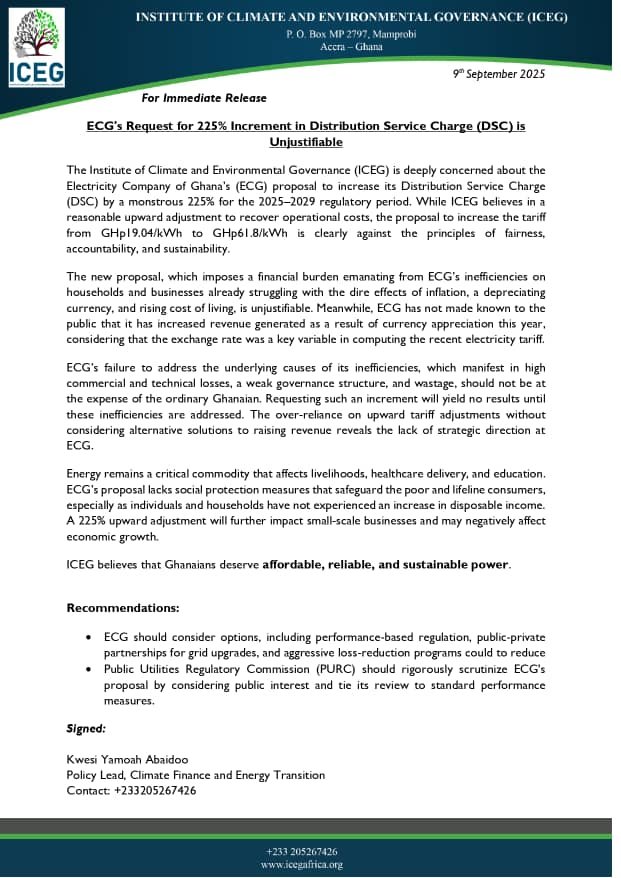
The Institute of Climate and Environmental Governance (ICEG) has strongly opposed the Electricity Company of Ghana’s (ECG) request to increase its Distribution Service Charge (DSC) by 225 percent for the 2025–2029 regulatory period, describing the proposal as unjustifiable and harmful to the public.
In a press release dated September 9, 2025, ICEG said it supports reasonable upward adjustments to help utilities recover operational costs.
However, ECG’s plan to increase the DSC from GHp19.04/kWh to GHp61.8/kWh, it noted, “is clearly against the principles of fairness, accountability, and sustainability.”
The Institute argued that the proposed increment would impose severe financial burdens on households and businesses already dealing with the effects of inflation, a depreciating currency, and rising costs of living.
ICEG also criticized ECG for failing to inform the public about additional revenue gained this year from currency appreciation. The Institute observed that the exchange rate was a key factor in the recent electricity tariff computation, yet ECG has not disclosed how this has impacted its finances.
According to ICEG, ECG’s operational inefficiencies remain unaddressed and should not be transferred to consumers through higher charges. These inefficiencies, the Institute said, include:
• High commercial and technical losses
• Weak governance structures
• Wastage in operations
ICEG stressed that “requesting such an increment will yield no results until these inefficiencies are addressed.” It added that relying heavily on tariff adjustments without considering alternative ways of raising revenue shows a lack of strategic direction at ECG.
The Institute highlighted that energy is a critical commodity that directly affects livelihoods, healthcare delivery, and education. It warned that ECG’s proposal lacks social protection measures to safeguard the poor and lifeline consumers.
ICEG further cautioned that “a 225 percent upward adjustment will further impact small-scale businesses and may negatively affect economic growth,” especially since households have not seen an increase in disposable income.
ICEG outlined several measures ECG should pursue instead of imposing such a heavy tariff burden on consumers. These include:
• Performance-based regulation to tie tariff reviews to efficiency and service delivery outcomes.
• Public-private partnerships to finance and upgrade grid infrastructure.
• Aggressive loss-reduction programs to cut down on both technical and commercial losses.
The Institute urged the Public Utilities Regulatory Commission (PURC) to rigorously scrutinize ECG’s proposal, taking into account the broader public interest. It emphasized that any review should be tied to standard performance measures rather than blanket tariff hikes.
ICEG reaffirmed its commitment to advocating for affordable, reliable, and sustainable power for Ghanaians. The Institute stressed that until ECG tackles its structural inefficiencies and adopts innovative reforms, passing costs on to consumers is both unjustifiable and unsustainable.
The statement was signed by Kwesi Yamoah Abaidoo, Policy Lead for Climate Finance and Energy Transition at ICEG.
Below is a copy of the statement
Source: Starrfm.com.gh


