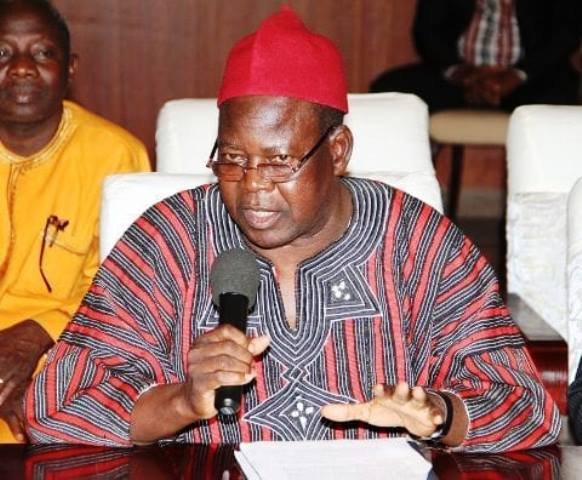
Anti-graft campaigner, Vitus Azeem has called for a probe into the allegations of financial discrepancies in the government’s GH¢49.72 million evacuation of Ghanaians from South Africa, stressing that any investigation must examine the entire process rather than focus solely on Foreign Affairs Minister Samuel Okudzeto Ablakwa.
Speaking to Starr News, Azeem argued that it was unrealistic to assume the minister personally handled every payment.
“How can you just say there’s no way he will do that? What is your proof that he can do that?” he asked.
He noted that if irregularities occurred, responsibility could lie with officials working under the minister.
“In any case, it is my belief that it’s not necessary, if something went wrong, otherwise it wasn’t necessarily a minister, it could be people that work with him,” Azeem said.
“And so investigations show whether something went wrong or not, and if it went wrong, who was responsible, who sanctioned it, and who actually engaged in the act.”
He emphasised that an investigation would cover the whole operation.
“Even the investigation is, is really the minister, but could force some of his people, workers under him, responsible. Because I don’t think that he can pay to the, to, to the evacuees. Somebody would have done it, and somewhere along the line, some money could have dropped into people’s pockets. And so an investigation is not necessarily about the minister alone, but about the entire process. And that’s why it may even be in his own interest that you carry out the investigation,” he said.
The comments come amid a heated parliamentary dispute over the cost of evacuating 1,964 Ghanaians from South Africa between 27 May and 4 September 2026.
The operation followed a resurgence of xenophobic attacks and intimidation targeting foreign nationals, including Ghanaians, linked to groups such as Operation Dudula.
Four Ghanaians reportedly lost their lives during the period of heightened tension.
Foreign Affairs Minister Samuel Okudzeto Ablakwa announced on 7 September that the total cost stood at GH¢49,721,786. Of this, the government provided GH¢33,721,786 while Engineers & Planners, owned by businessman Ibrahim Mahama, contributed GH¢16 million.
The breakdown included approximately GH¢38.84 million for chartered flights, commercial tickets, ground transport, feeding, accommodation and medical care; GH¢10.802 million for reintegration and transport allowances (GH¢5,000 reintegration grant and GH¢500 transport allowance per person); and about GH¢84,000 for the repatriation of two bodies.
The Minority in Parliament, led by Deputy Ranking Member of the Foreign Affairs Committee Nana Asafo-Adjei Ayeh, has alleged that records supplied in response to a Right to Information request leave GH¢16.42 million inadequately explained. Their review found that only 824 of the 1,964 evacuees could be confirmed as having received both allowances, with mismatches between the reintegration and transport payment registers.
Flight records, they said, accounted for 1,173 people (926 on chartered flights and 247 on commercial flights), leaving 791 unaccounted for in the documents reviewed.
The caucus also raised concerns about duplicate names, unsigned payments and the handling of allowances for minors.
Ablakwa has rejected the claims, insisting that “not a cedi, not a pesewa is missing.”
He has pointed to detailed documentation, including flight manifests, boarding passes, airline receipts and signed payment registers covering all 1,964 returnees, and has invited the Auditor-General to examine evacuation exercises dating back to 2017.
The Majority Caucus on the Foreign Affairs Committee has also dismissed the Minority’s allegations as baseless, stating that comprehensive records exist for every name and payment.
A research has separately reported finding duplicate names, payments without signatures, and some returnees who did not receive the full allowances. Some returnees have publicly defended the process, saying they received the full GH¢5,500 package.
Azeem’s intervention adds a civil-society voice to the calls for greater transparency. He maintained that a thorough, independent examination of the entire chain of decisions and disbursements would serve the public interest and could ultimately clear those involved if no wrongdoing is found.