The Eastern Regional Minister Seth Kwame Acheampong has directed all Municipal and District Assembly(MDAs) in the region to fully enforce Drilling license and groundwater development regulation 2006(L.I.1827) to ensure that drilling of wells and boreholes conforms with standard procedures to curb increasing over exploitation and pollution of groundwater.
According to the Minister, henceforth, Municipal and District Chief Executives must obtain drilling license before permitting individuals and organizations to drill wells and boreholes.
“The Drilling Licence and Groundwater Development Regulations 2006 (L.I. 1827) regulates the prospecting and drilling of water wells in an environmentally sustainable manner. We therefore owe it a responsibility to protect our water wells from abuse and indiscriminate destruction. I would therefore admonish all M/DCEs in the region to ensure that activities in relation to drilling of water that affects our ground water must first obtain a drilling licence from the Water Resources Commission.
I therefore advise all stakeholders in this sector to ensure that existing laws on ground water be enforced at both the local and national levels with the aim of protecting our underground”
The Eastern Regional Minister said this Tuesday March 22,2022 during the observation of World Water Day at Nsawam by the Ghana Water Company Limited .
World Water Day is observed every year on 22 March around the world. It is celebrated to highlight the importance of freshwater and to spread awareness about it.
The theme of for this year’s World Water Day is ‘Groundwater, making the invisible visible’. It focused on the importance of groundwater and raise awareness about its over exploitation.
The Minister said surface water have been heavily polluted by human activities such as illegal mining and bad farming practices making it unwholesome to consume hence attention has been diverted to groundwater which if not properly regulated will be overexploited,polluted and depleted .
“It is important to note that the distribution of water is not ubiquitous in nature but there exists scarcity of the resources in other areas, hence the need for us to take action as a people in tackling the water crisis looming in front of us.We need to explore solutions to protect our underground water by using the relevant information and the appropriate technologies in accessing groundwater.Although it may seem that we have enough distribution of surface water, yet, our human activities, such as galamsey, farming close to water bodies leading to seepages of chemicals into the river bodies contaminate the water bodies” said the Eastern Regional Minister .
According to the community water and sanitation agency,CWSA, about 90% of the thousand water systems in Ghana is from groundwater however discharge of harmful chemicals by illegal miners, misapplication of agrochemicals by farmers and improper waste management continue to threaten safety of groundwater in Ghana.
The Eastern Regional Director of CWSA Ing.Sampson Atakora , therefore called on all Ghanaians to desist from activities that contaminate groundwater for sustainable usage.
The Eastern Regional Chief Manager of Ghana Water Company limited , Ing.Asomani Nyarko said human activities have polluted both surface and groundwater therefore borehole water needs to be subjected to laboratory test before consumed to avoid cancerous diseases .
“With regards to bad practices such as farming ,fertilizers and weedicides also having impact on surface water because as they apply them in their farms , the run off from the rains carry all these into the river bodies and it ends up at the treatment plants adding to the cost of treatment.Some of the weedicides I don’t know if it has been approved by the FDA because it is having a negative toll on our treatment plants Those who are also rearing fish they get their waste also straight into the river without any preliminary treatment ,all ends up into the water adding to the pollution content of the water source”.
He added ” the concentration of the chemicals in the groundwater changes over time .During the dry season the water table is low so the concentration goes high ,during the raining season it is diluted so the concentration comes down but how will you know if you don’t bring samples for test that is what we are recommending that people who have boreholes in their house should bring it for testing during the dry season and during the raining season so that we advise them professionally”.
It is estimated that 2.2 billion people worldwide are living without access to safe water.
The UN reported that, 74% of the world’s population uses a safely managed drinking water service while that of Ghana is at 41% and 17% of the world’s renewable water resources is being withdrawn after taking into account the environmental flow requirement whiles that of Ghana is at 6%.
It was further reported by the UN that the proportion of Ghanaians using safely managed drinking water services progressed over time from 74% of the population in 2000 to 92% of the population in 2020.
As part of the World Water Day Celebration, the GWCL took visitors through its operational procedures at the Nsawam Water treatment plant.
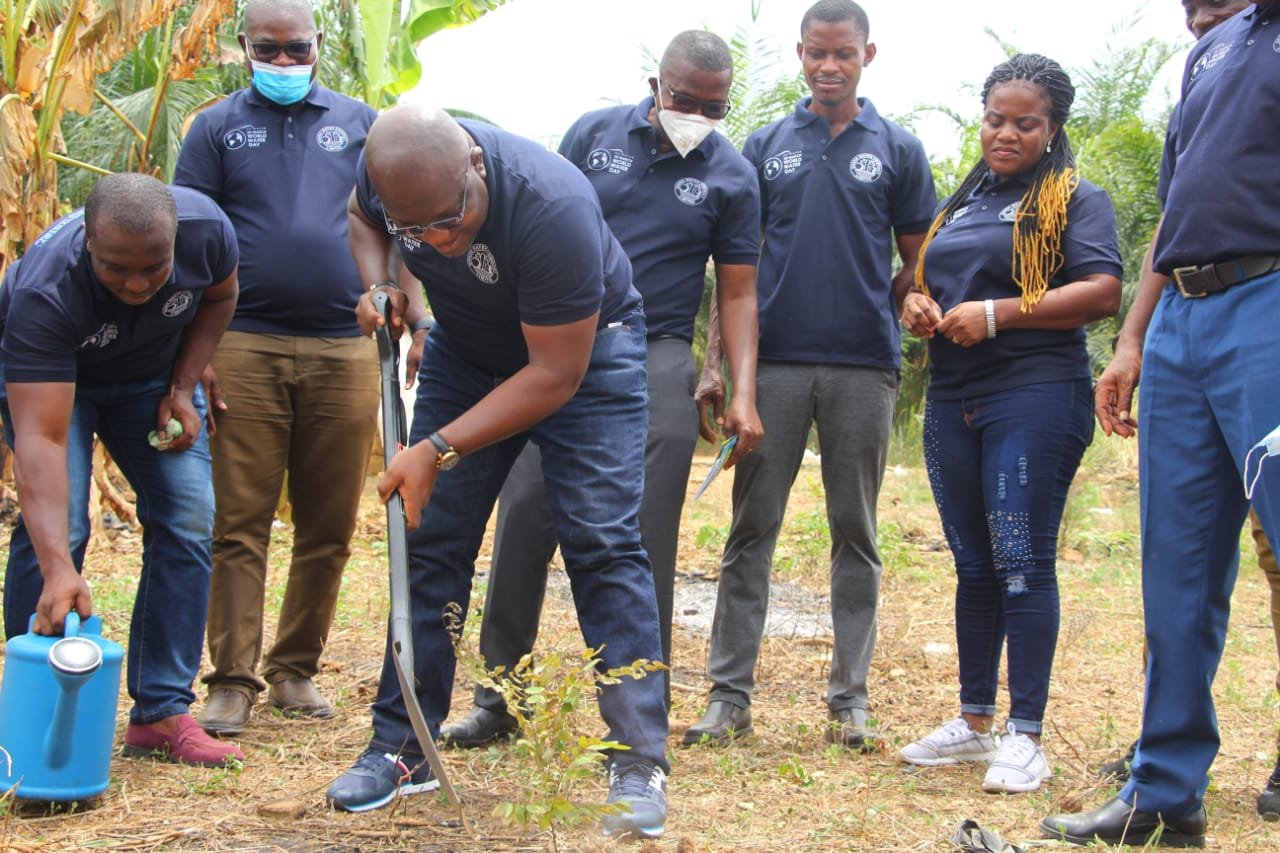
The Eastern Regional Minister Seth Kwame Acheampong and other stakeholders planted trees along the Densu Basin to protect the river in the spirit of the Sustainable Development Goal (SDG 6) which seeks to ensure safe drinking water and sanitation for all by focusing on the sustainable management of water resources, waste water and ecosystems and acknowledging the importance of an enabling environment by 2030.
Source : Ghana/Starrrfm.com.gh/Kojo Ansah