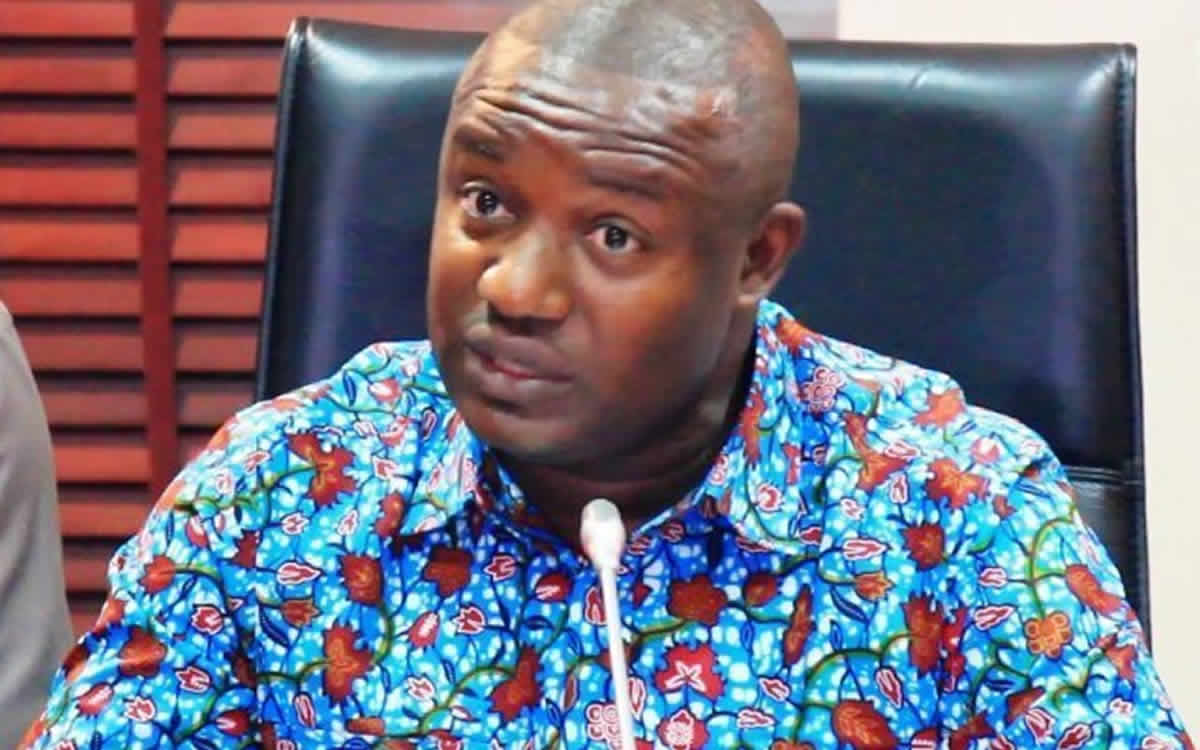
Ghana’s Minister for Energy and Green Transitions, John Jinapor, has issued a stark warning that the country’s energy sector is at risk of collapse if urgent steps are not taken to involve the private sector in key operations.
Speaking on a panel at the National Economic Dialogue (NED) in Accra, he disclosed that crippling debt and financial mismanagement threatening the sustainability of Ghana’s power sector while further revealing that the outstanding liabilities in the sector currently stand at ₵80 billion and continue to rise.
“Today, I had a briefing, and the outstanding liabilities so far are about 80 billion, and they keep increasing. 80 billion cedis, those outstanding liabilities. And so, today, if you were to put the energy sector back on its tools, you would have to cough up 80 billion to flush out the outstanding liabilities. Clearly, that’s unsustainable,” he stated.
Beyond this, John Jinapor pointed to a monthly shortfall of $70 million in the power sector, warning that the situation will worsen if nothing is done.
“Assuming you were to deal with only 80 billion, then that wouldn’t be the major problem. The major problem is that we have a total of about $175 million every month, especially with the power sector. The collection is less than $100 million. And so even going forward, if nothing is done, you’re going to be carrying about $70 million every month as a shortfall or liability. And so that for me is a major issue,” he explained.
John Jinapor also pointed to financial indiscipline as a key challenge in the sector. He cited ECG’s excessive spending, stating that in 2020, the PURC approved about $200 million as a cap for ECG’s capital expenditure, but by the end of the year, the figure had shot up to $700 million.
The indiscipline and other adjoining factors he believes emphasize the need for the private sector’s involvement.
“It’s quite obvious that we need private sector participation in the management of the distribution sector. If we don’t do that, the sector will collapse. And we are headed for that collapse already,” he said.
“Some power producers have shut their plants today as we speak over non-payment,” he added.
Jinapor finally emphasized the need for Ghana to transition from liquid fuels to gas for power generation as he revealed that the country’s liquid fuel bills, this year, so far, amount to over 1 billion cedis.
“From what I am seeing, we immediately have to move into a gas-to-power era. The liquid fuel bills alone this year are about 1 billion. Half of that can build a gas processing plant that alone will save us about 600 million per annum. And so for me, that is something that is non-negotiable,” he stated.
“We have stranded gas we cannot use. The little we have, we use to buy liquid fuel. We must bring that gas processing plant on and cut that cost.” he emphasized.
John Jinapor’s finally expressed optimism financial restructuring, private sector investment, and a transition to gas-powered energy will cut the corruption and wastage and ensure long-term sustainability of Ghana’s energy sector.