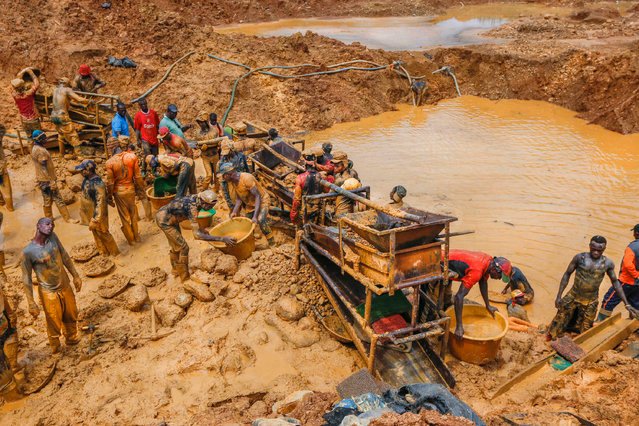
Research by the Water Research Institute of the Council for Scientific and Industrial Research – Water Research Institute (CSIR-WRI) has revealed that nearly 60 percent of water bodies across Ghana are polluted, largely due to illegal mining activities.
The findings, according to the CSIR, highlight a severe threat to water security, public health, and livelihoods, with some affected rivers potentially difficult to restore even if galamsey operations cease immediately.
Research scientist, Dr. Franklin Obiri-Nyarko of the CSIR-Water Research Institute told Starr News that while pollution also stems from agriculture, industrial discharges, and other sources, illegal mining remains a major contributor.
“Beyond the presentation, I showed a map that shows some areas where galamsey activities are taking place,” Dr. Obiri-Nyarko said.
“I had to mention that the pollution is not only from galamsey activities, but from other activities like agriculture, industries, industrial discharges and all that. But clearly, it shows that galamsey is a major contributor of the pollution,” he said.
He further stressed the seriousness of the contamination, noting Ghana’s heavy dependence on these water bodies for food production, agriculture and public health.
Surface waters, he explained, are hydrologically connected to groundwater aquifers, meaning pollution of rivers and streams will eventually contaminate underground sources as well.
Dr. Obiri-Nyarko warned that natural recovery of the polluted water bodies could take a very long time and may not be a viable option.
“These people are all going to be denied of the benefits of these water bodies. And that is going to be a long time…that is why I said that for natural recovery, it may take a very long time, and that may not be an option to go for. We have to bring in an intervention, and that is where I talk about the sustainable integrated remediation,” he said.
He emphasised that any lasting solution must target the source of the pollution.
“If you want to address it sustainably, you must look at it from the source. You cannot sustainably remediate the river if the source has not been dealt with. Otherwise, all the interventions that you put in there will not amount to anything. The source must be dealt with. It is either you stop it completely or it is reduced significantly,” he added.
Dr. Obiri-Nyarko called on the Mahama-led government to intensify efforts against illegal mining to protect the country’s water resources.
Source: Starrfm.com.gh