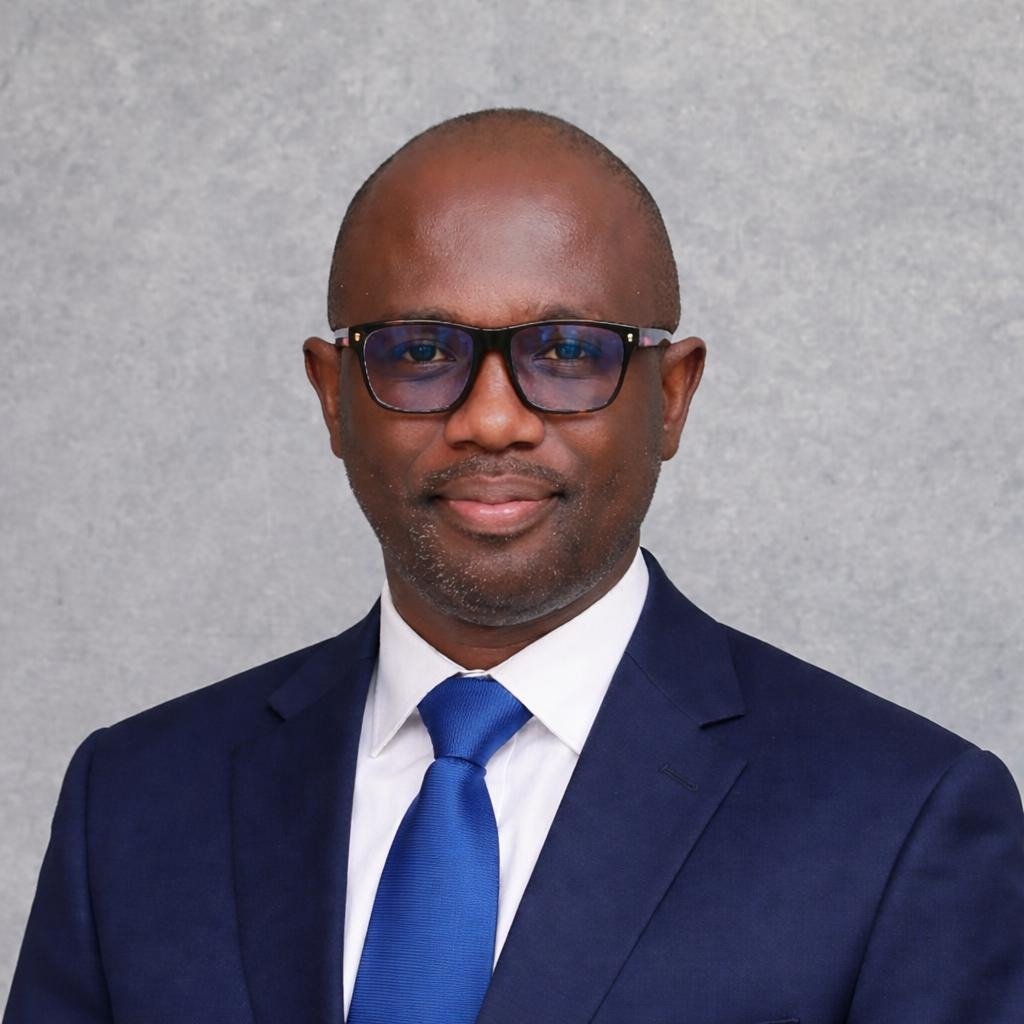
Third time is not always the charm. Sometimes it is simply the number of times a person must knock before the door finally opens. Andy Owusu knows that better than most in NPP UK. This was his third attempt at the chairmanship of the branch. On 8 August 2026, the door opened.
Andrews Owusu Osei—known throughout the party simply as Andy Owusu—is based in London. His home chapter is East London, where he secured 22 of the 35 votes cast on election night. By profession he serves as Assistant Director for Children’s Services at the London Borough of Lambeth Council. Until recently he held the post of NPP UK Youth Patron, a role that kept him closely connected to the branch’s younger members long before his name appeared on the ballot for chairman.
For full disclosure: I did not campaign for Andy Owusu. I supported Richmond Mensah, the former chairman of the Milton Keynes chapter, a figure many in the party still affectionately call “Double Chairman.” He lost. I state this at the outset so readers know precisely where I stood before assessing the results.
As part of Richmond Mensah’s campaign we conducted our own collation. Roughly an hour after polls closed, our figures already showed the winner was not Richmond Mensah. The official declaration from the Branch Elections Committee came later that night. Double Chairman did what every genuine democrat should do: he issued a quiet concession as soon as the outcome was clear and later congratulated Andy in person at the Dominion Centre in Wood Green, the venue designated for the formal count. That act of grace made it possible for me to examine the results with a clear head.
I have read election results for years and have learned one consistent lesson: the story a result tells at first glance is rarely the whole story. Once the NPP UK Branch declared Andy Owusu the winner with 266 votes—confirmed by our own collation—I set disappointment aside and did what I always do. I sat with the chapter-by-chapter breakdown and allowed the numbers to speak before forming any judgement.
They told a story that begins with a man who had already lost twice before he ever won once.
There is an Akan saying that one tree does not make a forest. I initially assumed Andy had won without relying on any single dominant chapter, that his support consisted of many modest contributions rather than one overwhelming base. The numbers quickly corrected me.
Andy did have a fortress. In Telford he took 35 of 38 votes, a 32-vote margin as decisive as any recorded by his rivals. Richmond Mensah had his own fortress in Milton Keynes, securing 52 of 62 votes. Appiah-Kubi swept West London, taking all 39 votes without conceding a single one. Each of the three candidates possessed a safe chapter. The decisive difference lay in what each achieved beyond that base.
Richmond Mensah’s and Appiah-Kubi’s strongest results were heavily concentrated in a single chapter each, with comparatively little beyond it. Andy’s fortress in Telford sat alongside genuine competitiveness almost everywhere else. He won eight of the 16 chapters outright and finished first or second in 13 of the 16 that reported. He placed third in only three: Birmingham and Leeds (firm Mensah territory) and West London (entirely Appiah-Kubi’s). A fortress alone was never going to decide this race. What decided it was a fortress plus real competitiveness in nearly every other room.
Telford might have been dismissed as an outlier—an unusually strong night in one chapter that flattered the overall picture. Bristol makes that reading untenable. There Andy took 30 of 38 votes, a margin of 24. This was a second chapter, hundreds of miles from Telford and hundreds of miles from London, where he again won by a landslide. Two lopsided victories in geographically distant parts of the country, combined with competitiveness almost everywhere else, form a pattern that is difficult to attribute to chance.
He was also strong in the capital, taking 88 of 187 votes across the four London chapters—North, South, East and West—including his home turf in East London. A coalition built on one region alone does not produce results of this breadth.
Andy himself has described the outcome as the product of “an elaborate campaign strategy.” The results support that characterisation. The plan appears to have played out almost exactly as drawn.
From the other side of the campaign I can confirm the difficulty of countering it. As part of Richmond’s team we tried more than once to identify precisely what Andy’s campaign was doing differently so we could respond. We never succeeded. It felt like chasing ghosts—something we knew was present but could never quite pin down. Eventually we stopped trying. Whatever he and his team built was not visible enough to be neutralised. That, in its own way, is a compliment.
As Andy put it, he won by roughly 10 and 12 percentage points respectively. The figures hold: 9.86 points over Richmond Mensah and 11.22 over Appiah-Kubi. Central Herts provided another illustration of breadth—18 votes to Richmond’s 8—a result Andy has cited as evidence that his support was structural rather than accidental.
Not every chapter was straightforward. Reading was decided by just two votes (16–14). Northampton went his way by seven. On another day either result might have flipped. Yet small wins accumulate. Sixty-five votes separated Andy from Richmond Mensah across the branch, and a substantial part of that gap came from victories few will remember—two here, five there, seven somewhere else. Narrow margins still count.
There is a lesson in Reading’s two votes that NPP UK should not overlook. Elections are won in the chapters nobody is watching as much as in the ones everybody discusses.
Andy’s 266 votes represented 40.36 per cent of the valid votes cast. Combined, Richmond Mensah and Appiah-Kubi received 393 votes—comfortably more than Andy’s total. At first glance this could appear to be an incomplete victory. I do not read it that way, and the numbers support a different conclusion. Had Appiah-Kubi not stood and his supporters split evenly between the remaining two candidates, Andy would still have won, roughly 362 to 297.
Even in the least favourable realistic scenario, Richmond Mensah would have needed to capture around two-thirds of Appiah-Kubi’s entire base to close the gap. Nothing in the chapter results suggests Appiah-Kubi’s voters leaned that heavily in his direction.
A three-way contest without a majority winner is not automatically a fragile result. Sometimes it is simply what a genuinely competitive election looks like.
Two previous defeats would have driven many people out of party politics. Andy stayed in the race a third time. This time the results show competitiveness spread across nearly every chapter rather than concentrated in one. There is a proverb my father used to repeat: it is not the loudest drum that leads the dance, but the one that keeps the rhythm the longest. Andy had his loud chapter in Telford, and he earned it. A single loud drum, however, was never going to be enough on its own. The results show twelve further chapters where he remained competitive, with only Birmingham, Leeds and West London left silent. In the end, one loud chapter plus twelve steady ones proved sufficient.
A number of people—some older and well-established in the party—advised Andy not to contest again, arguing that his time had passed and the field belonged to fresher blood. His victory is likely to land differently with that same group now. He has been with the party a long time and lost twice before this win. There is something in that record the old guard is likely to recognise not as luck, but as dues finally paid.
The real test begins now. A win constructed chapter by chapter carries a corresponding responsibility to govern the same way—one chapter at a time. Andy Owusu’s professional career has been in children’s services; for years before this election he served as the party’s Youth Patron. Supporters describe him as a stickler for structure, organisational ethics and good governance. Whether that background translates into the way he leads the chairmanship is not something these figures can reveal, but it is worth watching. What the figures do show is that this election will be remembered less for the narrowness of some of its margins and more for what a broad, hard-earned win made possible.
None of this was Andy alone. After the result was declared he released a statement thanking the volunteers, chapter organisers and everyone who performed the unglamorous work of turning out votes across fifteen chapters. A victory spread this wide does not occur without a team of equal breadth.
Congratulations, Chairman. NPP UK deserves a leader who takes structure and governance seriously. I hope that is precisely what we now have. And if I may close with a hope that reaches beyond this branch, it is that everything built here, chapter by chapter, contributes to NPP and Dr Bawumia’s success in 2028.
Source: Jibril Salifu Communications Officer, North London Chapter, NPP UK