Five years after the World Health Organization recommended widespread use of the first malaria vaccine, Ghana’s experience shows the promise of childhood vaccination — and the challenge of sustaining its benefits.
By Ridwan Karim Dini-Osman
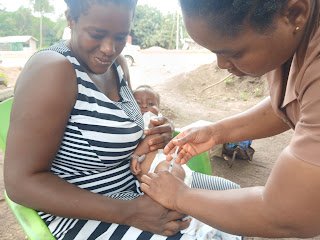
Adeline Ahiatrogah carries her seven-month-old twins to a vaccination session in Ghana’s Volta Region, where mothers wait beneath a sprawling tree for health workers to call their children’s names.
One twin is strapped to her back. The other rests against her chest.
Ahiatrogah, 27, has brought them for their second dose of a malaria vaccine. Her older children have had malaria, and she remembers the fevers, the weakness and the fear that their illness might become fatal.
“I was always afraid they could die,” she said. “As a mother, you just wish you could take the sickness away from them.”
According to the World Health Organization, malaria killed 610,000 people worldwide in 2024, about 95% of them in Africa. Young children remain particularly vulnerable.
Since her twins began receiving the vaccine, she said, neither has developed malaria severe enough to require a hospital visit. She hopes they will remain protected as they receive the remaining doses.
Ghana has made substantial progress against malaria. Ghana’s Health Service estimates that malaria deaths fell by 98% between 2011 and 2025, with 52 deaths recorded nationally in 2025. The country has also seen a significant decline in child malaria fatalities, which have fallen by 76% in just three years. The progress reflects years of prevention, diagnosis and treatment, including insecticide-treated mosquito nets and improved access to healthcare.
In October 2021, the WHO recommended widespread use of RTS,S, or Mosquirix, the first malaria vaccine to receive such a recommendation. Ghana, Kenya and Malawi had already begun a pilot program in 2019 to assess how vaccination could be delivered through routine health services. Today, malaria vaccination is offered in 25 African countries as part of national childhood immunization programs and malaria-control plans.
Five years after that landmark recommendation, Ghana’s experience illustrates both the potential of vaccination and the challenge of sustaining its benefits.
A complex target for vaccine science
Malaria has long challenged vaccine developers because Plasmodium falciparum, the parasite responsible for the deadliest form of the disease, has a complex life cycle and can evade the human immune system.
When an infected mosquito bites a person, it introduces parasites called sporozoites into the bloodstream. These travel to the liver, multiply and then enter red blood cells. The resulting infection causes malaria symptoms and can progress to severe anemia, organ failure and death.
RTS,S targets the parasite during this early stage. It trains the immune system to recognize the parasite’s circumsporozoite protein, helping prevent some infections from progressing to the blood stage.
Developed by GlaxoSmithKline with research partners, RTS,S emerged from decades of scientific work. It does not provide complete or lifelong protection, but it reduces the risk of clinical malaria during childhood, when the disease can be particularly dangerous.
Under Ghana’s RTS,S schedule, children receive doses at six, seven, nine and 18 months of age. The fourth dose requires caregivers to return months after the first three.
At the Noguchi Memorial Institute for Medical Research in Accra, immunology professor Kwadwo Asamoah Kusi said completing the schedule helps extend protection.
“If you just do one or two, it will protect you for a few weeks to a few months and then it’s gone,” he said. “But doing all the four extends how long that protection lasts for them. So it’s very important that we finish all of it.”
Protection varies, but the schedule presents practical challenges for families living far from health facilities or struggling with transport costs. Missed appointments can mean children do not receive the full intended protection.
In Adaklu, 32-year-old Dope Kulafe has taken her two youngest children, aged four years and 23 months, through all four doses. She initially worried about side effects. Her children experienced symptoms that she said resolved after about three days.
“From my experience, the vaccine is helping my children, and I’d encourage other mothers to get their babies vaccinated,” she said.
Building trust in vaccination
In Adaklu, health workers say misinformation remains an obstacle to vaccination.
Emelia Tanyeva, a health worker involved in community outreach, says some caregivers have carried suspicions from the COVID-19 pandemic into the malaria vaccination program.
Some believe the malaria vaccine is being introduced because parents refused COVID-19 vaccination, while others suspect it is part of a Western effort to reduce Africa’s population.
“Some caregivers believe that it is a way of reducing their population. They want to kill their children or wipe out the children they are giving birth to,” Tanyeva said.
There is no credible scientific evidence supporting these claims, but health workers say such rumours can undermine confidence in vaccination.
Some parents also question why children need four malaria vaccine doses on top of routine childhood immunizations.Health workers are responding by taking vaccination services and information into communities, explaining the schedule and addressing concerns about side effects. Yet misinformation is not the only obstacle. Transport expenses, time away from work and competing family responsibilities can also cause missed appointments.
The Adaklu District Health Directorate said nearly 70% of eligible children had completed all four doses. It also reported that annual malaria cases among children under five had fallen from about 6,000 to 2,000, with no deaths recorded since the vaccine was introduced, alongside existing malaria-control measures.
Evidence of an effect on child survival
A 2026 study published in The Lancet, examining malaria vaccine implementation in Ghana, Kenya and Malawi, reported a 13% reduction in deaths from all causes other than injury among children eligible to receive three doses.
“So basically in these communities, the malaria vaccine prevented approximately one in eight deaths of children that were non-accidental, non-injury related,” said Dr William Moss, a professor of epidemiology and deputy director of the Johns Hopkins Malaria Research Institute.
Moss explained that the data strengthens the case for vaccination. But he said sustaining those gains will require the vaccine to complement — not replace — existing malaria-control measures.
“If funding for bed nets and surveillance, testing and treatment all decline, we’re going to see more people, unfortunately and tragically, infected with the parasite, developing disease,” he said. “And even in the face of the vaccines, we’re going to see a larger disease burden.”
Moss added that sustaining these gains will be critical as Ghana confronts the spread of the invasive Anopheles stephensi mosquito, emerging insecticide and diagnostic resistance, and growing pressure from other mosquito-borne diseases, all of which threaten to complicate malaria control even as vaccination expands.
Who will pay for the gains?
That creates a financial challenge for Ghana as international health assistance comes under pressure.
Disruptions to United States foreign assistance, including the dismantling of the United States Agency for International Development, USAID, have contributed to a $78 million health financing gap for Ghana, affecting several interventions, including malaria programs.
The shortfall raises questions about whether Ghana can sustain the procurement, distribution and community outreach needed to protect children against malaria while maintaining other essential health services.
Ghana is also gradually assuming a greater share of its immunisation costs through co-financing arrangements with Gavi, the Vaccine Alliance.
Official figures for Ghana’s obligations put its contribution at $54 million next year, rising to $60 million by 2030.
Ghana’s rollout covers more than 130 of the country’s 260 districts. The national program includes RTS,S and, more recently, R21, another WHO-recommended malaria vaccine.
Health Minister Kwabena Mintah Akandoh said the government would find the resources needed to finance the programme fully when Gavi’s support ends in 2030.
Delivering on that commitment will require clear budgets for vaccine procurement, distribution, cold storage, trained health workers and outreach to families whose children miss appointments.
Gladys Damalin, programs manager at Hope for Future Generations, a civil society organization advocating better health policies, said sustaining the vaccine’s impact requires clearer financing plans and accountability.
“The question is sustaining and ensuring that every district is covered,” she said.
Damalin wants a dedicated immunization budget that would make allocations and disbursements easier to track. Without predictable funding, she warned, the services needed to keep vaccination programs functioning could weaken even when vaccines remain part of national policy.
Back in Adaklu, Ahiatrogah’s twins still have doses to complete. She said she is holding on to the promise that the protection they have begun receiving will help spare them the illness that frightened her when her older children contracted malaria.
But experts say whether that promise translates into lasting progress will depend not only on getting vaccines to children, but also on Ghana’s ability to finance the program and sustain the wider measures that keep malaria in check.
By Ridwan Karim Dini-Osman