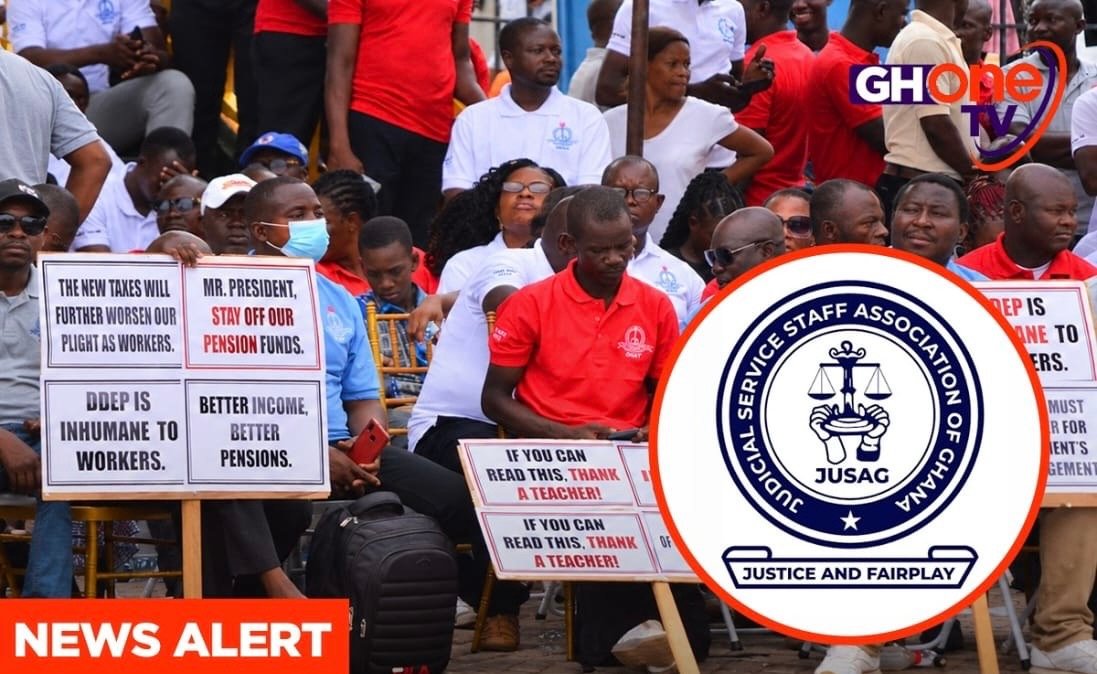
The Judicial Service Staff Association of Ghana (JUSAG) has declared an indefinite strike effective Monday, November 2, 2026, over the government’s failure to approve recommendations for the 2026 salary review of Judicial Service employees.
The association has directed all Judicial Service staff to stay away from work until the government approves the revised salaries and pays them in November, alongside arrears covering January to October 2026.
In a press release dated October 30, 2026, and signed by its General Secretary, Abdulai Yakubu, JUSAG said the decision followed months of unsuccessful engagements with the government and relevant authorities to secure the salary review.
The association explained that it submitted its proposal for the 2026 salary review to the Judicial Council in December 2025, in accordance with Article 149 of the 1992 Constitution and the Judicial Service (Terms and Conditions of Service) Regulations, 2026 (C.I. 141).
It said the Judicial Council subsequently completed its work and submitted its recommendations to the President for approval, but the necessary approval from the Office of the President had not been forthcoming.
JUSAG said repeated appeals to the Judicial Council, government officials and Judicial Service management, including engagements at conferences and staff durbars, had failed to produce the desired outcome.
The association had consequently given the government until October 30 to approve the recommendations, with payment of the revised salaries and outstanding arrears expected in November.
However, it expressed dissatisfaction with the government’s response, particularly a proposal from the Ministry of Finance to pay the arrears in three instalments without specifying clear timelines.
JUSAG also criticised the Ministry of Employment, Labour Relations and Employment Relations for scheduling a meeting with the parties for November 3, a day after the planned commencement of the strike.
It further faulted the National Labour Commission (NLC) for directing the parties to report on November 6, four days after the industrial action would have begun.
According to the association, the Ministry of Finance’s proposal was issued without consultation with JUSAG, which it described as the principal party representing the affected employees.
The association maintained that its demands were backed by Article 149 of the 1992 Constitution and Regulation 25 of C.I. 141, which provides for an annual review of Judicial Service staff salaries.
It said the strike declaration was made after exhausting available avenues for dialogue, adding that it remained open to genuine negotiations but would no longer accept promises without concrete action.
Directives to Judicial Service staff
As part of measures to enforce the industrial action, JUSAG has directed security personnel to remain at their posts to safeguard Judicial Service properties.
Drivers have also been instructed to hand over official vehicles to the Transport Department and refrain from driving official vehicles, officers or judges throughout the strike.
The association further directed that no registrar should open or be compelled to open any registry or court for use during the industrial action.
Regional Executive Board and Committee members have been tasked with monitoring compliance, while staff who face threats or pressure from management to report for duty have been instructed to report such incidents to the association.
JUSAG warned that it would respond collectively through lawful means to any attempts to intimidate or coerce members into working during the strike.
The association called on its members to remain united and comply with the directive until the government meets its demands.
The strike is expected to affect the operations of the Judicial Service, including court and registry activities, from November 2.