Ghana is proposing sweeping changes to its petroleum fiscal regime to attract fresh investment into the upstream oil sector, as government seeks to reverse years of declining crude production and secure new exploration commitments.
The proposed reforms, which include lower initial carried interests for the Ghana National Petroleum Corporation (GNPC), revised royalty arrangements and longer tax-loss recovery periods, are expected to make the country’s petroleum investment framework more competitive.
The push comes as government targets at least six new petroleum agreements with major international oil companies by March 2027.
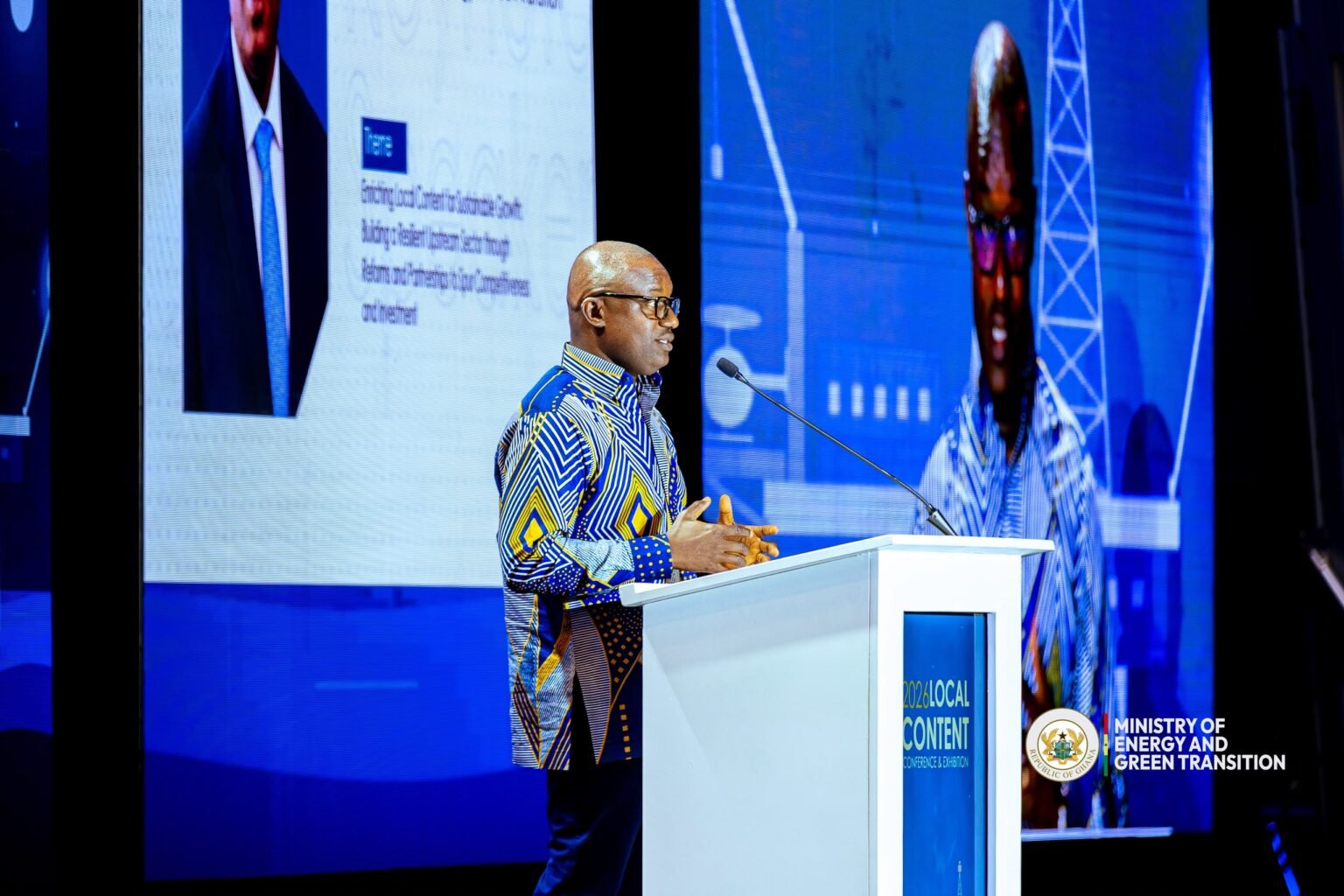
Speaking at the opening of the Petroleum Commission’s 2026 Local Content Conference and Exhibition in Takoradi on Tuesday, November 10, Dr Jinapor said the proposed agreements formed part of a broader strategy to restore investor confidence and reposition Ghana as a competitive destination for petroleum investment.
Dr Jinapor acknowledged that attracting investment would require more than promoting the country’s petroleum potential, given the competition for global exploration capital.
“Capital is mobile. Investors have choices. And Ghana cannot assume that its petroleum potential alone will attract investment,” he said.
He stressed that the success of the negotiations would ultimately depend on the investments and economic opportunities they generate rather than the number of agreements signed.
“Our success will not be measured by the number of agreements signed, but by the number of wells drilled, discoveries made, developments sanctioned and jobs created.”
He added that Ghana remained open to international investment but expected investors to demonstrate a genuine commitment to exploration, development and long-term value creation.
Petroleum tax reforms
The proposed changes to Ghana’s petroleum tax and regulatory framework had been submitted to Cabinet, with the relevant legislative bills expected to be presented to Parliament subsequently.
The proposals include a three-tier sliding-scale royalty regime based on water depth, which is intended to make exploration in deeper waters more attractive.
Government is also proposing to reduce GNPC’s initial carried interest — its stake in a petroleum project that does not require an initial financial contribution — from 15 percent to 10 percent.
Other proposed changes include replacing upfront signature bonuses with payments triggered when a discovery is declared commercially viable, and replacing the Additional Oil Entitlement with an Additional Petroleum Tax that increases as project profitability rises.
Dr Jinapor maintained that the changes would seek to balance investor competitiveness with the country’s obligation to secure fair returns from its natural resources.
“Ghana must remain competitive enough to attract investment, while ensuring that the Ghanaian people receive a fair and sustainable share of the value of their petroleum resources,” he said.
However, the proposed changes are expected to reduce the state’s overall share of petroleum project value.
An adviser to the Finance Ministry, Theophilus Acheampong, has estimated that implementing the full package could reduce the state’s share from approximately 65–67 percent to about 55 percent, according to the Ecofin news agency.
The proposed reduction has implications for government revenue, particularly given the contribution of carried and participating interests to petroleum receipts.
According to Ecofin, these interests generated approximately $339.3 million of Ghana’s $770.3 million in petroleum receipts last year.
Dr Jinapor has defended the proposed adjustments on the basis that a smaller government share of a significantly expanded petroleum industry could ultimately deliver greater economic benefits than a larger share of a shrinking industry.
Government targets six new petroleum agreements
Alongside the proposed fiscal reforms, government is intensifying engagements with international oil companies to secure fresh exploration commitments and unlock new petroleum developments.
Dr Jinapor said negotiations were under way with Eni and its partner Vitol, Shell, Chevron and Petrobras, with government targeting at least six new petroleum agreements by the end of March 2027.
He said government’s priority was to move beyond stabilizing output towards building a sustainable production base through exploration, reserve replacement and the development of new discoveries.
“Our objective is not merely to arrest production decline. It is to establish a sustainable pathway for reserve replacement, increased production and long-term investment,” he said.
Among the projects being prioritized are the development of the Eban-Akoma discoveries, which Eni declared commercially viable last year, and the Pecan field.
Government is also supporting GNPC’s Hummingbird initiative, which seeks to commercialize smaller and stranded discoveries by leveraging shared infrastructure.
Meanwhile, President John Dramani Mahama announced a new gas and condensate discovery at the Nya Gyidie-1X well in the Deepwater Cape Three Points block.
The block is operated by Planet One Oil & Gas, with GNPC and GOIL Upstream participating as partners. The discovery adds to efforts to expand Ghana’s petroleum reserves and strengthen the long-term outlook for the upstream industry.
Beyond crude oil, government is also seeking to expand domestic natural gas production to strengthen energy security and reduce reliance on expensive liquid fuels for electricity generation.
Dr Jinapor said the target was to increase domestic gas production from approximately 270 million standard cubic feet per day to 350 million standard cubic feet by 2028.
Local content value nearly doubles
The government is also seeking to ensure that increased investment in the petroleum sector translates into greater economic opportunities for indigenous Ghanaian businesses.
Dr Jinapor disclosed that the value of services provided by indigenous Ghanaian companies in the upstream petroleum industry increased from approximately $227.5 million in 2024 to $451.8 million in 2025. He said local content should be viewed beyond compliance with regulatory requirements or the achievement of prescribed participation targets.
“Local content is not simply a regulatory obligation or a percentage to be achieved. Local content is about economic transformation,” he said, urging international oil companies to deepen partnerships with indigenous businesses through technology transfer, skills development and the expansion of local supply chains.
Dr Jinapor, however, challenged Ghanaian businesses to strengthen their operational capacity and competitiveness to take advantage of opportunities in the sector.
“Our ambition must be to build Ghanaian companies that succeed not simply because they are Ghanaian, but because they are capable, innovative, efficient and internationally competitive,” he said.
The 2026 Local Content Conference and Exhibition is being held under the theme, “Enriching Local Content for Sustainable Growth,” and runs until November 13.
The conference brings together government officials, regulators, international oil companies and indigenous service providers to discuss investment, regulatory reforms and opportunities to deepen Ghanaian participation in the petroleum industry.