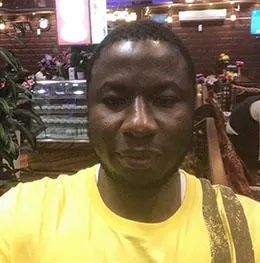
The High Court in Accra has turned down a request from businessman Daniel Koranteng Owusu, accused of the murder of investigative journalist Ahmed Husain Suale.
On two previous occasions, the accused was refused bail by the District Court since his first appearance on March 19, and his latest request to a higher court (High Court) is the third time his request has been refused by the various courts.
Koranteng, 35, faces two provisional charges – abetment and murder – while his plea has been reserved with further investigations ongoing.
On Monday, April 14, 2025, Justice Kizita Naa Koowa Quarshie, after hearing submissions from the applicant (Daniel Koranteng) and the state prosecutor, said the court is currently unable to admit the accused to bail.
While assuring that the request for bail could be considered in the future, the court said he should be remanded into prison custody until otherwise determined.
It would be recalled that on March 19, 2025, Koranteng made his first appearance at the District Court on the provisional charge of murder.
The charge sheet was amended on his second appearance on April 2, with the charge of abetment included in the latest charge sheet.
The 35-year-old businessman, also known as Nana Amakye, is said to have sold photographs of the investigative journalist to former Member of Parliament Kennedy Agyapong before Suale’s murder in 2019 but denied his involvement.
The prosecution also alleged that Suale had identified Koranteng as the person responsible for supplying the images that were later broadcast on Net2 TV, where Kennedy Agyapong called for retribution against the journalist.
Argument for bail
Lawyer for the applicant, Nathaniel Egbor, anchored his application on four main grounds, saying the facts do not support the charges preferred against the accused person.
Secondly, counsel argued that the accused person, if granted bail, would not interfere with investigations, and the refusal of bail should not be used to punish him.
Counsel further submitted that the constitutional right to presumption of innocence until proven guilty means any attempt to restrain the liberty and freedom of movement of the applicant violates his constitutional rights to liberty.
Counsel argued that the applicant meets the conditions set by law and statute. Counsel for the applicant further submitted that the charge of murder is defined by law, and it is expected that in presenting facts before the court, those facts will lead to the ingredients of the charge.
While analyzing the charge of murder, counsel said the ingredients that talk about intent to cause harm and the infliction of unlawful harm were missing in the brief facts.
Suale already known
On the selling of Ahmed Suale’s pictures to Kennedy Ohene Agyapong, which were later circulated, leading to his death, counsel said Suale’s identity was already revealed by himself on Facebook.
Counsel argued that the deceased had written extensively about Martin Amidu on his Facebook page, signing off with his name.
Invasion of Justice
Counsel disputed claims that the accused person evaded justice and was arrested only when he returned to the country in August this year.
Counsel said the prosecution’s own account shows the deceased was murdered in January 2019, and the accused left the country in September 2019.
Counsel argued that there is evidence to show the accused has been in the jurisdiction all along, traveling in and out as an ordinary citizen would.
AG’s opposition
Maame Afua Osei Gyamerah, Assistant State Attorney, opposed the grant of bail, citing Article 14(1)g of the 1992 Constitution.
She argued that the opposition to bail is not to punish the applicant but to ensure he faces trial, given reasonable suspicion of his involvement in the crime.
The ASA stated that call detail records show the accused person’s phone number had connections to the applicant’s neighborhood on four separate days before Suale’s demise.
The prosecution urged the court to refuse the bail application, describing it as premature given the ongoing investigations.
In the alternative, they proposed stringent bail conditions, including depositing the applicant’s passport and requiring a public servant with a net salary of at least GH₵5,000 as surety.