


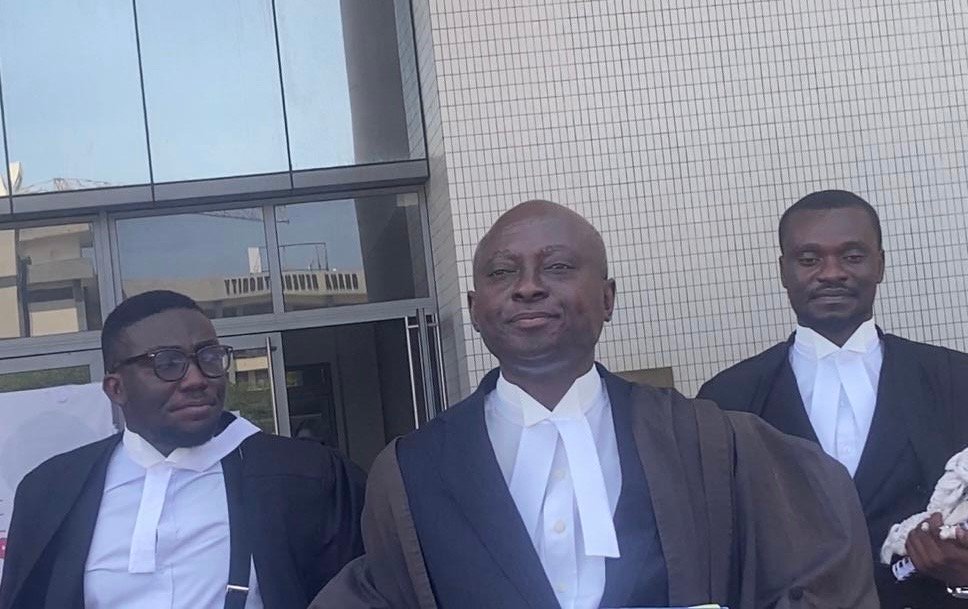
Lawyers representing former National Signals Bureau (NSB) Director, Kwabena Adu-Boahene, have justified their decision to walk out from court proceedings, saying, “We’re not comfortable that this judge would give us justice.”
The defense has filed a motion at the Supreme Court to have the trial judge, Justice John Nyante Nyadu, prohibited on alleged bias and partiality.
On Thursday, October 23, after the trial judge, Justice Eugene Nyadu Nyante, refused to grant an adjournment, the lawyers abandoned the court in protest of the court’s alleged disregard for the Supreme Court.
Addressing journalists moments after the dramatic courtroom walkout, lead counsel for the accused, Samuel Atta Akyea, said having filed an application at the Supreme Court seeking to prohibit the judge from continuing with the trial on grounds of alleged bias, it was only proper for the High Court to suspend proceedings until the apex court ruled on the matter.
“I had filed for a prohibition motion in the Supreme Court, saying that we’re not comfortable that this judge would give us justice,” he stated. “I brought it to the attention of the judge. I also raised an issue that we should adjourn the case and abide by the outcome of the application of the Supreme Court. The judge said he wouldn’t grant us the adjournment and that he would continue the case,” he said.
He questioned what he described as the judge’s “unnecessary haste” in proceeding with the case despite a pending motion at the Supreme Court and asked, “Why is the judge in an ambulance mood to continue the case and cannot wait for the Supreme Court for one week?”
On Thursday, state prosecutors led by Esi Dentaa Yankah, a Principal State Attorney, had opposed the request for an adjournment, arguing there was no legal justification to halt the proceedings.
Despite the defense team’s exit, Justice Nyantei directed that the case proceed, with the second prosecution witness taking the witness box.
The first accused person, following the walkout of his lawyers prayed the Court to allow him time to speak to them outside to reconsider their decision. The case was stood down to allow him the opportunity, but he came back to inform the Court that his lawyers have left the premises. The case was then adjourned to October 30.
Kwabena Adu-Boahene, his wife Angela Adjei Boateng, and a company, Advantage Solution, are facing multiple charges, including stealing, money laundering involving an alleged GH¢49.1 million, and willfully causing financial loss to the state. They have pleaded not guilty and have been granted bail.
Grounds of alleged bias
In an application filed on Wednesday, October 22, at the Supreme Court, lawyers for the accused persons stated four grounds for their application.
The first ground was that “His Lordship is caught in a continuing operative bias demonstrated in his prejudgment and/or predetermination of the critical issues of the essence and import of exculpatory evidence in aid of a fair trial as spelt out in Article 19 of the Constitution and judicially pronounced upon in the Supreme Court case of Republic v Baffoe-Bonnie & 4 Others [2017-2021] 1SCGLR 327.”
READ: JAPP denies AG’s allegations of overpayment, tax evasion, clarifies DRIP contract details
The second ground stated that “The posture of His Lordship, John Eugene Nyante Nyadu, J., that he is determined to continue with the trial when he has judicially predetermined that the exculpatory evidence is not relevant to the case and the defense of the accused persons/applicants amounts to a real likelihood of bias against the applicants.”
The third ground was that “The Attorney-General’s stampeding of His Lordship, John Eugene Nyante Nyadu, J., relating to his time in delivering his own decisions and deferring to the Attorney-General’s time dictates is a real likelihood of bias against the applicants.”
The fourth ground stated that “A court of general jurisdiction having elected to hear the criminal case from 9 am to 4 pm when he sits has shown special extrajudicial interest in the case, which is a real likelihood of bias disqualifying His Lordship from adjudicating the case as an independent justice delivery umpire.”
Special interest
In their 42-paragraph affidavit in support of the motion, it was stated, among other things, that “The special interest which His Lordship, sitting as a judge of the general jurisdiction, is giving to this criminal case brings us to the conclusion that he cannot be an impartial arbiter in this our case, as he is comfortable that the Attorney-General and his good self run with the trial while we are denied the exculpatory disclosures/evidence, our necessary weapons to undermine the Attorney-General’s case and for the putting together of our defense if it becomes necessary.”
They argued that “based on the summary of accompanying facts signed by the learned Attorney-General and duly filed in court making categorical assertions against us that we misappropriated monies belonging to the Government of Ghana to purchase houses in London, Accra, and Kumasi, on the 17th day of July 2025, we caused our lawyers to file an application for further disclosures.”
The affidavit in support of the motion also recounted that “On the 31st day of July 2025, when Exhibit KAA 13 was scheduled to be moved, the learned Deputy Attorney-General withdrew his affidavit in opposition to the disclosures he filed the very morning. After hearing arguments, His Lordship ruled that disclosure be made by the Attorney-General as and when they come to their custody and thereby making those critical matters open-ended to our detriment.”
It recounted the pronouncements of the judge as follows, which in the view of the defense amounted to a predetermination of the matter: ‘It is significant to note that proof of property may come in different forms, especially so when an offense of money laundering is alleged. A property may be held by way of resulting trust for some other person, and the ownership documentation or the title may not necessarily be in the name of the 1st or 2nd accused persons. Therefore, to specifically request disclosures for title deeds among other information to prove ownership where the Honorable Attorney-General states that the same has not come into his possession would be complicated. However, by whatever means the Honorable Attorney-General intends to prove ownership of these two properties, the information to that effect if not yet disclosed to the 1st and 2nd accused persons has to be disclosed to the accused persons as and when they come into the custody of the prosecution.’
It said, “On account of the positive judicial confessions as expressed above, the bias of His Lordship in this criminal case against us is very prominent and continuing. His Lordship does not pay obeisance to a fair trial, and we pray for his disqualification in the further hearing of the case.”
The Application for prohibition is expected to be moved on Wednesday, October 29, 2025.
Source: Starrfm.com.gh


