


By: Alice Aryeetey/Starrfm.com.gh
In a stark reminder of Africa’s untapped economic potential, Mxolisi Mgojo, President of Business Unity South Africa and Co-Chair of the B20 Africa, is urging African nations to fast-track the implementation of the African Continental Free Trade Area (AfCFTA).
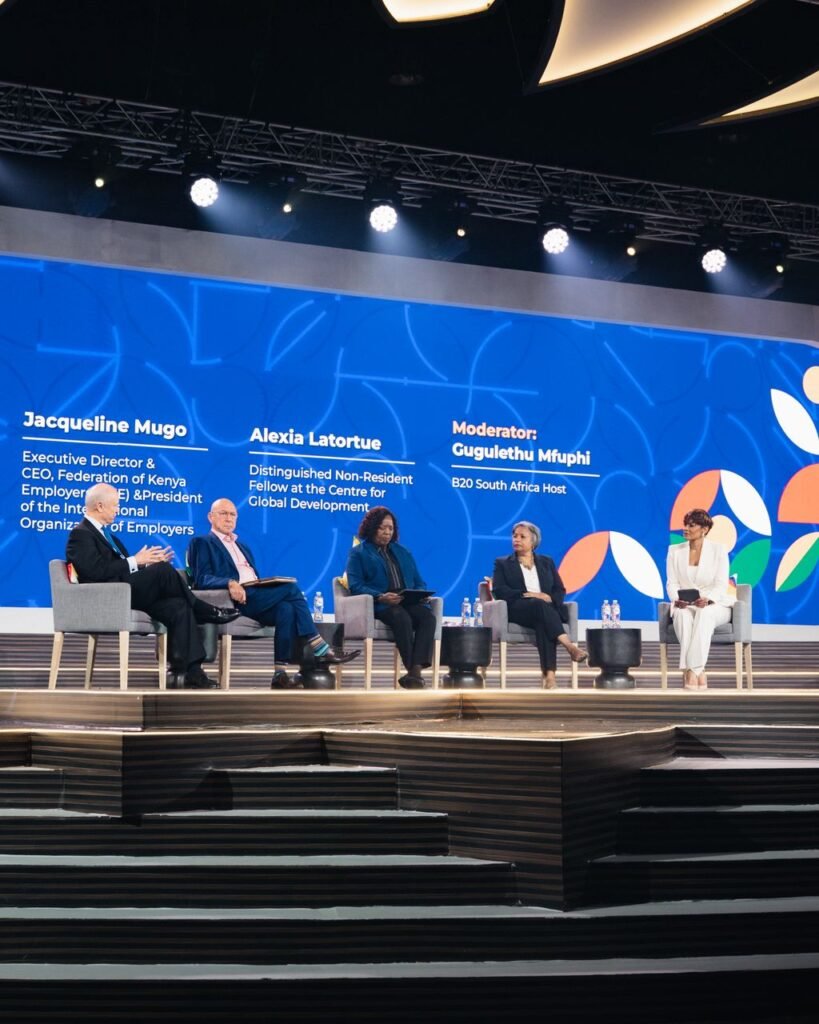
Speaking on the sidelines of the B20 Summit, which is underway in South Africa’s capital, Johannesburg, Mr. Mgojo emphasised that harmonising policies, regulations, and infrastructure is the surest way to ignite sustainable growth across the continent.
Launched in 2021, the African Continental Free Trade Area (AfCFTA) aims to create a single market for over 1.3 billion people in Africa, with a combined GDP exceeding $3.4 trillion, potentially boosting intra-African trade.
Despite milestones such as the Guided Trade Initiative (GTI), which has enabled initial shipments of products from Kenya and Rwanda to Ghana, the AfCFTA’s full potential remains constrained by deep-rooted challenges in cross-border trade.
Mxolisi Mgojo, the President of Business Unity South Africa (BUSA) and Co-Chair of the B20 Summit, believes these longstanding challenges can be overcome through uniform border requirements and digitalisation to streamline the movement of goods and customs clearance.
“Africa has to get its house in order. At a political level, you’ve got a lot of opportunities through the AU to actually say, as the AU, what does it mean for us—54 countries? We need to harmonise a lot of the policy and regulatory requirements that enable trade, investment, and the sharing of certain infrastructure,” he added.
Mr. Mgojo affirmed that this is important because, in some instances, a country by itself does not have a market big enough to justify major investments, but it may be the place where regional capacity for a market can be created.
In Ghana, home to the AfCFTA Secretariat in Accra, informal cross-border trade alone surged to GH¢7.4 billion—equivalent to $500 million—in the last quarter of 2024, sustaining livelihoods for thousands but operating largely in the shadows due to suppression risks and the lack of integration into formal systems.
Exporters at borders such as Aflao (with Togo) and Paga (with Burkina Faso) endure multi-day waits caused by manual inspections, inconsistent documentation, and multiple checkpoints—frustrations that continue to hamper stakeholders in both export and import markets.
Even South Africa, Africa’s trade powerhouse and a GTI participant since January 2024, grapples with similar issues despite its advanced logistics hub in Durban.
For Mr. Mgojo, these are urgent, real-world problems that demand immediate action. He says the B20 Africa Summit has prioritised inclusivity, bringing together experts, business leaders, and academics from across the continent to ensure that the recommendations drive growth for the entire region.
“This is not South Africa’s B20. This is Africa’s B20. That’s why the whole thing is about the significance of this moment: the potential of Africa being put on the map and actually being acted on. That’s why we made sure that even in our task forces we brought in all the experts, thinkers, business leaders, and academics from right across the continent,” Mr. Mgojo affirmed.
The B20 is the official business engagement forum for the G20, providing a platform for companies and business organisations worldwide to articulate their perspectives on pressing global economic and trade issues.


