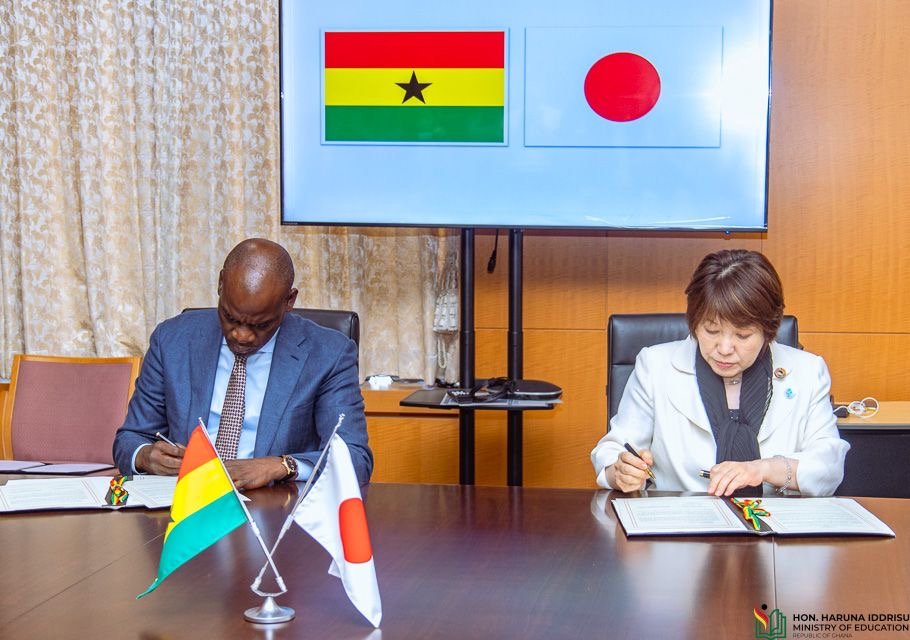
Ghana and Japan have officially cemented a landmark bilateral cooperation agreement to deepen educational collaboration aimed at sustainable development and digital transformation.
Ghana’s Minister for Education, Honourable Haruna Iddrisu, and Japan’s Ministry of Education, Culture, Sports, Science and Technology (MEXT) signed the agreement in Tokyo to promote inclusive, quality education and equip Ghanaian youth with the skills needed for a knowledge-based economy.
The new partnership sets out key priorities including:
- Building institutional capacity through teacher training and joint curriculum development
- Advancing green skills in Technical and Vocational Education and Training (TVET) to meet emerging industry needs
- Expanding Science, Technology, Engineering, and Mathematics (STEM) and digital innovation to drive problem-solving and environmental consciousness
- Promoting student exchanges and research collaboration at the tertiary level
- Embedding Education for Sustainable Development (ESD) principles in schools and communities
As part of the agreement, Japan will also support the rollout of comprehensive coding courses to develop essential digital skills for Ghanaian students.

Minister Iddrisu praised the Government of Japan and MEXT for their long-standing partnership and technical support, stating that the agreement “goes beyond bilateral cooperation—it reflects a shared belief that education is the most powerful tool for building peaceful, resilient, and sustainable societies.”
He noted Ghana’s admiration for Japan’s community-based learning models and commitment to environmental stewardship, principles that Ghana aims to incorporate into its ongoing education reforms.

Describing the collaboration as “strategic, timely, and transformative,” the Minister reaffirmed Ghana’s dedication to achieving tangible results aligned with its Education Strategic Plan (ESP 2018–2030) and the Sustainable Development Goals (SDGs), particularly SDG 4 on quality education.
Japan’s leadership in ESD was also spotlighted, with special mention of the UNESCO ESD Centre in Okayama and its history of hosting World Conferences on ESD. Ghana, the Minister said, fully embraces ESD as central to its education transformation agenda.

Ongoing support from Japan through initiatives like the Japan International Cooperation Agency (JICA), the Project for Improving the Quality of Primary Education through Teacher Development, and the Sakura Science Exchange Program continues to play a vital role in advancing Ghana’s education sector.
Source: Starrfm.com.gh