


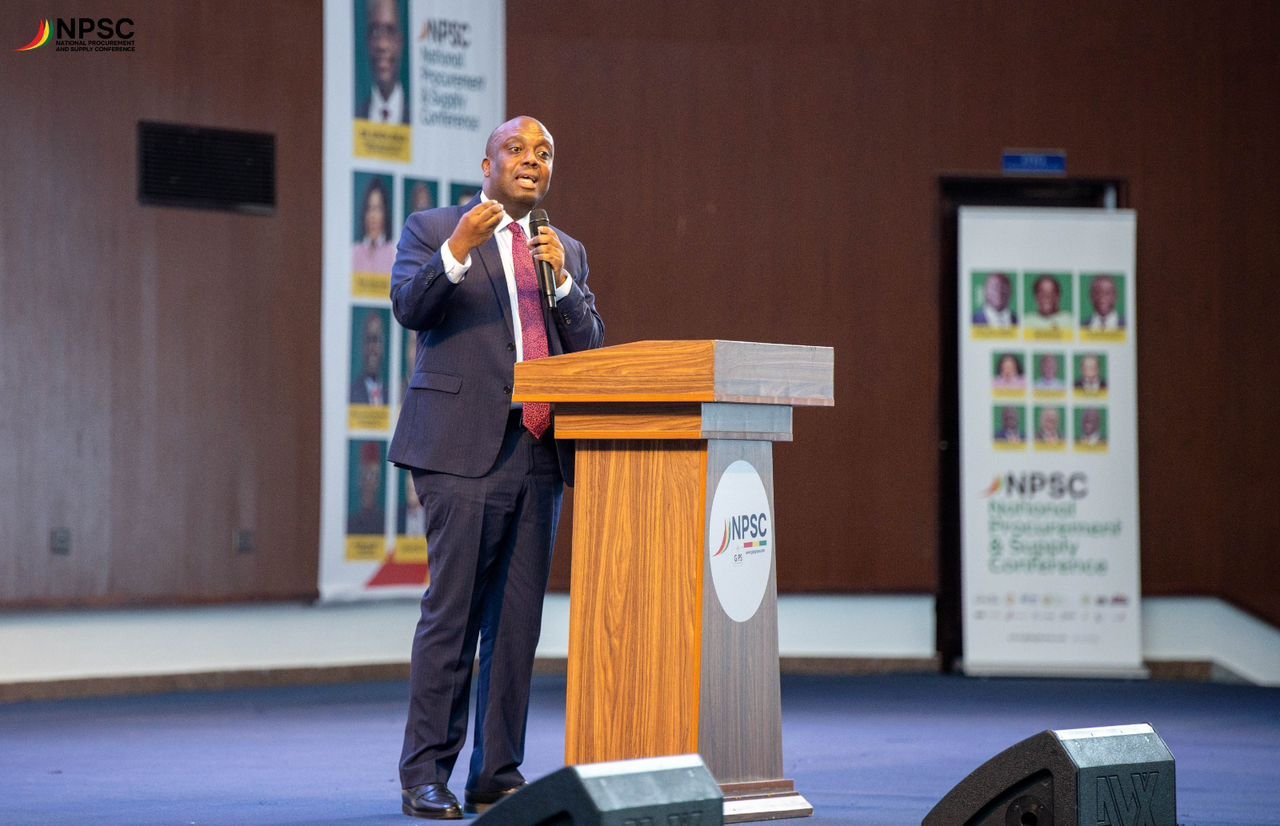
Deputy Finance Minister, Thomas Nyarko Ampem, has announced new reforms aimed at ensuring fiscal discipline in Ghana’s public procurement system.
Speaking at the National Procurement and Supply Conference in Accra, held under the theme “Transforming Public Procurement for Sustainable Development: Policies, Practices and Pathways”, Ampem Nyarko said that going forward, only Ministries, Departments, and Agencies (MDAs) with approved budgets and allotments will be granted procurement approval to award contracts.
He explained that this measure forms part of President John Dramani Mahama’s “reset agenda,” which seeks to address leakages, inefficiencies, and corruption in public financial management.
“From the start, on 7th January 2025, President John Dramani Mahama committed this Government to resetting the economy by creating a new culture of economic governance. Since then, under the able leadership of My Minister, Dr. Cassiel Ato Forson, the Ministry of Finance has moved swiftly to reform the PFM system, with strong focus on the Procurement System,” he stated.
The Deputy Minister further revealed that the Public Procurement Act has been amended to make commencement certificates and budgetary provisions prerequisites for all procurements to be paid by central government.

Citing reports from civil society organizations and professional bodies such as Imani Ghana, ACEP, and the Ghana Institute of Procurement and Supply (GIPS), he highlighted that Ghana has lost billions of cedis to procurement irregularities over the years.
According to him, procurement infractions cost public boards GH¢850 million between 2011 and 2021, while GIPS estimated that GH¢11.8 billion was lost between 2015 and 2019 — averaging GH¢2.36 billion annually. He stressed that these losses deprived key social programs, particularly those under the Ministry of Gender, Children and Social Protection, of essential resources.
“Unsurprisingly, the reports do not attribute the huge losses in public funds to politicians/policy makers alone. Rather, they confirm a shared responsibility. They attribute the losses to weak oversight, lack of professionalism, and inadequate enforcement of procurement laws. In effect, all stakeholders, including policy makers and procurement professionals are responsible for that outcome,” he added.
Hon. Ampem emphasized that procurement should not be reduced to a clerical task but treated as a strategic tool for sustainable development. He commended GIPS for championing the Procurement Practising Bill, which is currently before Cabinet.
When passed, the Bill is expected to professionalize procurement practice, improve ethical standards, curb malpractice, and embed environmental and climate considerations into contracting.
The Deputy Minister outlined key pathways to strengthen Ghana’s procurement system, including continuous training for procurement professionals, strict enforcement of laws, full adoption of technology through GHANEPS, supporting local suppliers to boost resilience and job creation, embedding green procurement to reduce environmental impact, and ensuring the passage of the Procurement Practising Bill.
He also linked the reforms to government’s 24-Hour Economy Policy and local content agenda, stressing the importance of deliberately reducing imports of products that can be produced locally.
“Every contract awarded to a capable Ghanaian company creates jobs that endure beyond a single project. Every insistence on local content builds industries that can compete across Africa and beyond,” he noted.
He concluded by urging procurement professionals to see themselves as vital players in strengthening fiscal discipline, building public trust in governance, and driving industrialization under the African Continental Free Trade Area (AfCFTA).
Source: Ghana/Starrfm.com.gh


