Beekeeping Initiative funded by UK government is being implemented in Kwahu Afram Plains in Eastern Region to leverage Ghana’s potential to produce tonnes of honey to meet local demands, thereby creating job opportunities and boosting the economy.
A 2020 Ghana EXIM Bank report indicates that 60% of honey consumed locally or used for manufacturing is imported from West Africa, Europe, and Asia.
Pharmaceutical companies in Ghana continue to import honey from Burkina Faso, Ivory Coast, India, and parts of Europe; a situation stakeholders believe can be reversed with improved local production standards and better sector coordination.
The Federation of Ghana Beekeepers Association (FGBA) estimates that Ghana could earn up to US$1.5 billion annually if the beekeeping industry is properly structured and incentivised.
Although 70% of Ghana’s vegetation is suitable for beekeeping, but that potential remains untapped.
About One thousand (1,000) residents from over 30 communities in the Kwahu Afram Plains in Eastern Region have been trained in modern beekeeping under Bees for Development Ghana Limited’s livelihood and environmental restoration.
Six hundred of these beneficiaries are currently producing honey in commercial quantities.
At stakeholder engagement meeting held in Donkorkrom in the Kwahu Afram North District, community leaders, beneficiaries and partners, reviewed progress, shared experiences and strategise for expansion to make Kwahu Afram Plains a hub for honey production for Ghana.
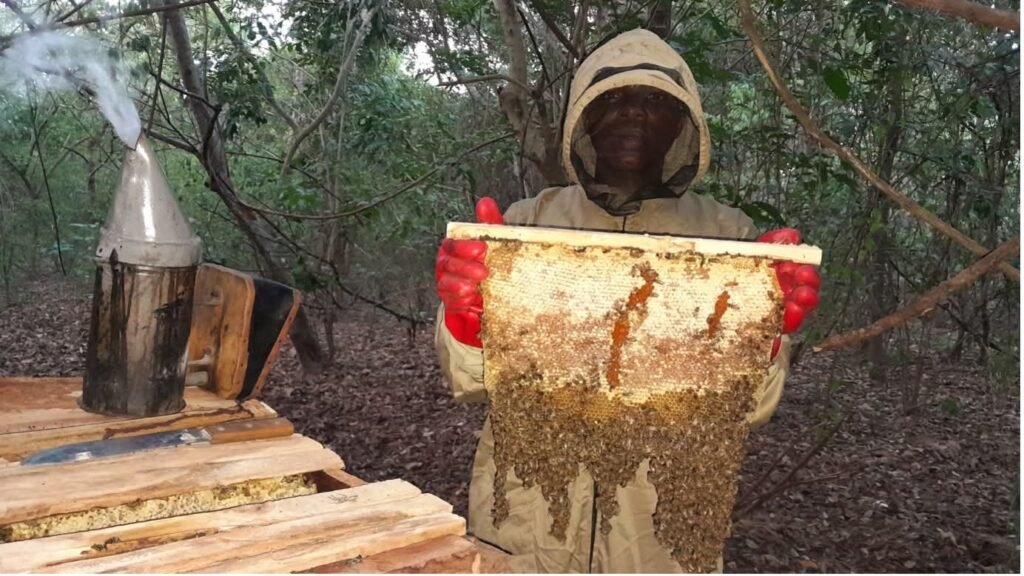
Speaking to the media at the sideline of a stakeholders engagement, the Programmes Director at Bees for Development Ghana Limited, Isaac Kwadwo Mbroh, said the core objective of the project is to tackle rural unemployment while restoring degraded forest lands.
According to him, beekeeping prevents harmful practices such as bush burning, supports forest regeneration, and provides a sustainable income source for rural households.
“Two years now, going on our third year, we have been able to make over 600 people become beekeepers. And what they are doing is basically to restore the forest of our Afram Plains. We are using beekeeping to do that. Because people put their hives in the forest and they prevent bushfire, and they protect the trees so that the trees will be there to be able to produce honey for them. And this is more sustainable than cutting down trees to produce charcoal and other things. So basically that is what we are doing in Afram Plains”. Said Isaac Kwadwo Mbroh.
He said honey is more valuable than crude oil, therefore Ghana can leverage on the market value to boost the economy.
“In fact, I would say beekeeping is one of the strongest tools to reduce unemployment in Ghana, and also to end a lot of foreign exchange. Honey is expensive than oil, fuel, petrol, or diesel”.
He added that “Dubai and other Middle East countries have been able to use oil to develop their country.Honey is expensive than oil. So why can’t we also leverage on the power of bees to produce more honey, export to other countries so that we can get more foreign currency to develop our country, so that our currency will be strong”.
Dr. Janet Lowore, Director of Programmes, Bee For Development – UK, pledged more support to Ghana for initiatives that conserve biodiversity and improve livelihood.
“Bees for Development and we’re based in the UK and we work in partnership with Bees for Development Ghana and this event today has been sponsored by our organisation with support from a funding opportunity called Darwin Initiative from the UK government and the objective is to initiate and support programmes which achieve biodiversity conservation at the same time as supporting people’s livelihoods and the Bees for Development we work in many different countries Ghana is just one of them but we’re really very excited to be working in Ghana to be working with our partners and stakeholders friends and colleagues here in Ghana to further the beekeeping and honey industry”
She maintained that Beekeeping industry has lot of benefits to the poverty alleviation and conservation.
“We recognise that the beekeeping industry has so much to offer in terms of achieving the sustainable development goals towards alleviating poverty supporting life on land, gender empowerment, social inclusion and that’s why we’re so excited to be part of this event today” Said Janet Lowore.
Beekeeping experts highlight that honey and beeswax yields grow significantly with good management practices. Production estimates show that a working hive can produce:10 litres of honey and 3kg of beeswax in Year 1, and 20 litres of honey and 6kg of beeswax in Year 3.
Some beneficiaries of the beekeeping initiative in Afram Plains shared how the project has diversified livelihood.
“After completing SHS, I did not have money to further my education, so I returned to my village to farm. That was when I met Bees for Development Ghana Limited. They introduced me to beekeeping, and today I am. Making more income, which I have opened my own boutique shop adding to my stream of income and I am living a better life.”
With more than 900 trainees already active, the Afram Plains initiative has the potential to contribute thousands of litres of honey to the local market annually.
Source: Starrfm.com.gh