By using this site, you agree to the Privacy Policy and Terms of Use.
Accept
Starr FmStarr FmStarr Fm
  • Home
  • Election Hub
  • General
    GeneralShow More
    Cannabis cultivation a blessing to Ghana’s economy – CEO of Cannabis Industry
    February 16, 2026
    CETAG suspends strike after gov’t releases outstanding payments
    February 16, 2026
    NRSA calls on transport operators in petroleum sector to strengthen safety protocols following tanker explosions
    February 16, 2026
    Court orders man to compensate woman with GHc200k for breach of promise to marriage
    February 16, 2026
    Interior Minister Muntaka swearing in Gaming Commission board to tackle betting issues.
    Ghanaian tomato traders caught in terror attack in Northern Burkina Faso; gov’t working to verify details – Interior Ministry
    February 16, 2026
  • Business
    BusinessShow More
    Automobile Dealers reduce vehicle prices by 15%, cite cedi stability and COVID-19 levy removal
    February 16, 2026
    Gov’t orders COCOBOD to pay cocoa farmers all outstanding debts with immediate effect
    February 12, 2026
    Gov’t reduces Cocoa producer price to GH¢41,392 per tonne following global market drop
    February 12, 2026
    Gov’t to lay new COCOBOD Bill for automatic pricing system; guarantee 70% FOB – Finance Minister
    February 12, 2026
    GoldBod Jewellery dissociates itself from ‘gold investment opportunity’, warns against fake platforms
    February 12, 2026
  • Politics
    PoliticsShow More
    Criminalising paternity fraud is “bad for our democracy” – Lawyer warns A-Plus
    February 14, 2026
    No raw mineral export by 2030 – Mahama declares
    February 14, 2026
    Ken Ofori-Atta permanently removed from INTERPOL Red Notice list
    February 13, 2026
    Mahama meets UN Chief, discusses African security and democracy
    February 13, 2026
    Ofosu Nkansah’s lawyer cautions politicians to be mindful of public statement following arrest of client
    February 13, 2026
  • Entertainment
    EntertainmentShow More
    Kojo Antwi: “I’m lucky to be born in Kwame Nkrumah’s Ghana”
    February 14, 2026
    I write my music with women in mind – Kojo Antwi
    February 14, 2026
    Kojo Antwi advises musicians to stay humble as they rise
    February 13, 2026
    I’m a ‘conscious African’; my career is built on cultural identity, pan-Africanism – Kojo Antwi
    February 13, 2026
    Kojo Antwi reflects on creative freedom, independent career on Starr Chat with Bola Ray
    February 13, 2026
  • Sports
    SportsShow More
    Accra Hearts of Oak stun Asante Kotoko 1-0 in Kumasi Super Clash
    February 16, 2026
    Cynthia Kwabi clinches Sheroes 2 title in commanding fashion
    February 16, 2026
    Police Ladies FC stun Southern Zone Leaders FC Epiphany in Matchday 13 clash
    February 16, 2026
    Mohammed Kudus’ Tottenham Hotspur names Igor Tudor as Interim Manager
    February 14, 2026
    Black Princesses set for Uganda showdown in final qualifying round
    February 14, 2026
  • Technology
    TechnologyShow More
    Yamoransa Model Labs Program Africa announces 5th Annual Impact Roundtable and Robotics Competition
    February 11, 2026
    Ghana, Zambia to partner on fintech and cybersecurity as AI fake news rises
    February 7, 2026
    GSTS and STEMQUEST: How an Alumni-Led Extracurricular Initiative is Redefining Technical Education in Ghana
    February 4, 2026
    IShowSpeed’s energy is on another level; he has to entertain followers nonstop – Wode Maya
    January 30, 2026
    A new layer of privacy five years in the making
    January 29, 2026
  • International
    InternationalShow More
    Interior Minister Muntaka swearing in Gaming Commission board to tackle betting issues.
    Ghanaian tomato traders caught in terror attack in Northern Burkina Faso; gov’t working to verify details – Interior Ministry
    February 16, 2026
    Ghana elected first Vice-Chair of African Union at 39th Summit
    February 16, 2026
    Lordina Mahama champions support for women’s health, education, and empowerment at OAFLAD Summit
    February 16, 2026
    Ghana to push for UN recognition of transatlantic slave trade as crime against humanity – Mahama
    February 16, 2026
    Mahama commissions $9.8m Ghana Chancery in Ethiopia, strengthens bilateral and continental ties
    February 16, 2026
  • Factometer
Search
© 2024 EIB Network Ltd. All Rights Reserved.
Reading: Lessons from Kenya on how to boost breastfeeding rates
Share
Notification Show More
Font ResizerAa
Starr FmStarr Fm
Font ResizerAa
  • Headlines
  • Election Hub
  • General
  • Politics
  • Sports
  • Business
  • Entertainment
  • Factometer
Search
  • Headlines
  • Election Hub
  • General
  • Politics
  • Sports
  • Business
  • Entertainment
  • Factometer
Have an existing account? Sign In
Follow US
© 2024 EIB Network Ltd. All Rights Reserved.
Editors PickFeatures

Lessons from Kenya on how to boost breastfeeding rates

Starrfm.com.gh By Starrfm.com.gh Published August 1, 2019
Share
SHARE

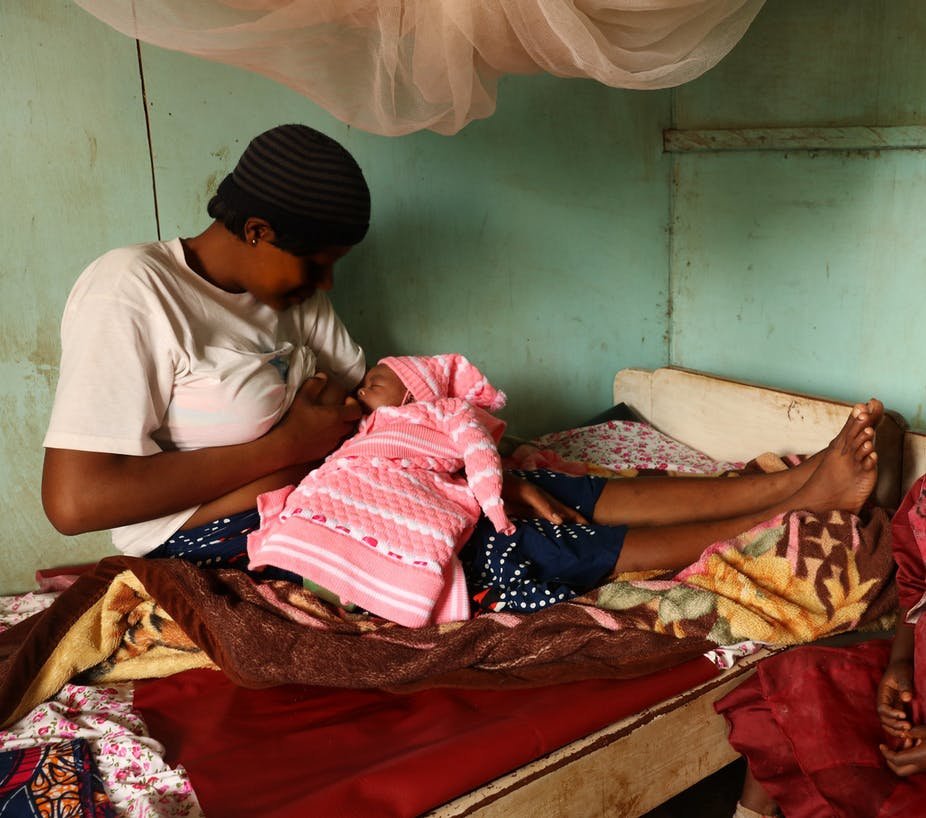
Kenya has, over the past two decades, made tremendous achievements in promoting breastfeeding. The number of babies who were exclusively breastfed rose from just 13% in 2003 to about 61% in 2014.

Contents
Home-based counsellingLessons for improvement

This was achieved largely because of two programmes led by the Ministry of Health: the Baby Friendly Hospital Initiative and the Baby Friendly Community Initiative. The hospital initiative promotes breastfeeding in hospitals at the time of delivery, while the community initiative promotes breastfeeding at home.

Breastfeeding is important. It lowers incidences of child illness and death and has also been linked to better outcomes at school. The World Health Organisation recommends that babies be breastfed immediately after they’re born, followed by exclusive breastfeeding for the first six months of their lives.

For over ten years scientists at the African Population Health Research Centre (APHRC), myself among them, have tried to tackle the challenges that still stand in the way of Kenya achieving its national target of getting 80% of women to breastfeed.

To do this, we focused our research on the Baby Friendly Community Initiative. Over the past five years, it’s been rolled out in several counties. The initiative recognises that many women deliver at home and need continued support after delivery.

Our studies, carried out in rural and urban settings, looked into how well home-based counselling worked. The aim was to see where improvements could be made. We also carried out an exercise across Kenya to understand community perceptions on how best to implement the initiative.

We found that the project was a success. Mothers developed confidence and knowledge about breastfeeding and felt supported by the community health workers. These health workers are volunteers motivated by goodwill and recognition for the work they do.

But more needs to be done. It is important to include fathers and others – such as grandmothers and traditional birth attendants – in implementing the project. Also, incentives should be given to community health volunteers to ensure they stay engaged.

Our hope is that the study will inform guidelines being developed by the Ministry of Health for scaling up the initiative.

Home-based counselling

To test the initiative, we designed a project that involved regular home visits by community health workers during a woman’s pregnancy and until the baby was a year old. It was implemented in two low-income settlements in Nairobi for almost two years.

The health workers taught mothers about nutrition, the immediate initiation of breastfeeding after birth, breast positioning and attachment and the importance of exclusive breastfeeding. Workers also explained how long and often they should breast feed for, how to express breast milk and how to store it.

It was hugely successful. Exclusive breastfeeding rates for the baby’s first six months rose from 2% to 55%.

The intervention also worked in rural areas. We implemented the study in Koibatek – a rural area in the Rift Valley area. Over 87% of the mothers who received counselling breastfed exclusively for six months, compared to 43.8% at control sites.

In addition to these two studies, in partnership with Kenya’s Ministry of Health, we conducted an exercise across the country to get insights into what communities thought was the best way to implement the Baby Friendly Community Initiative and what the role of different stakeholders – like fathers, grandmothers, community leaders, traditional birth attendants and community health volunteers – should be.

Lessons for improvement

The key lesson was that consistently supporting mothers to breastfeed through home-based personalised care worked. This was partly because the health workers came from their community and so the women trusted them more. The health workers were also more accessible than other health care providers, like hospital nurses.

When it came to the role of the different stakeholders, the community suggested that fathers and other key influencers of infant feeding – like grandmothers, traditional birth attendants, and community leaders – should be involved in implementing the initiative. They also suggested that community mother support groups be formed.

But a major challenge in scaling up the initiative is how to embed the programme into Kenya’s health care system, working with existing resources and within existing structures.

The initiative is a low-cost intervention, as the community health workers are volunteers. This is great in resource-constrained situations – but it also raises a problem: the community health volunteers often lose motivation. We suggest that they be supported through income generating activities such as farming or bee keeping, as was the case in the Koibatek study.

There are also questions of workload and how much more the community health workers can take on.

Once these issues are ironed out, the low resource requirements of the initiative should make it interesting for other African nations. In the future, we plan to translate the learning from Kenya to other countries in sub-Saharan Africa.

Milka Wanjohi and Florence Sipalla, from the African Population Health Research Center, contributed to the writing of this articleThe Conversation

Elizabeth Kimani-Murage, Research Scientist, African Population and Health Research Center

This article is republished from The Conversation under a Creative Commons license. Read the original article.

You Might Also Like

Yaw’s Wahala Before the Roses: A Val’s Day Caution

How Thoughtful Gifting and Financial Intent Reflect Emotional Intelligence

Naa Dedei Tettey: The Woman Breaking the Glass Mic and Redefining Morning Radio on Starr 103.5 FM

Ghana’s Gold Reserves: Strategic Management for Economic Stability

International Day of Education 2026: Youth, Technology and the Future of Learning

TAGGED:breastfeeding
Share This Article
Facebook Twitter Email Print
Share
Previous Article Visit to slave dungeons humbled us – Pelosi
Next Article PDS saga: Interdict MiDA bosses – ACEP

Starr 103.5FM

Starr FmStarr Fm
Follow US
© 2024 EIB Network Ltd. All Rights Reserved.
newsletter icon
Join Us!

Subscribe to our newsletter and never miss our latest in news, podcasts etc..

[mc4wp_form]
Zero spam, Unsubscribe at any time.
adbanner
AdBlock Detected
Our site is an advertising supported site. Please whitelist to support our site.
Okay, I'll Whitelist
Welcome Back!

Sign in to your account

Lost your password?
