Pope John Senior High School and Minor Seminary will reduce its student intake from the 2025/2026 academic year as part of efforts to phase out the transitional double track system, the school’s Headmaster, Rev. Fr. Benjamin Opoku Ohene, has announced.
The reduction is in line with a directive from the Ministry of Education and the Ghana Education Service (GES), which is working with selected schools to revert to the single track system by 2027. The double track system, introduced in 2017 under the previous NPP administration to manage increased enrolment from the Free SHS policy, divides students into two cohorts – “Green” and “Gold” – to accommodate infrastructure limitations. However, the system has faced persistent criticism for its impact on teaching hours and student performance.
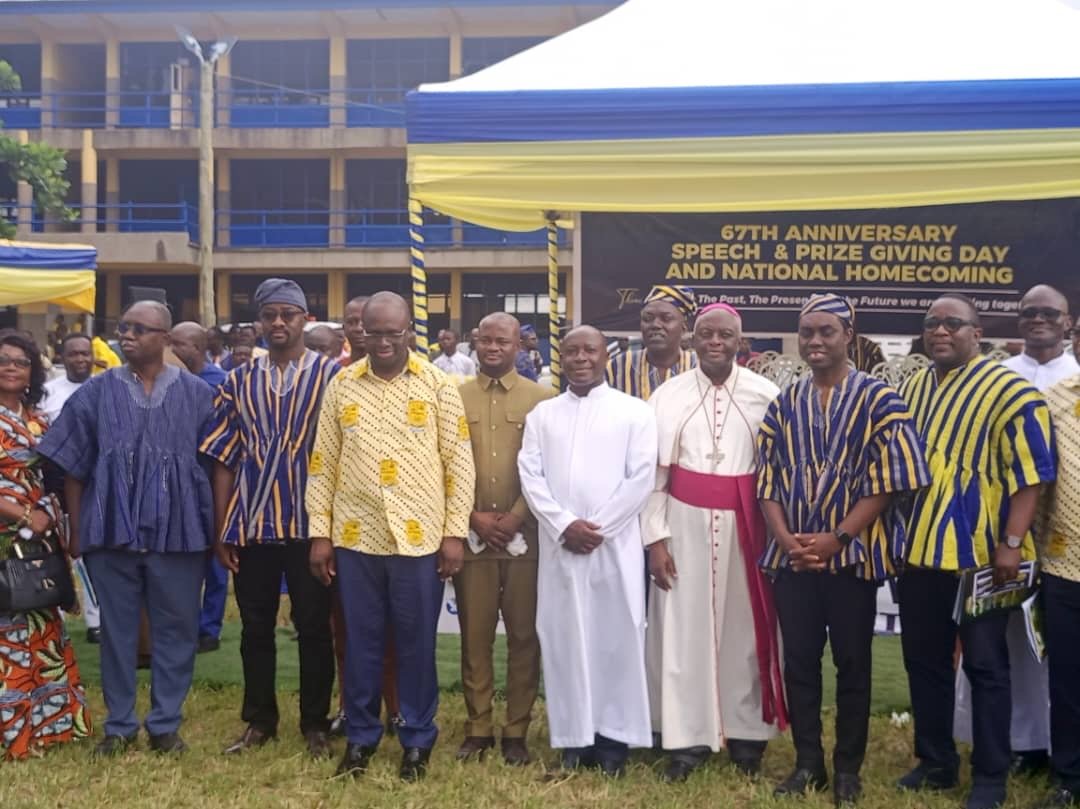
Speaking during the school’s 67th Anniversary Speech and Prize-Giving Day, Rev. Fr. Opoku Ohene confirmed that the changes would begin with the 2025/2026 first-year admissions.
“To effectively achieve this in our school, there will be the need to reduce the intake of students and the number of classes starting with the coming of this 2025/2026 Form One admission,” he stated.
READ: NSS Scandal: Mustapha Ussif Breaks Silence, Denies GH₵548m Fraud Claims
According to the new plan, the number of Form One classes for various programmes will be scaled down as follows:
- General Arts and General Science: from 7 to 5 classes each
- Business: from 4 to 3 classes
- Visual Arts: from 3 to 2 classes
While welcoming the benefits of the transition in terms of reduced congestion and improved learning conditions, the headmaster also raised concerns about possible long-term implications.
“There are other far-reaching consequential effects; namely, one day there shall be redundancy and the reduction of number of teachers with time,” he noted.
The school is among several Senior High Schools across the country preparing to fully revert to the single track model by 2027 in line with the current government’s education reform agenda.
Minister for Defence, Dr. Edward Kofi Omane Boamah, who served as Guest of Honour at the event, also used the occasion to rally support for the government’s “One Million Coders” programme, a flagship initiative aimed at equipping Ghanaian youth with vital digital skills.
“This programme is about giving young people the tools they need to thrive in a digital age—skills in artificial intelligence, cybersecurity, coding, data analysis, and more. These are not luxury skills for Silicon Valley; they’re becoming basic survival tools for modern life,” Dr. Omane Boamah stated.
He emphasised the critical role digital literacy would play in careers across medicine, education, engineering, and agriculture, urging students to embrace learning as a pathway to innovation and national transformation.
READ: University of Agriculture and Allied Health Sciences to be established in Damongo – Mahama
“We’re building capacity to solve real Ghanaian problems; how to improve healthcare with data, how to protect farms with smart tools, how to use AI to boost learning in our classrooms, or how to defend our nation more intelligently and securely,” he said.
He also appealed to alumni and parents to support efforts to upgrade the school’s science laboratories and ICT infrastructure, aligning with Ghana’s broader digital transformation agenda.
Dr. Omane Boamah encouraged students to see global challenges like climate change and digital disruption as opportunities for growth.
“The world is changing. Learn digital skills, artificial intelligence, entrepreneurship. Build things. Break things. Try again. Learn, unlearn and re-learn. Use your knowledge to serve others. That’s where real joy comes from,” he concluded.
Source: Ghana/Starrfm.com.gh/Obed Kojo Ansah