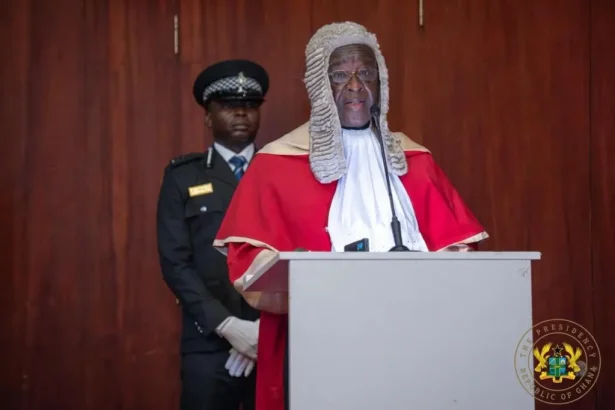
The Chief Justice, Justice Paul Baffoe-Bonnie, has acknowledged that access to justice in Ghana remains constrained by cost, location, and time, raising concerns about inequality within the country’s legal system.
Speaking at the launch of the 150th anniversary of the Supreme Court of Ghana in Accra on Thursday, April 16, 2026, he admitted that despite progress made over the years, many Ghanaians still face barriers when seeking justice.
“Should access to justice, in too many cases, still hinge on geography, cost, or time?” he questioned, highlighting persistent challenges within the system.
READ: Chief Justice calls for faster, more accessible justice at Supreme Court @150 Launch
The Chief Justice noted that while the judiciary has evolved over the past century and a half, the lived experiences of many citizens suggest that justice is not always within reach. He stressed that when justice becomes too expensive, too distant, or too slow, it risks excluding those who need it most.
He warned that such barriers undermine public confidence in the legal system, particularly when individuals are unable to pursue or defend their rights due to practical limitations.
“There are still delays. There are still barriers. There are still moments when justice feels distant to those who need it most,” he stated.
The Chief Justice emphasised that justice must not only exist but must be accessible in practical terms, adding that a system that fails to reach ordinary citizens weakens its own relevance.
“Distant justice is denied justice,” he said, underscoring the human impact of systemic limitations.
He called for a renewed commitment to reforms that prioritise accessibility and fairness, noting that the future of the judiciary must be defined by its ability to serve all citizens equally, regardless of their location or financial capacity.
The remarks formed part of reflections marking the anniversary celebration, themed “Honouring the Past, Celebrating the Present, and Defining the Future,” as the judiciary assesses its progress and charts a path toward a more inclusive justice system.
Source: Starrfm.com.gh