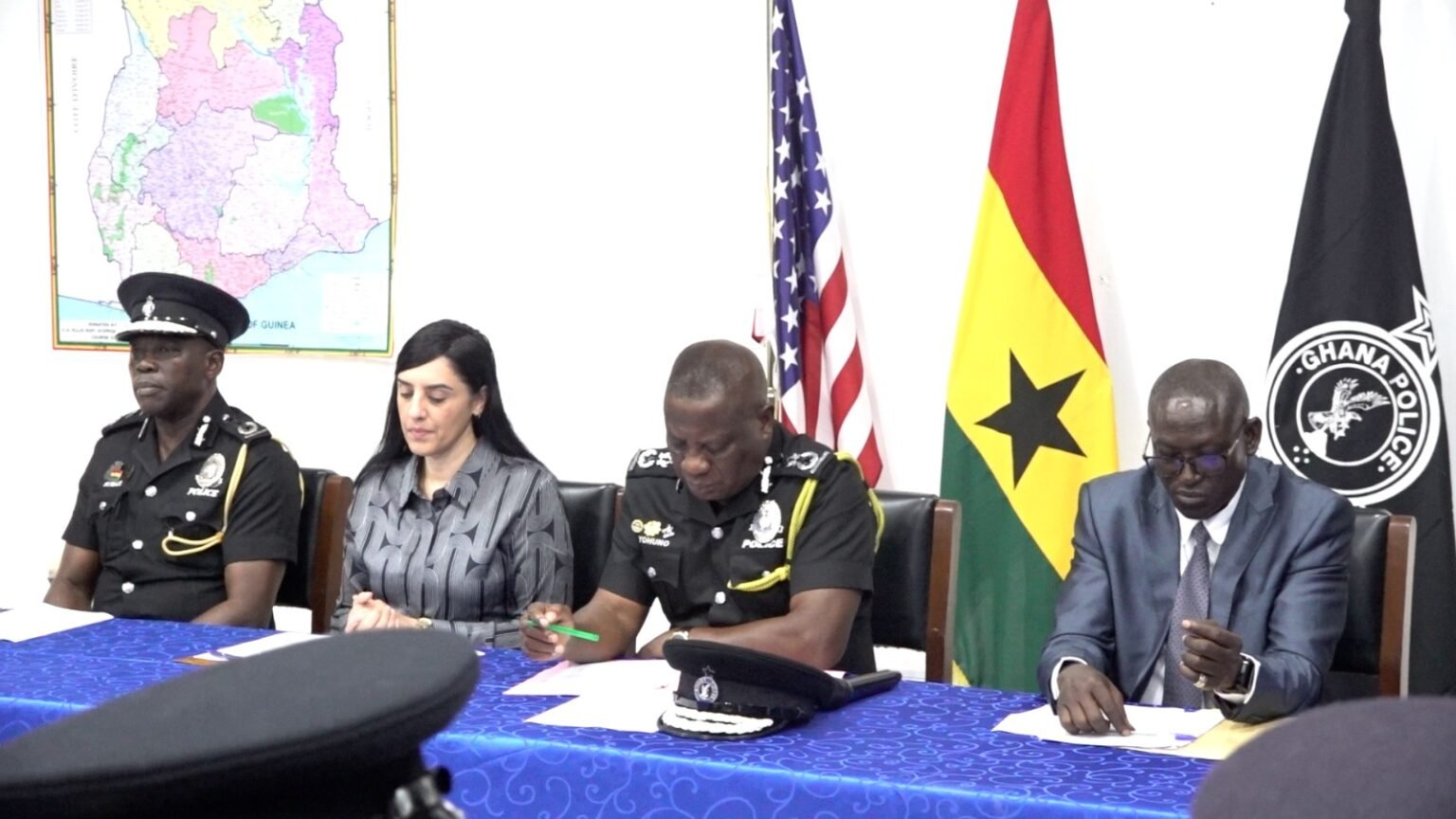
The Ghana Police Service has taken a major step toward strengthening intelligence-led policing with the commencement of a ten-day intensive Police Intelligence Operations Training Programme at the Police Academy in Accra.
The programme, organised in collaboration with the United States Federal Bureau of Investigation (FBI), is aimed at sharpening the operational capabilities of officers in intelligence gathering, operational planning, undercover operations, threat identification, and proactive crime prevention.
The high-level training brings together officers from the Police Intelligence Directorate and the Criminal Investigations Department as part of broader efforts to modernise policing and tackle increasingly sophisticated criminal networks operating within Ghana and across the sub-region.
Opening the programme, the Director-General of the Police Intelligence Directorate, Peter Baba Atiniak, described the initiative as a strategic intervention designed to strengthen intelligence capabilities within the Service.
According to him, modern crime trends demand advanced operational skills and intelligence-based approaches capable of detecting and disrupting criminal activities before they escalate.
“Crime is becoming sophisticated and requires in-depth knowledge and skills to nip crime in the bud,” COP Atiniak stated.
He noted that the training would equip participants with practical expertise in advanced intelligence operations and operational planning to support police leadership in detecting, preventing, and solving crimes more effectively.
COP Atiniak further emphasised that the vision of the Ghana Police Service remains the transformation of the institution into a world-class police organisation driven by professionalism, intelligence, and operational excellence.
The Acting Deputy Chief of Mission at the U.S. Embassy in Ghana, Rabia Qureshi, reaffirmed the United States Government’s commitment to strengthening security cooperation with Ghana.
She explained that emerging threats such as organised crime, violent extremism, gun trafficking, fraud syndicates, and transnational criminal networks require stronger intelligence systems and highly trained law enforcement officers.
“Strong intelligence capabilities allow law enforcement agencies to move proactively rather than reactively,” she said.
Rabia Qureshi stressed that the training would provide participants with real-world operational tools used globally to identify threats, recruit intelligence sources, conduct undercover operations, and dismantle criminal networks before they cause harm.
She also highlighted the importance of balancing technological intelligence with human intelligence in modern policing.
“Human intelligence remains one of the most effective tools in understanding intent, identifying emerging threats, and penetrating criminal organisations,” she noted.
The Inspector-General of Police, Christian Tetteh Yohuno, in his keynote address, described the programme as a critical milestone in the longstanding partnership between the Ghana Police Service and the FBI.
The IGP said the changing nature of crime across the world requires police institutions to transition from traditional reactive policing to intelligence-led operational strategies driven by foresight, analysis, and preventive action.
“Intelligence-led policing is not merely a concept; it is a philosophy that prioritises information, analysis, and proactive decision-making in the fight against crime,” IGP Yohuno stated.
According to him, the Ghana Police Service, under his leadership, is prioritising intelligence-driven policing as the backbone of its operational strategy in response to evolving security threats, including cybercrime, organised criminal syndicates, and transnational crimes.
The IGP stressed that the training was not just another capacity-building exercise but a strategic investment in the future of policing in Ghana.
He explained that the selected officers were expected to return as “force multipliers,” capable of strengthening intelligence gathering, improving analytical capabilities, enhancing inter-agency collaboration, and driving innovation within the Service.
“The true value of this training will be seen in safer communities, disrupted criminal networks, and increased public confidence in the police,” he added.
IGP Yohuno also used the occasion to deepen calls for expanded collaboration between the Ghana Police Service and the FBI, including opportunities for more Ghanaian officers to receive specialised training at the FBI Academy in Quantico, Virginia.
He said exposure to world-class policing systems and intelligence methodologies would significantly strengthen institutional capacity within the Police Intelligence Directorate and other specialised units of the Service.
The training programme reflects growing international cooperation between Ghana and the United States in addressing complex security challenges, intelligence sharing, and strengthening modern policing systems.
Source: Peter Quao Addator/Starrfm.com.gh