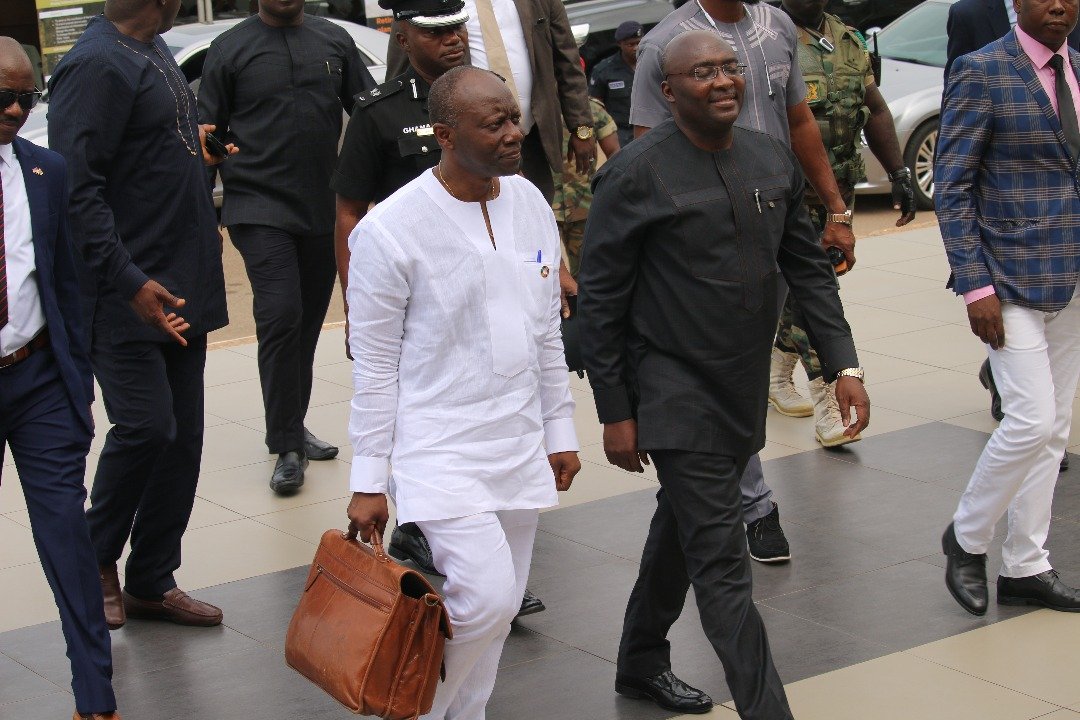
Finance Minister Ken Ofori-Atta will be presenting the 2019 Budget Statement in Parliament today, Thursday November, 15, 2019.
Ahead of the presentation, GN Research is advising the government to focus more on job creation which will lead to poverty reduction.
“About 10,000 direct jobs were lost since 2017. Some of the sectors affected include, financial, media, hospitality, telecommunication and mining sectors. This figure could increase to hundreds of thousands in indirect terms.
“The President’s admission that the country is going through hard times, provides enough evidence about current conditions in the country. Unemployment and underemployment are big challenges government must directly target with the 2019 budget. The 2019 budget should not deliver “jobless” growth, but growth that is inclusive and should be led by the real sector of the economy. The oil sector has become the major contributor to economic growth,” GN Research said in a statement.
Below is the full statement:
The 2018 budget theme “Putting Ghana Back to Work” had an objective to continue stabilizing the economy, offer reliefs to make the private sector competitive and create more employment. These were to be achieved through investing in (i) Human Capital, (ii) Strategic Infrastructure, (iii) Agriculture and (iv) Agribusiness, (v) Entrepreneurship and (vi) Innovation Programmes. The 2018 budget has achieved some successes in terms of policy initiatives. Key among them are the NABCO, which has created jobs for about 100,000 graduates, the LPG promotion policy and the launch of the Commodities Exchange under the “Akufo-Addo Program for Economic Transformation (AAPET)” program. Government, continued with the implementation of the free SHS, the 1D1F and Planting for food and jobs (but not without challenges).
Under the One-Village-One Dam initiative, 192 small dams and dugouts in 64 districts were earmarked for completion in 2018. It is important that the government provides information on the progress on these projects. Our checks revealed that policy initiatives such as; the Cylinder Recirculation Model, the Petroleum Products Trading Policy, the Renewable and Alternative Energy Development initiative and the National Informal Sector Pension Scheme were yet to be fully implemented. The inability to achieve the National Informal Sector Pension Scheme especially should be disappointing since it is expected to help the nation’s Cocoa, Coffee, and Sheanut farmers, who contribute a lot to the nation’s economy.
The Ghana Statistical Service (GSS) concluded the rebasing of the economy in September 2018 by changing the base year from 2006 to 2013. This raised the value of the economy by almost 25%. Also, the economy expanded by 5.4% year on year in the second quarter of 2018, same as quarter one (in 2013 constant prices). The Monetary Policy Committee (MPC) of the Central Bank has reduced the Monetary Policy Rate (MPR) to 17% from 20% in December 2017. In addition, inflation declined from 11.8% in December 2017 to 9.8% in September 2018. In the currency market, the Cedi did not fare well against the major trading currencies especially the US Dollar. As at Friday 9th November 2018, the Cedi had recorded a year to date depreciation of 8.46%, 4.70% and 2.58% against the US Dollar, the British Pound and the Euro respectively compared to 4.58%, 10.79% and 15.16% in the same period in 2017.
The major challenge faced by the government in the implementation of policies for the 2018 fiscal year is shortfall in revenues which led to lower than expected expenditures in some critical areas of the economy. Analysis of revenue and expenditure based on data between January 2018 and July 2018 showed that total revenue and grants for the period amounted to GH¢27,172.31 million (49% of the annual target) against the period target of GH¢24,732.82 million. Tax revenue amounted to GH¢20,308.5 million (50% of the annual target) as against the target of GH¢21,608.9million. This represents 17% increase in the amount collected in the same period of 2017. Total expenditure on the other hand amounted to GH¢33,004 million (54% of budget) compared to the target of GH¢34,600million for the period. Out of the total expenditure for the period, 68% went into expenditure on compensation, interest payment and goods and services while 8% went into capital expenditure. This pattern of expenditure makes it difficult for government to have the necessary resources for investment in critical areas of the economy, like agriculture, infrastructure -4 -2 0 2 4 6 8 10 12 Q1-2014 Q2- 2014 Q3-2014 Q4-2014 Q1-2015 Q2-2015 Q3-2015 Q4-2015 Q1-2016 Q2-2016 Q3-2016 Q4-2016 Q1-2017 Q2-2017 Q3-2017 Q4-2017 Q1-2018 Q2-2018 Fig 1: Quarterly Economic Growth -5.00% -3.00% -1.00% 1.00% 3.00% 5.00% 7.00% 9.00% Jan-18 Feb-18 Mar-18 Apr-18 May-18 Jun-18 Jul-18 Aug-18 Sep-18 Oct-18 Nov-18 Fig 2: Cedi Peroformance in 2018 DOLLAR POUND EURO and energy.
Therefore, it is important for government to use the 2019 budget to introduce tax reforms that focus on increasing the tax net and realign its spending to free more resources for these investments. The problem has always been how to increase the informal sector’s contribution to the tax revenue. Because the majority of tax burden has been on tax payers within the formal sector especially in terms of direct taxes. Hence emphasis should be on compliance, education, electronic channels for payment, segmentation to locate potential high collection points and auditing for tax purposes. Also, the 2019 budget should announce measures to boost property tax collection. On the expenditure side, there is the need for government to reduce its size by merging and scraping some ministries and also reducing the number of appointments to certain ministries. The ministries that may be considered include; Special Development Initiatives, Monitoring and Evaluation, Inner City and Zongo Development, Business Development, Planning and Procurement.
These ministries together were allocated GH¢1.4 billion (2% of budgeted expenditure), an amount more than what is required to solve the infrastructure problems to ensure smooth running of the free SHS. Another cost center that should be looked at is the Office of Government Machinery. The allocation to the office increased by 24.5%, from about GH¢1.56 billion in 2017 to GH¢1.94 billion.
About 10,000 direct jobs were lost since 2017. Some of the sectors affected include, financial, media, hospitality, telecommunication and mining sectors. This figure could increase to hundreds of thousands in indirect terms. The President’s admission that the country is going through hard times, provides enough evidence about current conditions in the country. Unemployment and underemployment are big challenges government must directly target with the 2019 budget. The 2019 budget should not deliver “jobless” growth, but growth that is inclusive and should be led by the real sector of the economy. The oil sector has become the major contributor to economic growth. Meanwhile, the effect of the real sector’s contribution to growth impact more lives in general compared to the oil sector’s contributions due to different resource requirements. This means that the oil sector growth is less inclusive and thus it has a lower impact on poverty reduction – 2.00 4.00 6.00 8.00 Fig 2: Rev. and Exp. in 2018 Total Exp Total Rev 0 1 2 3 4 5 Jan-18 Feb-18 Mar-18 Apr-18 May-18 Jun-18 Jul-18 Fig 3:Top 3 exp. items & Rev. in 2018 Total Rev Exp. compensation, G&S and Interest CAPX and inequality. The Ghana Living Standard Survey (GLSS) 7 showed that the rate of poverty reduction has reduced and inequality is on the rise. This is reflective of recent economic policies which gave little focus to inclusive growth. Therefore, the 2019 should be different with the objective of reversing this trend. There must be proper prioritization and government’s scarce resources should be applied to very critical sectors of the economy which are labour intensive. For example, agriculture, agro processing (industry), infrastructure and energy to support industry. Focus on agriculture A booming agriculture sector means that, potentially, more than 55% of the population can benefit directly thereby improving their standard of living. After 15years, Ghana remains far from achieving the targets of the 2003 Maputo declaration. The target is to allocate at least 10% of the national budget to agriculture, and to achieve at least 6% annual agricultural growth. However, annual spending on agriculture in Ghana has been less than 2% of total annual government expenditure.
The Ministry of Food and Agriculture’s portion of total allocation to the Ministries, Departments and Agencies declined from 1.6% in 2017 to 0.90% in 2018. Also, donor funding for the sector fell from 49% of the ministry’s allocation in 2017 to 21.5% in 2018. Consequently, the Annual Budget Funding Amount (ABFA) share of total allocation increased from 18% in 2017 to 41.6% in 2018. In order for the agriculture sector be to the fuel for industrializing the country, the current level of allocation to the sector should increase substantially, at least 10% of total annual expenditure (that is the Maputo target). Also, given the volatility in the ABFA relative to the importance of the sector to the Ghanaian economy and government’s flagship programmes like Planting for Food and Jobs and One Village One Dam, the 2019 should find a sustainable way of funding agriculture. Perhaps, a specialized levy for agriculture development should be considered.
Also, since government has refused to scrap the Special Petroleum Levy, a portion, if not all, should be diverted into a special fund earmarked for agriculture development. This will increase resources available to projects such as irrigation projects, warehouses among others. The establishment of the commodities exchange is a great idea and if it goes well, it will provide adequate market for agriculture produce. Hence, there is the need to start considering increasing yield/productivity of the sector. Inadequate investment in agriculture may weaken investor confidence in 1D1F In addition to focus on agriculture, the 2019 budget should be business friendly and create incentives especially for agro processing. This will provide market driven opportunities for farmers and provide a linkage between the two sectors which should serve as a new framework for Ghana’s development. Also, government should recognize that its investment into the agriculture sector is a major signal to investors willing to participate in the 1D1F initiative.
This is because, the survival of these firms will largely depend on agriculture for raw materials. Therefore, government should use the 2019 budget to initiate the process of creating an agro-processing sector that has linkages both up – stream (a link to agriculture across a wide variety of farming models and products) and down – stream (a link with markets or end users). Fixing the broken infrastructure The level of deterioration in the country’s infrastructure especially roads and the generally poor state of infrastructure in the country should get massive attention in the 2019 budget. Government should provide workable solutions, especially closing the finance gap. The infrastructure finance gap for Ghana is projected to be between US$3.9billion and US$5.5 billion (an average of Gh¢21 billion) per year for the next 10 years if the country will have good infrastructure base. Capital expenditure outturn in 2017 amounted to GH¢6.3 billion (98% of budgeted) relative to GH¢7.7 billion in 2016. In 2018, government reduced its initial allocation of GH¢6.9 billion (11.3% of total expenditure) to GH¢6.4 billion (10.5% of total expenditure). However, in the first seven months of the year (January – July), only 41% of this amount was spent relative to 51% in the same period of 2017.
Infrastructure is very crucial to all government initiatives, especially the 1D1F, planting for food and jobs among others. Also, its development is labour intensive and will provide jobs to the unemployed youth. Building capacity in Renewable Energy (RE) Adequate and reliable energy supply is crucial for industrialization. According to the BP’s Statistical Review of World Energy in June 2016, oil and natural gas reserves are expected to support the current levels of consumption for the next 40-50 years and coal which is somewhat more abundant should be exhausted in the next 100 years. This may however be shorter because of issues of environmental pollution. Hence, the need to focus significantly on RE. Currently, the country’s energy installed capacity of 4398.6 MW is made up of 2796 MW thermal, 1580 MW hydropower and 22.6MW renewables.
Although Ghana has massive potential for developing wind and solar energy, it constitutes only 0.5% of all installed capacity. The peak demand was estimated at 2192MW in 2017 and it is expected to increase to 4333MW by 2023. Though the Scaling Up Renewable Energy Programme (SREP) plan target of 10% of electricity production from solar, wind and biofuels by 2020 will be missed, government should begin working towards the 1000MW solar generation and 800MW wind generation by 2030. The drive to achieve this goal should come from government. This should be done through capacity building by providing the right partnerships, investment in research and development, investment in the grid infrastructure and increasing the skilled labour in the industry through standardized curriculum and technological transfer arrangements.
Best Regards, Samuel Kofi Ampah
Source: Ghana/Starrfmonline.com/103.5FM