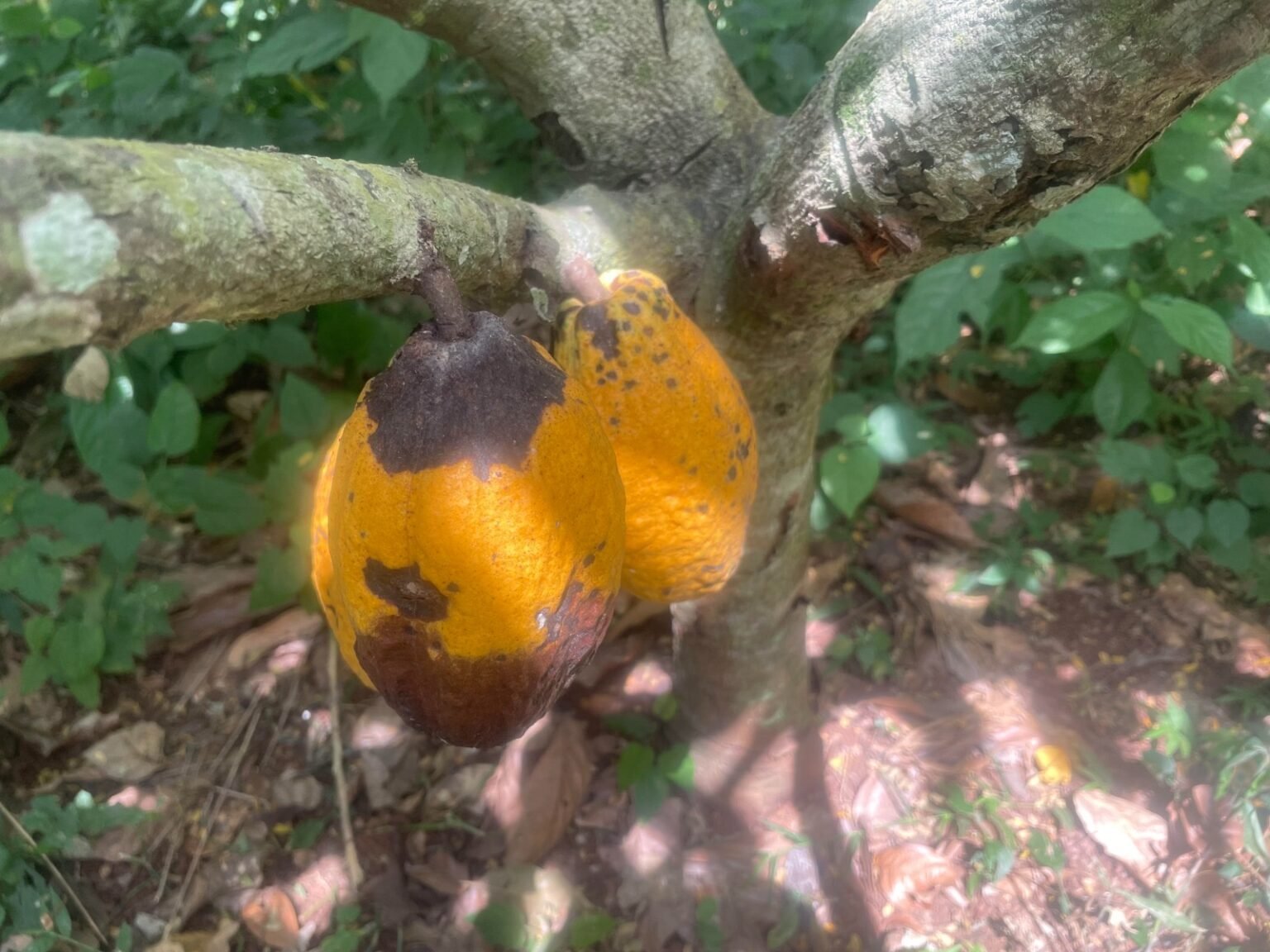
At Jumapo, a farming community in Ghana’s eastern region, 69-year-old cocoa farmer Agya Manu walked through his one-acre farm, where discolored leaves, swollen stems and blackened, rotting pods hang among the trees.
Manu has grown cocoa for nearly 30 years. But unpredictable weather has made it increasingly difficult to know when to plant and what to expect at harvest.
“Years ago, predicting the weather was easy. We knew when to expect the rains. But now, when you plant your cocoa, you can’t tell when the rains will come. And when the heat becomes too intense, it brings pests and diseases. It’s not easy at all,” he said.
His experience reflects a growing challenge for Ghana’s cocoa industry, which supports millions of livelihoods and generates billions of dollars in export revenue.
It also highlights the pressures facing African countries as they prepare for COP31, the United Nations climate change conference scheduled for Nov. 9–20 in Antalya, Turkey. African negotiators want greater access to climate finance, technology and support to help communities adapt without compromising their development ambitions.
Ghana is the world’s second-largest cocoa producer after neighboring Côte d’Ivoire. Together, the two countries supply more than 60% of the world’s cocoa, making them central to the global chocolate industry.
Ghana earned more than $3 billion from cocoa in 2025, according to the country’s central bank. But changing weather patterns and crop diseases threaten the livelihoods that sustain the industry.
Cocoa trees need suitable temperatures and adequate moisture. Prolonged dry spells can stress trees and reduce yields, while excessive moisture can encourage diseases such as black pod disease.
Manu has watched his own production fall sharply. Five years ago, he harvested about 12 bags of cocoa beans each season. Now, he struggles to produce even five.
“Nowadays, you can work on your farm throughout the year, spend money on labor and fertilizer, and still harvest very little because the weather has not been favorable. It is painful because cocoa is what we depend on to feed our families,” he said.
Ghana’s cocoa production outlook remains under pressure. The projected harvest for the 2026/2027 crop season is 650,000 tonnes, down from 750,000 tonnes in the previous season.
Farmers need help to adapt
A few kilometers from Manu’s farm, 72-year-old Afia Kwartemaa sorts dry cocoa beans spread across a mat in the open sun.
She has been involved in the cocoa business for more than 45 years. Swollen shoot disease, she said, has destroyed more than a quarter of her farm.
“The pests and diseases are really taking a toll. If the rains continue to change like this and the heat keeps increasing, I am really worried about whether our children will be able to inherit cocoa farming and sustain the industry,” she said.
Adapting to these conditions requires investment at a time when falling harvests are leaving many farmers with less money to spend.
Experts say possible measures include planting more resilient cocoa varieties, improving soil management, controlling pests and diseases, and managing water more effectively. Agroforestry, which involves growing cocoa alongside selected shade trees and other crops, can also help moderate temperatures around cocoa trees.
But farmers need affordable seedlings, agricultural advice, reliable climate information and access to finance to adopt these practices.
Ghana’s Minister of State responsible for Climate Change and Sustainability, Baba Issifu Seidu, said the country could not meet its climate financing needs alone.
“Ghana requires about $22.6 billion to take care of our climate needs. We cannot raise it by ourselves. We need strategic partners to be able to do that,” he said.
The funding gap reflects a wider challenge across Africa, where governments need substantial resources to strengthen agriculture, protect communities from floods and droughts, improve infrastructure and expand access to energy.
The African Development Bank estimates that the continent needs more than $3 trillion dollars by 2030 to effectively implement its national climate plans.
The consequences of insufficient support are already visible. In 2025, extreme weather and climate-related events affected at least 13 million people across Africa and killed more than 3,000, according to the World Meteorological Organization.
Africa wants climate pledges delivered
At COP31, African negotiators will press developed countries to honour their commitments and make climate finance more accessible.
A central concern is the reliance on loans to fund adaptation. African countries argue that vulnerable developing nations should not have to accumulate more debt to respond to a crisis they contributed relatively little to creating.
Dr. Antwi-Boasiako Amoah, chair of the African Group of Negotiators, said borrowing to finance climate adaptation could worsen the debt burdens of countries already facing economic pressures.
“You cannot go and take loans that are going to increase the debt burden of developing countries that are already struggling to address climate change adaptation, something they did not cause,” he said.
Amoah said the negotiations must also establish a clear pathway towards replenishing the Green Climate Fund and the Loss and Damage Fund, which support countries and communities dealing with climate impacts.
“We want to see at COP31 readiness by these parties that they are willing to send money to replenish these two main funds, so that money will flow to the communities that we are talking about. That is the assurance that we are expecting,” he said.
Climate finance is also central to Africa’s efforts to expand energy access while moving towards cleaner energy systems.
African governments and climate advocates want international agreements to recognize the continent’s development needs and allow countries to pursue the energy transition at a pace suited to their economic circumstances.
Philip Kilonzo, who leads policy and communication work at the Pan-African Climate Justice Alliance, said the transition must account for the different challenges facing African countries.
“We need a transition that is just, fair, and inclusive, meaning that African countries must be allowed to develop at their own pace, taking into consideration their special needs, special circumstances under which they are in,” he said.
More than 560 million people in sub-Saharan Africa lack access to electricity, while 970 million lack access to clean cooking energy, according to the United Nations.
Closing these gaps will require investment in electricity infrastructure, affordable technologies and cleaner energy sources, including solar and wind power.
Although Africa has substantial renewable energy potential, developing it at scale requires financing, technical expertise, infrastructure and access to equipment.
Kilonzo said control over renewable energy technologies remained a major concern.
“Who is controlling the technology? It’s so clear that there are technologies that can now enable us to tap on these renewable resources, but these technologies are held by countries and institutions that are unwilling to support Africa,” he said.
His concerns reflect a wider debate over technology transfer and the terms on which developing countries can access the tools needed to build cleaner energy systems.
For African countries, the transition is also about expanding electricity access, creating jobs, developing industries and ensuring climate action does not deepen existing inequalities.
What COP31 must deliver
As COP31 approaches, African negotiators are seeking tangible progress on long-standing priorities, including adaptation support, accessible climate finance, technology transfer and a fair energy transition. They also want greater support for communities suffering losses and damage from climate impacts that cannot be fully avoided through mitigation or adaptation.
The African Union has reiterated these priorities, stressing the need to match international commitments with resources and implementation.
But the Antalya negotiations will take place amid geopolitical tensions that threaten to push climate action down the global agenda. The war involving Iran, disruptions to energy markets, trade rivalries and rising defense spending are intensifying competition for public resources. The United States’ retreat from international climate diplomacy has also complicated efforts to sustain global leadership.
The mid-year UN climate talks in Bonn exposed persistent divisions between developed and developing countries over climate finance. Disagreements over adaptation funding and the wording of financial commitments highlighted the lack of trust that African negotiators say must be addressed before meaningful progress can be achieved.
With Ethiopia scheduled to host COP32 in 2027, African advocates say progress must begin in Antalya rather than be postponed to another summit.
Back in Jumapo, Manu faces another growing season uncertain about when the rains will come and how much cocoa he will harvest.
For him, the success of COP31 will come down to whether decisions made thousands of kilometres away can help farmers like him sustain their livelihoods — and whether the next generation can still find a future in cocoa farming.
By Ridwan Karim Dini-Osman