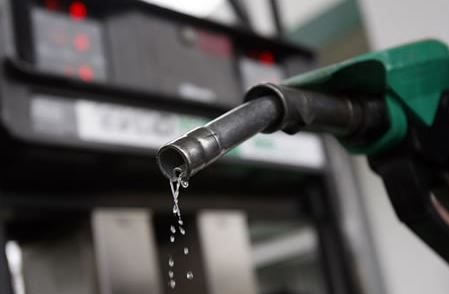
The Chamber of Oil Marketing Companies (COMAC) has projected a marginal decline in fuel prices at the pump, citing a dip in crude oil prices on the international market and recent exchange rate movements.
Dr. Riverson Oppong, CEO of COMAC, stated that the price adjustments will see petrol decrease by 0.6%, diesel by 0.3%, and LPG by 0.3% in the upcoming pricing window.
“We have seen a slight drop in crude oil prices from $76.86 per barrel to $75.49 per barrel, representing a 1.32% decrease,” Dr. Oppong explained. “Most refined product prices have followed this downward trend, with petrol prices falling by 1.1% and LPG by 1.42%. However, diesel recorded an increase of 2.47%, making it the only product to experience a price rise.”
The Ghanaian cedi continues to experience slight depreciation against the US dollar. Data from COMAC indicates that as of February 14, 2025, the forex rate stood at GHS 15.4244 per USD, rising to GHS 15.5793 per USD by February 21, 2025, reflecting a 0.99% depreciation.
Dr. Oppong attributed the currency depreciation to global economic conditions, particularly trade uncertainties.
“The exchange rate remains one of the biggest cost drivers for fuel prices in Ghana,” he noted. “While the depreciation has been moderate, it still impacts the pricing structure of petroleum products.”
He further explained that oil prices have hit a new low for the year, partly due to conflicting trade announcements from US President Donald Trump.
“There’s a lot of uncertainty in the global oil market, especially with the ongoing U.S.-China trade tensions and potential geopolitical shifts in the Middle East and Russia,” he said. “These factors affect crude oil demand and, consequently, fuel prices in Ghana.”
Additionally, the American Petroleum Institute (API) reported a 3.34-million-barrel increase in US crude oil inventories, surpassing analyst expectations. Meanwhile, OPEC+ is expected to ease production cuts by 2.2 million barrels per day between April 2025 and September 2026, with the Asia-Pacific region,led by China and India, driving demand.
Despite the expected decrease in pump prices, Dr. Oppong raised concerns over diesel availability in the local market, noting signs of a potential shortage.
“Even as we speak today, there is somewhat of a diesel shortage in the market,” he cautioned. “This is something we are closely monitoring because supply disruptions could offset any expected price reductions.”
Some industry players believe the price reductions, though marginal, will provide some relief for consumers. However, others argue that taxes and levies on petroleum products continue to keep prices relatively high.
A leading fuel retailer, speaking on condition of anonymity, said:
“The price adjustments are welcome, but we need to have a broader conversation on the taxes and levies that make up a large portion of fuel prices. The government must look at long-term measures to ease the burden on consumers.”
A commercial driver at a major transport hub in Accra, Kwame Mensah, expressed mixed feelings about the price changes:
“Any reduction is better than nothing, but 0.6% or 0.3% is not much when we are already struggling with high transport fares. The government should intervene more aggressively.”
COMAC’s latest report highlights that taxes, levies, and regulatory margins account for 21% of fuel prices, while marketers and dealers take 5%, and the ex-refinery price makes up 74%. Among the key taxes influencing prices are:
• Energy Debt Recovery Levy: GHS 0.49 per liter (petrol and diesel)
• Road Fund Levy: GHS 0.48 per liter • Special Petroleum Tax: GHS 0.46 per liter
• UPPF (Uniform Price Policy Fund): GHS 0.90 per liter
Projected Prices at the Pump (1st – 15th March 2025)
• Petrol: GHS 15.60 per liter (down 0.6%)
• Diesel: GHS 15.80 per liter (down 0.3%)
• LPG: GHS 18.05 per kg (down 0.3%)
While the marginal reductions are expected to bring some relief to consumers, industry analysts caution that fluctuations in crude oil prices and exchange rates could still influence pricing trends in the coming weeks.
The new pricing window takes effect March 1, 2025.