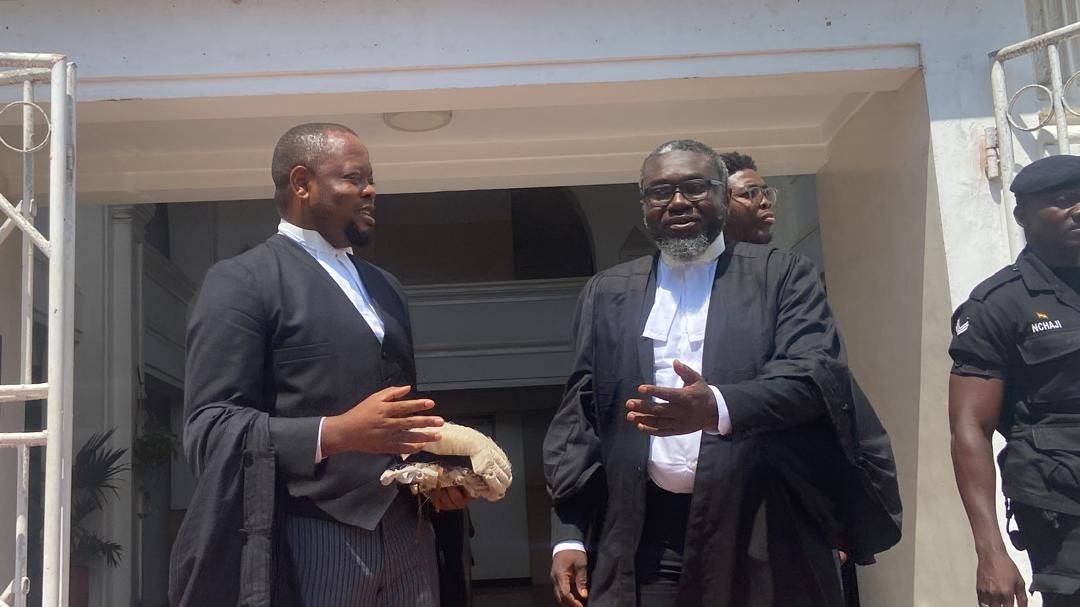
The Supreme Court has set timelines for both the Attorney General and the plaintiff, Democracy Hub, to file their written submissions in a case challenging the government over an alleged “secret Memorandum of Understanding (MOU) with the United States of America on the deportation of West African nationals.”
Per the timeline set by the Apex Court panel of five, presided over by Justice Gabriel Scott Pwamang, both the Applicant and the AG are to file their submissions relating to the plaintiff’s application for discovery simultaneously within one week from Wednesday.
The panel, which also includes Justices Ernest Gaewu, Richard Adjei-Frimpong, Senyo Dzamefe, and Hafisata Amaleboba, said the Court will deliver a ruling on November 26, 2025, on the application for discovery before considering the Injunction.
Deputy Attorney General, Dr. Justice Srem-Sai, had indicated that the State is uncertain about the nature of requests before the Court by the applicant, a view echoed by the Court.
Oliver Barker-Vormawor said they had two applications – one for discovery and the other for an interlocutory injunction, highlighting the urgency of the matter.
The Court noted that the processes before it had not assisted the Court on the matter, hence the order to file written submissions to assist the Court.
Background
Civil society organisation, Democracy Hub, jad dragged the Government of Ghana to the Supreme Court over what it described as an unconstitutional and secret Memorandum of Understanding (MOU) with the United States of America on the deportation of West African nationals.
The group, through its lawyers Merton & Everett LLP, argued that the agreement violates the 1992 Constitution and Ghana’s obligations under international law, including the 1951 Refugee Convention, the Convention Against Torture, and the OAU Refugee Convention.
Filed on October 13, 2025, the suit seeks 28 reliefs, including a declaration that the MOU is unconstitutional and an order restraining government from implementing it.
The group maintains that the agreement required parliamentary ratification under Article 75(2) but was secretly concluded without it, making it null and void.
Democracy Hub contends that, under the arrangement, 42 individuals have already been involuntarily repatriated into Ghana from the United States and detained under armed military custody at the Bundase Military Training Camp.
The detainees were allegedly held for weeks without charge, access to lawyers, or basic facilities.
The group insists that detaining civilians and asylum seekers in a military facility is a gross violation of Articles 14, 15, and 19 of the Constitution, which guarantee liberty, human dignity, and fair trial rights. It described the treatment of the deportees as “inhumane and degrading.”
Democracy Hub further argues that the MOU makes Ghana complicit in ‘chain refoulement’, a process where refugees are indirectly returned to danger through a third country, contrary to peremptory norms of international law known as jus cogens.
READ: AG to parade four witnesses in Wontumi-Akonta Mining case over galamsey
The organization maintains that even if Parliament were to ratify the deal, it would still be unconstitutional, as the Constitution does not allow Ghana to enter into agreements that violate fundamental human rights or international law.
“The Constitution is not a suicide pact. No government has the authority to secretly contract Ghana out of its human rights obligations,” the group said in its statement.
Democracy Hub says the legal action is aimed at protecting not only the individuals affected but also Ghana’s democratic integrity, constitutional supremacy, and reputation as a state governed by the rule of law.
Source: Starrfm.com.gh