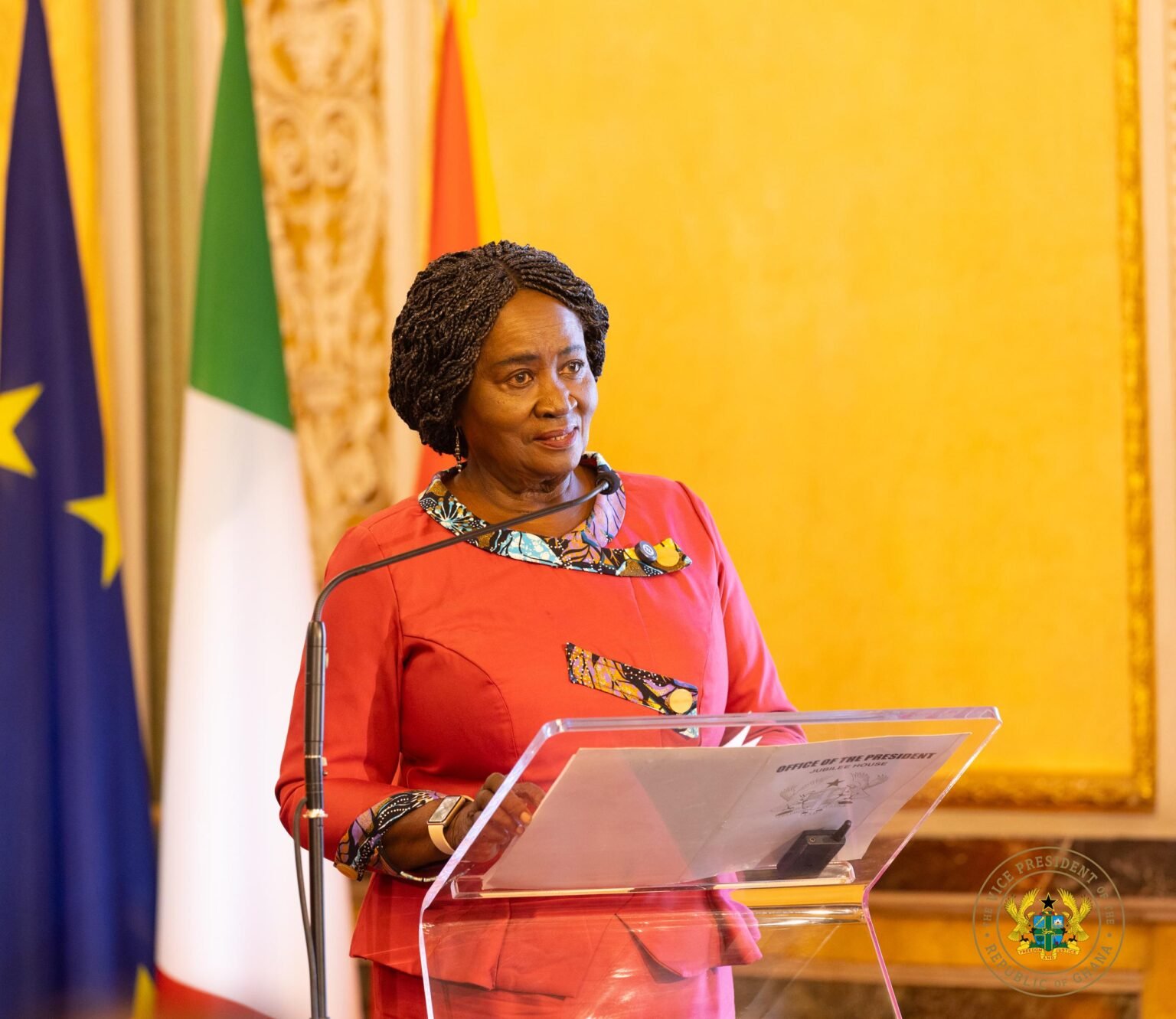
Vice-President Professor Naana Jane Opoku-Agyemang has reiterated that agriculture remains the cornerstone of Ghana’s job creation strategy under President Mahama’s 24-Hour Economy framework.
Speaking at the Africa Growth and Opportunity – Research in Action (AGORA) Conference in Palermo, Prof. Opoku-Agyemang said agriculture continues to be the largest source of livelihoods in Ghana and must therefore be transformed to become more productive and profitable.
“Feed Ghana builds on a simple idea: that the farm gate should no longer be the end of value creation,” she stated, highlighting that government is expanding irrigation networks, rehabilitating small dams, and investing in storage and processing hubs such as the Tamale Agro-Industrial Park in the north and the Nsawam corridor in the south.
According to the Vice President, the programme “places strong emphasis on women and youth,” with thousands being supported across key value chains to enhance productivity and income generation.
READ: Mahama’s 24-Hour Economy to drive inclusive growth and jobs – Naana Jane
Turning attention to cocoa, Prof. Opoku-Agyemang said Ghana is determined to move from “raw exports to refined opportunity.”
“Our goal is clear: by 2030, Ghana aims to process at least half of her cocoa locally, thus generating thousands of skilled and semi-skilled jobs,” she declared.
She further noted that through the Living Income Differential mechanism, “farmers themselves share in the value chain’s success,” adding that “Cocoa is not just an export for us; it is an ecosystem that now employs engineers, logistics workers, marketers, and packaging designers.”
In a related development, Minister for Finance Dr. Cassiel Ato Forson has announced an upward adjustment in the producer price of cocoa, increasing the price by GH¢400 per bag.
The new price, which rises from GH¢3,228 to GH¢3,628 per bag, was agreed upon after consultations between the Ministry of Finance and the Producer Price Committee of Cocoa at an emergency meeting in Accra.
Dr. Forson said the increment was necessary “to ensure Ghana remains competitive with neighbouring Ivory Coast while reflecting recent shifts in the economy.”
Source: Starrfm.com.gh