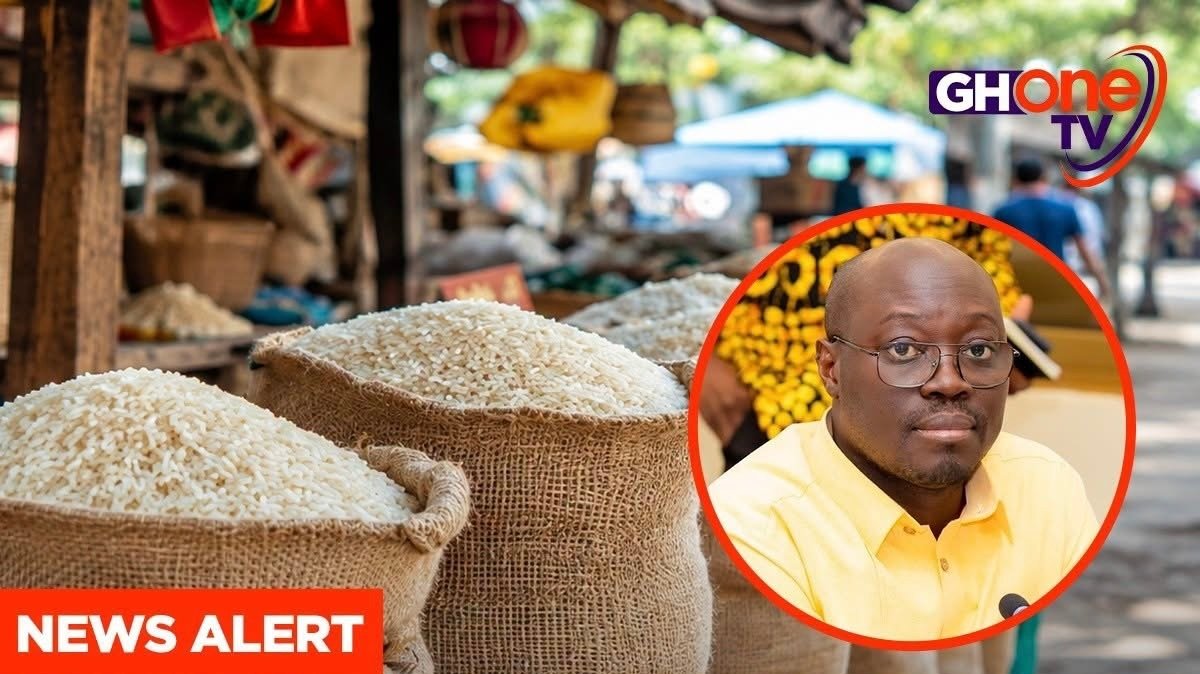
Government will prohibit commercial rice imports into Ghana by 2030 as part of measures to boost local production and reduce the country’s dependence on imported food, Finance Minister Dr Cassiel Ato Forson has announced.
Presenting the 2027 Budget Statement and Economic Policy to Parliament on Thursday, November 12, 2026, Dr Forson said the government would progressively restrict rice imports while strengthening the capacity of local farmers and millers to meet domestic demand.
He announced that, beginning in 2027, rice import licences would be tied to purchases from verified Ghanaian farmers and millers, with the proportion of locally sourced rice increasing as domestic production expands.
“The local-purchase ratio will rise as domestic output expands and import quotas decline,” he told Parliament.
“Commercial rice imports will be prohibited by 2030,” he added.
Dr Forson said the planned restriction would be supported by investments in domestic rice production, milling, storage, quality assurance and distribution to ensure that locally produced rice could meet the country’s requirements.
As part of the strategy, government will establish Rice Development Hubs in Afram Plains, the Volta Basin, Western Ghana and Northern Ghana to organise production around irrigation, mechanisation, silos, modern mills, packaging and logistics.
The hubs are expected to bring an additional 100,000 hectares under rice cultivation, with targeted yields of between five and six metric tonnes per hectare. They are also projected to support approximately 125,000 jobs.
Government will provide targeted tax incentives for investments in irrigation, mechanisation, silos, modern mills, packaging and logistics to lower investment costs, reduce post-harvest losses and improve the competitiveness of locally produced rice.
The Finance Minister also announced plans to amend public procurement laws to require schools, hospitals and other public institutions to purchase only foodstuff grown in Ghana using public funds.
He said the measure would provide a reliable market for local farmers while ensuring that public expenditure supports domestic production and job creation.
“If you spend their money to put rice on the table, that rice must come from their farms,” he said.
Dr Forson further emphasised the government’s intention to ensure that local production benefits farmers, processors and other businesses across the rice value chain.
“The rice on a Ghanaian table should increasingly come from a Ghanaian field, pass through a Ghanaian mill and support Ghanaian work,” he stated.
The rice import restriction forms part of government’s US$3 billion Commercial Agriculture pillar under its broader economic transformation programme, which seeks to increase domestic food production, strengthen agro-processing, create jobs and reduce dependence on imports.