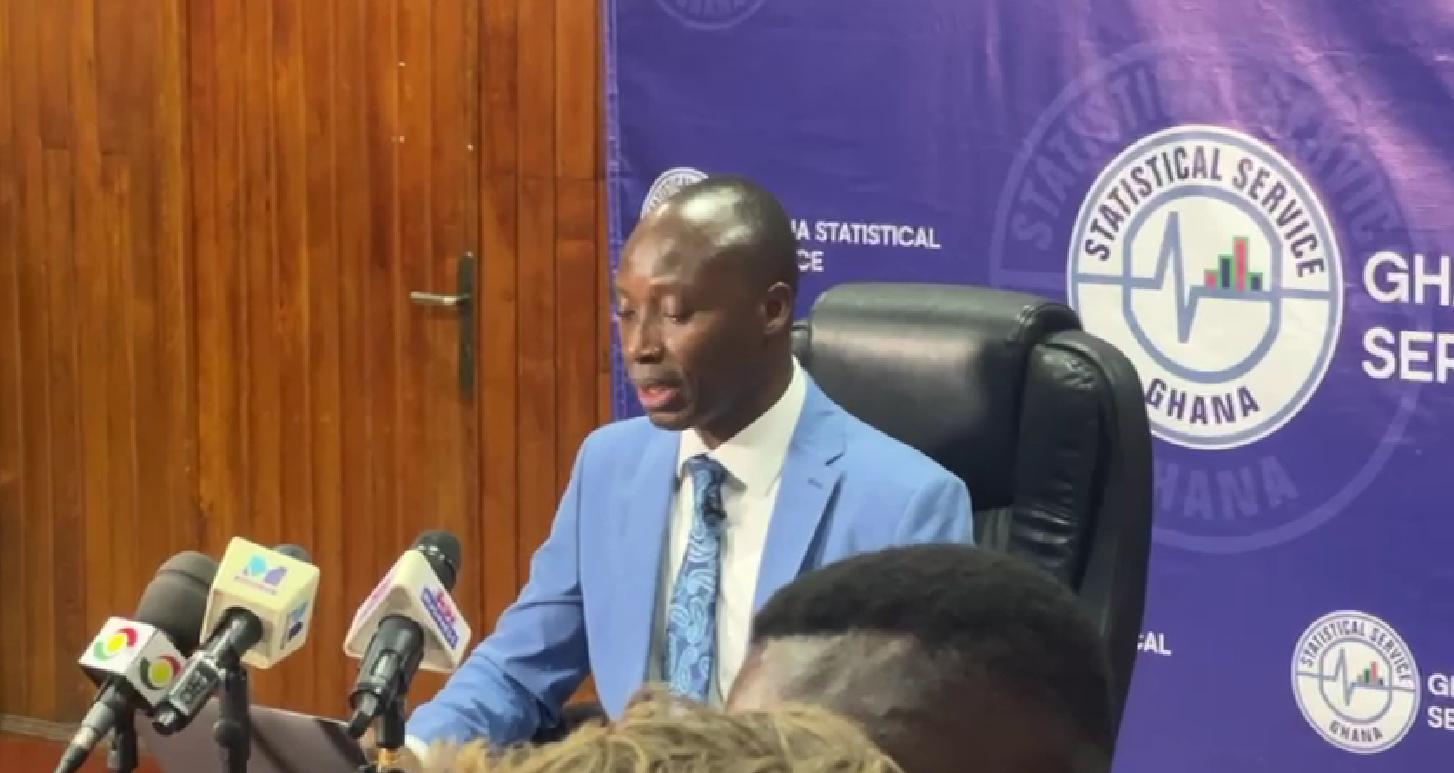
Ghana’s economy expanded by 4.5 percent in July 2025, according to the maiden release of the Monthly Indicator of Economic Growth (MIEG) by the Ghana Statistical Service (GSS).
The new index, unveiled at a press conference in Accra, provides the country’s first-ever monthly snapshot of economic activity, designed to deliver real-time insights into growth trends.
Speaking at the event, Government Statistician Dr. Alhassan Iddrisu described the launch as “a major milestone in Ghana’s statistical development,” noting that, for the first time in history, the economy will be tracked monthly rather than quarterly or annually.
“The MIEG offers the earliest glimpse of how our economy is performing in near real time,” he said. “It complements the quarterly GDP and gives policymakers faster evidence-based signals to guide decisions.”
According to Dr. Iddrisu, the MIEG for July 2025 stands at 110.2, compared to 105.4 in July 2024, reflecting year-on-year growth of 4.5 percent.
While the data confirms continued expansion, it also points to a slowdown from the 8.3 percent growth recorded in July 2024.
“In plain language, Ghana’s economy in July 2025 was 4.5 percent larger than it was a year ago, he explained, adding that a clearer trend would emerge when the official third-quarter GDP is released in December.
The Statistician attributed the slower pace of growth to reduced activity in key sectors.
“The below-trend growth in July mainly reflects lower output in the petroleum sector as well as slower activity in accommodation, food services, health, and manufacturing,” Dr. Iddrisu stated.
“Across the broader economy, the industry sector has shown the most visible slowdown this year.”
Breaking down the data, he noted that agriculture grew by 8 percent, industry by 0.1 percent, and services by 6.4 percent.
“The services sector contributed the most to the overall growth, accounting for 2.6 percentage points of the total 4.5 percent, followed by agriculture with 1.7 percentage points,” he detailed.
“This clearly shows that services and agriculture remain the main engines of Ghana’s economic expansion.”
Dr. Iddrisu stressed that the MIEG will play a crucial role in supporting key government programmes such as the 24-hour economy, Big Push infrastructure, and Agriculture for Economic Transformation initiatives.
“Timely and frequent data on how our economy performs has never been more important,” he said. “The MIEG is a breakthrough for Ghana—it helps us see, month by month, what’s driving growth or decline.”
He also acknowledged the technical and institutional partners who supported the project, including the UK Office of National Statistics, the International Monetary Fund (IMF), and the ODI Fellowship Scheme.
“We are deeply grateful for the collaboration that led to this achievement,” he said, commending the GSS technical team for developing the indicator.
Dr. Iddrisu reaffirmed GSS’s commitment to transparency and continuous improvement in data production.
“The goal is to give Ghana timely, transparent and reliable economic information so decisions at every level are guided by the best possible evidence,” he said.
“The MIEG marks a new chapter in how we measure and understand our economy.”
Source: Starrfm.com.gh