MultiChoice Ghana has denied agreeing to reduce DStv subscription prices, contradicting claims by Minister of Communication, Digital Technology and Innovation, Sam George.
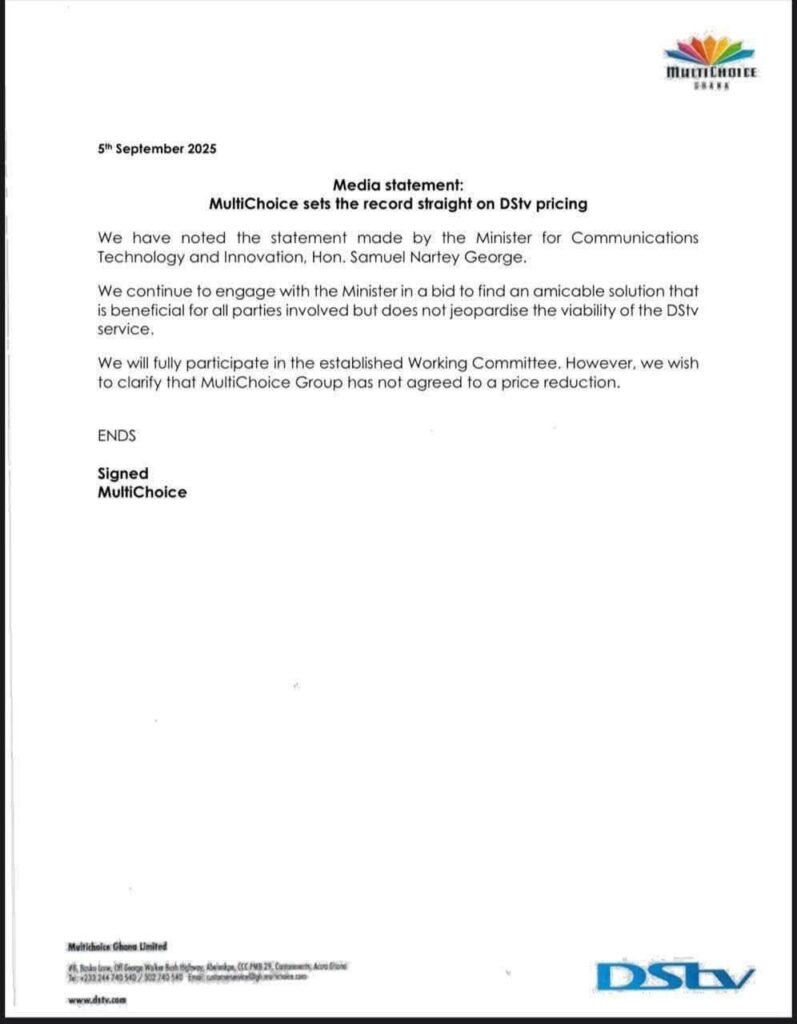
In a press statement issued on Friday, September 5, MultiChoice said while it remains committed to dialogue, it has not signed off on any price reduction.
“We continue to engage with the Minister in a bid to find an amicable solution that is beneficial for all parties involved but does not jeopardise the viability of the DStv service. We will fully participate in the established Working Committee. However, we wish to clarify that MultiChoice Group has not agreed to a price reduction,” the company stated.
Earlier that day, Sam George had told reporters that MultiChoice had accepted a reduction in principle, with the only issue left being the percentage. He explained that a committee, comprising representatives from the Ministry, the National Communications Authority (NCA), MultiChoice Ghana, and MultiChoice Africa, would finalize the decision within 14 days, despite the company’s request for a 30-day period.
READ: DStv agrees to reduce subscription prices after talks
The dispute over DStv pricing has been brewing for months. MultiChoice announced increase in its subscription packages, citing inflation, cedi depreciation, and rising operational costs. Some packages rose by nearly 20 percent, sparking public outrage.
The Ministry of Communication responded by directing the company to cut its tariffs by 30 percent, a directive MultiChoice rejected as “untenable.” The firm warned that such a move could undermine service delivery and affect jobs. Instead, it proposed freezing current tariffs and suspending remittances to its parent company in South Africa; an offer the Ministry dismissed.
On August 7, 2025, the NCA issued a suspension notice under the Electronic Communications Act, demanding compliance within 30 days or risk of license withdrawal. In addition, MultiChoice was fined GHS 10,000 daily for failing to submit a breakdown of its operational costs, with the fines accumulating to over GHS 150,000 by early September.
The standoff has since become a major public issue, with many Ghanaians accusing the company of exploiting its dominant position in the pay-TV market, while others see it as a critical test of government’s ability to protect consumers.
Below is a copy of the statement:
Source: Starrfm.com.gh