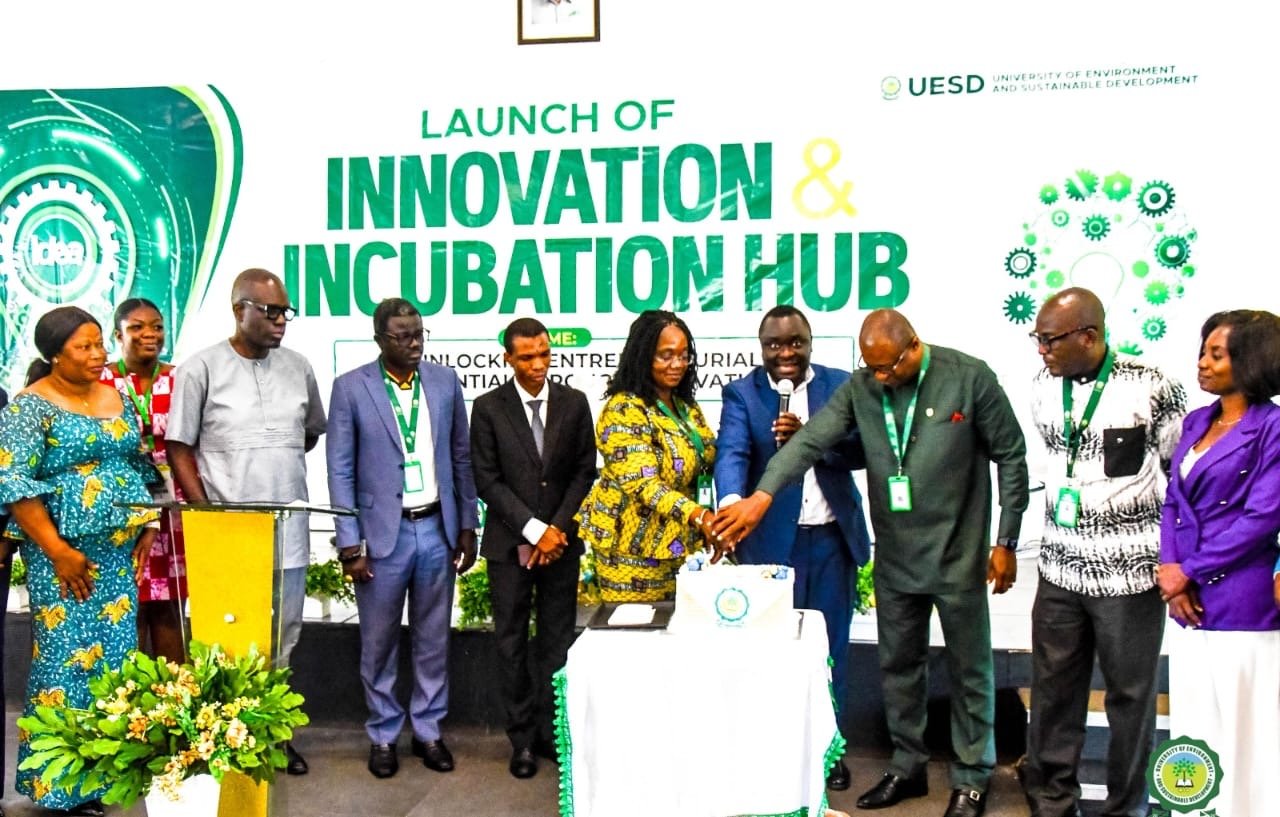
The University of Environment and Sustainable Development (UESD) has officially launched its Innovation and Incubation Hub to develop and shape problem solving ideas of students into a viable entreprenurial ventures to reduce the high rate of graduate unemployment.
Nearly 60% of about 300,000 graduates entering the labor market each year fail to secure durable employment,according to data from the Ghana Statistical Service (GSS).
This small absorption of skilled labor continue to increase the high youth unemployment levels. In 2025, the GSS recorded an unemployment rate of 32% among Ghanaians aged 15 to 24.
The launch of the UESD Innovation and Incubation Hub held at the University’s Multipurpose Auditorium, brought together members of the university community, development partners, industry players and entrepreneurship advocates to share ideas on how the platform can be designed to transform innovative ideas into reality.

Launching the program, the Hub Coordinator and lecturer at the Department of Applied Economics, Dr. Kwaku Adu, said the initiative was created to support young innovators in developing solutions to national challenges rather than focusing solely on financial gains.
Dr. Adu disclosed that the Hub is currently mentoring more than 100 students and supporting over 100 innovative ideas aimed at creating employment opportunities and reducing dependence on imports.
“One thing we’ve realized is that most of this young generation prefers to look for money instead of solving problems. They feel that after getting the money, the money will be able to help them solve these challenges. But that is not the case.So those who have the ideas, they start. And the moment they start, you realize that within the next few months, next few years, they’ve collapsed their business all because they lack the entrepreneur spirit”.
He contimued “So what we have done is to bring all of these students on board, give them entrepreneurship training so that they will be able to inculcate that into whatever innovation, innovative activity they have.With this, they will be able to solve problems. And in solving problems, money will rather follow them instead of chasing money. We’ll be able to solve a problem in a society, then money will obviously follow them”.
According to him, while government’s Student Entrepreneurship and Enterprise Development (SEED) programme provides seed capital support, additional investment is needed to bridge the gap between academia and industry.He called on the private sector to partner the university to invest in brilliant entreprenurial ideas incubated to help contribute to economic growth and job creation.
“Here is the case, as a country, there are no jobs.Even in the private sector, the jobs are limited. But if these students are able to solve one problem or the other, are able to innovate, they are able to create jobs. And in creating jobs, we will not import.Our import bills are going to come down. And when we bring down the import bill, we are giving jobs to the people, not jobs to people outside or beyond the borders of this country. So this is one reason why as a university hub, we are launching this particular hub today” He said.
Delivering the keynote address, Professor George Acheampong of the University of Ghana Innovation Hub and Executive Secretary of the Think Network emphasised the need for a stronger innovation ecosystem to nurture young entrepreneurs.
He noted that Ghana possesses abundant talent but lacks the coordinated support systems needed to help innovators access technical expertise, financing and collaborative opportunities.

Professor Acheampong encouraged students to begin entrepreneurial activities while still in school to minimise risks and take advantage of available mentorship opportunities.
“What is missing is the ecosystem that supports them.
And to be honest, the NEIP is working with universities. Eric Adjei and his team are working with the universities . So you will see that they brought us into the dream era and together we are launching something called the SEED- Student Entrepreneurship and Enterprise Development Program and it’s still being run by universities and higher education”
He added “So now what we are looking to do is to build an ecosystem so that when you’re a young man you don’t need to know anybody to succeed. The ecosystem has been set for you so you know where to find technical support, you know how to get financial support, you know where to get collaborators to work with. That’s all that matters” Prof.Acheampong opined.
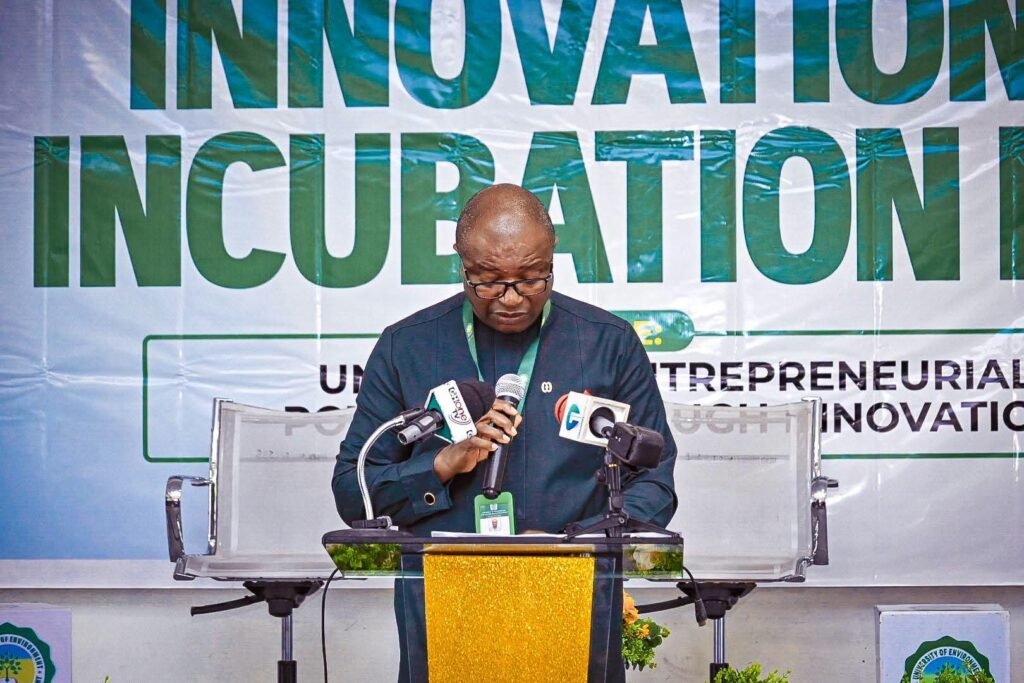
Chairman of the event and Vice-Chancellor of UESD, Professor Eric Nyarko-Sampson, described the launch as a defining moment in the university’s history.
He said the initiative aligns with UESD’s vision of producing graduates who become job creators rather than job seekers.
The UESD Innovation and Incubation Hub is expected to serve as a platform for developing sustainable business solutions and strengthening entrepreneurship among students and the larger society.
The hub has already chopped some successes with Eastside Sankofa Industries, a student-led venture from the University of Environment and Sustainable Development (UESD) Innovation and Incubation Hub, which recently emerged as the winner of the Nkabom Africa Case Competition, securing a top prize of CAD 10,000.
The students impressed judges with a systems-driven solution that addresses both food waste and poor diet diversity. By converting surplus mangoes into nutritious, shelf-stable products for schools, the team demonstrated a scalable model that connects farmers, processors, and educational institutions within a unified value chain.
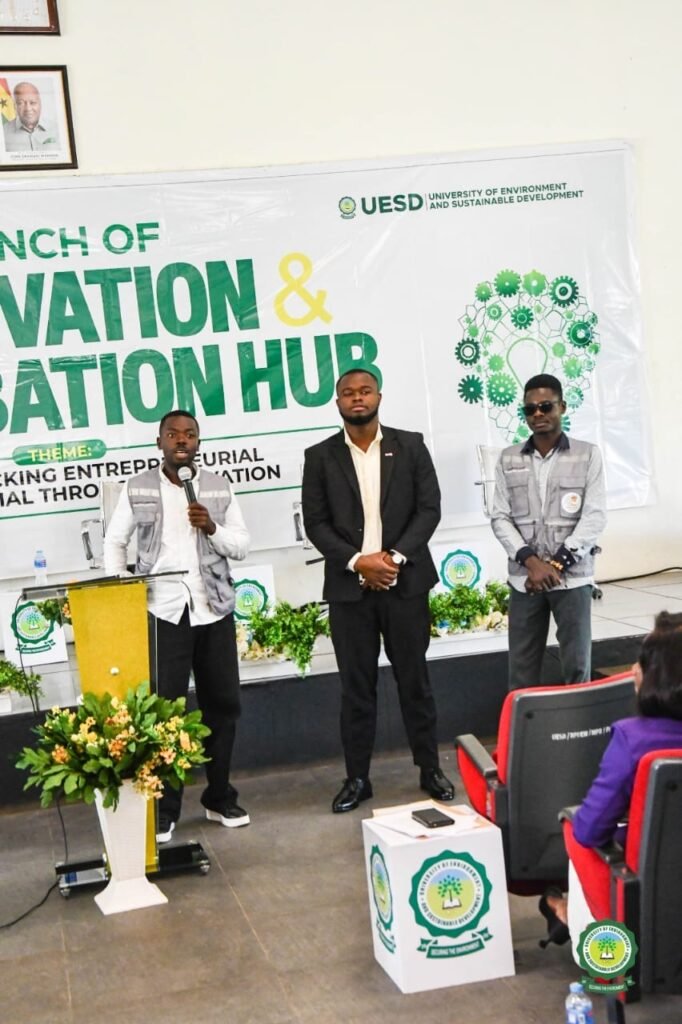
Eastside Sankofa Industries’ flagship products include Mango Bites, a high-fibre, ready-to eat snack designed for school feeding programmes, and Mango Juice, a nutrient-rich beverage that supports child nutrition and hydration. The model leverages low-energy processing and local aggregation systems to reduce post-harvest losses while improving access to nutritious food for schoolchildren.
Source: Starrfm.com.gh