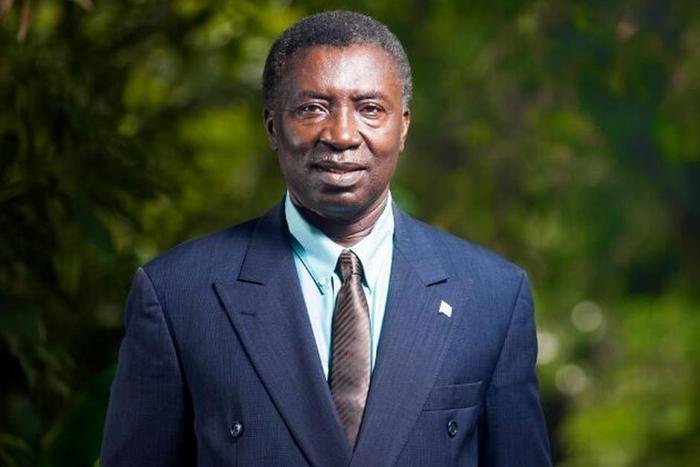
Cardiothoracic Surgeon and Former Environment, Science, Technology and Innovation Minister, Professor Kwabena Frimpong-Boateng, says Ghana is not at a crossroads in its environmental management but is instead stuck on a “roundabout”, repeatedly confronting the same problems without sustaining the solutions needed to address them.
According to him, the country has spent decades identifying its environmental challenges and developing policies and interventions to address them, yet successive administrations have often failed to sustain those measures.
He made the remarks while delivering a keynote lecture at the Fourth Annual Colloquium of the Department of Political Science Education at the University of Education, Winneba.
Prof. Frimpong-Boateng argued that Ghana’s environmental challenges are not primarily the result of a lack of knowledge, insisting that the country has known about many of its environmental problems for decades.
He said the real challenge lies in the country’s inability to consistently act on what it already knows.
“Ghana is not at a crossroads,” he said. “We are on a roundabout.”
He explained that the metaphor reflects a country that repeatedly reaches points where decisions and interventions are required, only to return to familiar problems because policies and systems are not sustained.
Environmental crisis is political
Prof. Frimpong-Boateng said Ghana’s environmental crisis should be understood largely as a political problem rather than a technical one.
He noted that the country has had sufficient knowledge of environmental degradation, illegal mining, deforestation, pollution and other threats for many years.
The challenge, he argued, is translating that knowledge into sustained political action.
He said environmental enforcement often carries an immediate political cost for the person or institution enforcing the law, while the consequences of failing to enforce environmental regulations are often delayed and less politically visible.
“The political cost of enforcing environmental law falls on the enforcer, political cost of not enforcing it falls on nobody,” he said.
This, he suggested, creates a structural incentive for governments and political actors to avoid difficult environmental decisions whose benefits may only become apparent over a longer period.
Four-year politics versus ecological time
Prof. Frimpong-Boateng said one of the fundamental difficulties in environmental governance is the mismatch between Ghana’s political cycle and the time required for environmental policies to produce results.
While political administrations operate within relatively short electoral horizons, rivers, forests, wetlands and ecosystems respond over much longer periods.
He therefore cautioned that policies designed to protect the environment can easily become vulnerable to changes in political administration.
“Rivers do not vote,” he said, stressing that environmental protection must be approached as a long-term national responsibility rather than an issue tied to the fortunes of individual governments.
Operation Vanguard as an example
Using Ghana’s fight against illegal mining as an example, Prof. Frimpong-Boateng said the country had previously demonstrated that sustained intervention could produce results.
He recalled the establishment of Operation Vanguard in July 2017, involving about 400 military and police personnel deployed to parts of the Eastern, Ashanti and Western regions.
According to him, the intervention produced measurable improvements, including a reduction in turbidity, lower water treatment costs and the recovery of some water bodies.
He said the Pra River, for instance, began running clear, while fishermen reported improvements in fish catches.
However, he argued that Ghana failed to sustain the gains made.
‘We built an architecture and abandoned it’
Prof. Frimpong-Boateng said the country subsequently developed a broader system to tackle illegal mining, describing it as an “architecture” that was built over about 20 months.
The measures included the establishment of 72 District Committees on Illegal Mining, training of miners in sustainable mining practices, mapping and verification of small-scale mining concessions, the development of an electronic licensing system and the tracking of earth-moving equipment.
Other measures included alternative livelihood programmes, efforts towards mercury-free gold processing, satellite and drone monitoring, and reforms intended to strengthen oversight of small-scale mining.
He said the system was developed between April 2017 and December 2018, but many of its conditions and mechanisms were subsequently abandoned.
Prof. Frimpong-Boateng said the lifting of the moratorium on artisanal and small-scale mining survived, but the architecture created to regulate the sector did not.
He described this pattern as a form of policy abandonment in which systems gradually cease to function without any formal decision being taken to repeal them.
The cost of abandonment
For Prof. Frimpong-Boateng, this cycle of creating policies, implementing them and eventually allowing them to lapse is at the heart of Ghana’s environmental governance problem.
He proposed the establishment of a National Environmental Compact, negotiated across political parties and ratified by Parliament, to prevent governments from simply abandoning critical environmental commitments.
Under his proposal, a government seeking to discontinue a commitment would have to report to Parliament, identify the decision-maker and explain the grounds for the change.
He argued that such a system would make policy abandonment more difficult and costly.
“Abandonment in Ghana is currently free. Make it merely expensive,” he said.
Prof. Frimpong-Boateng also called for personal liability for permits issued on protected wetlands, watercourses, drainage systems and forest reserves, alongside public registers for seized and released mining equipment.
He further proposed annual public State of the Environment audits to track indicators including water quality, forest cover, degraded and reclaimed land, waste and wetland areas.
“What is not measured publicly is not governed,” he said.
A call to break the cycle
Prof. Frimpong-Boateng said Ghana’s environmental challenges require more than new policies or announcements, arguing that the country must develop systems that survive changes in government.
He maintained that the country already knows many of the problems it faces and, in several instances, has demonstrated that effective interventions are possible.
The greater challenge, he said, is sustaining those interventions.
For Ghana to leave the “roundabout”, he argued, political leaders must be prepared to maintain environmental commitments beyond electoral cycles and make decision-makers accountable for the consequences of abandoning them.
He ended with a call for stronger accountability and continuity in environmental governance.
“Make abandonment expensive. Make the signature personal. Make the measurement public. And then hold the wheel,” he said.
Source: Starrfm.com.gh