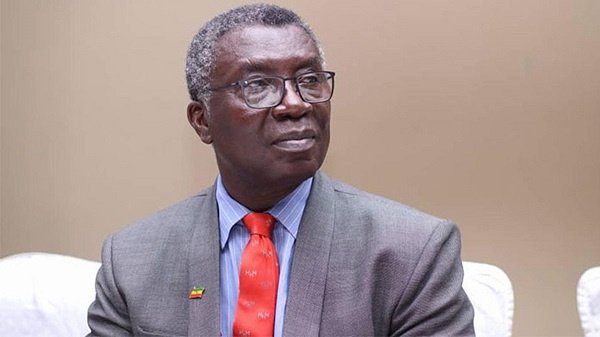
Ghana’s environmental crisis is not primarily a problem of inadequate knowledge but a political problem arising from the failure to act on challenges the country has known about for decades, former Environment, Science, Technology and Innovation Minister, Prof. Kwabena Frimpong-Boateng, has said.
According to Prof. Frimpong-Boateng, Ghana has known about its environmental challenges for about 50 years, yet the country has repeatedly failed to translate that knowledge into sustained action.
He made the observation while delivering the keynote lecture at the Fourth Annual Colloquium of the Department of Political Science Education at the University of Education, Winneba.
The lecture, titled “Airs, Waters, Places — and Ghana: Politics, the Environment, and the Habit of Abandonment,” examined Ghana’s environmental challenges through the lens of governance, politics and policy continuity.
Prof. Frimpong-Boateng said the country’s environmental problems are well diagnosed, making diagnosis the “cheap part” of the challenge.
“The expensive part is doing something about it,” he argued, stressing that the failure to act cannot simply be attributed to a lack of technical knowledge.
He said Ghana’s challenge is rooted in what he described as the country’s “mental environment” — the attitudes and behaviours that determine what society tolerates, neglects or chooses to address.
According to him, while the physical environment is often the focus of environmental discussions, the mental environment is equally important because it influences how people respond to environmental threats.
He argued that Ghana has the knowledge required to identify problems such as pollution, environmental degradation and the destruction of natural resources, but lacks the political will and institutional consistency to sustain solutions.
Political cost of enforcement
Prof. Frimpong-Boateng said one of the central reasons environmental policies fail is the difference between political timelines and ecological timelines.
He explained that political leaders operate within relatively short electoral cycles, while environmental problems and their consequences often develop over much longer periods.
Environmental enforcement, he said, can therefore carry immediate political costs for those who implement it, while the benefits may only become visible years later.
“The political cost of enforcing environmental law falls on the enforcer, political cost of not enforcing it falls on nobody,” he said.
He further noted that environmental benefits are often delayed and widely distributed, whereas the political costs of enforcement tend to be immediate and concentrated.
This, he said, creates an incentive for political actors to prioritise short-term considerations over long-term environmental protection.
“Rivers do not vote,” he said, illustrating the difficulty of translating environmental protection into immediate political rewards.
‘Minister for consequences, not causes’
Prof. Frimpong-Boateng also argued that Ghana’s environmental governance structure makes it difficult for the sector responsible for the environment to address the causes of environmental degradation.
He described the Environment Ministry as essentially a “minister for consequences, not causes”, because many of the activities that damage the environment fall under other sectors.
Mining, land-use planning, sanitation, energy, roads, agriculture and industry, he noted, all have significant environmental consequences, but the Environment Ministry does not control all these areas.
He therefore argued that treating the environment as a stand-alone sector rather than the foundation upon which other sectors depend contributes to the country’s inability to effectively manage environmental challenges.
He stressed that water, for instance, should not be treated merely as an environmental issue because it is also directly linked to public health.
Enforcement without alternatives
Prof. Frimpong-Boateng further argued that enforcement alone cannot sustainably resolve environmental challenges such as illegal mining.
He said people engaged in galamsey respond to the economic realities of their lives and that enforcement without credible alternatives risks merely moving the problem elsewhere.
“Enforcement without alternative is theatre,” he said, arguing that soldiers or other security personnel deployed without accompanying economic alternatives could turn affected communities against the state.
He said this was one reason previous campaigns against illegal mining had struggled to achieve lasting results.
According to him, environmental enforcement must therefore be accompanied by practical and credible alternatives for people whose livelihoods depend on activities that are being restricted.
Five reforms proposed
To address what he described as Ghana’s recurring environmental policy failures, Prof. Frimpong-Boateng proposed a number of institutional reforms.
Among them is a National Environmental Compact, negotiated across political parties and ratified by Parliament, to establish a limited number of long-term environmental commitments that successive governments would not be able to abandon administratively.
He also proposed personal liability for officials who issue permits affecting gazetted wetlands, watercourses, drainage systems and forest reserves.
Other proposals include an annual State of the Environment audit presented to Parliament, a system for publicly registering seized and released mining equipment, and the creation of a statutory Environmental Restoration Fund financed from mineral royalties.
He also called for small-scale mining to be regularised, mechanised and properly traced rather than simply criminalised, while maintaining that forest reserves and river bodies should remain completely outside such a system.
Prof. Frimpong-Boateng said the country must move away from a cycle in which environmental policies are introduced, implemented for a period and subsequently abandoned without clear accountability.
He argued that the solution requires making policy abandonment costly, ensuring that responsibility for decisions can be traced to individuals and making environmental performance measurable and publicly accountable.
“What is not measured publicly is not governed,” he said.
In his closing remarks, Prof. Frimpong-Boateng returned to the central argument of his lecture: Ghana’s environmental challenges are not unknown problems awaiting diagnosis.
Rather, the country must confront the political and institutional choices that have allowed known environmental problems to persist.
He said Ghana was not at a crossroads but on a “roundabout”, and that getting off it would require someone to “hold the wheel” through successive political cycles.
“Make abandonment expensive. Make the signature personal. Make the measurement public. And then hold the wheel,” he said.
Source: Starrfm.com.gh