Claim:
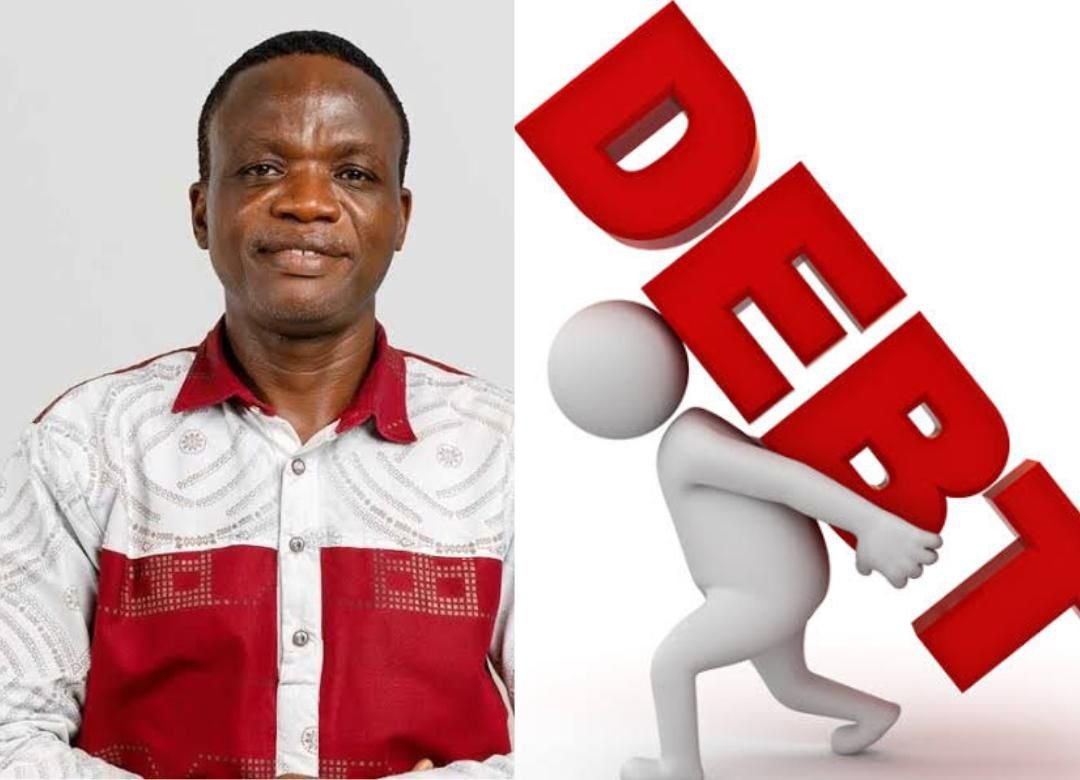
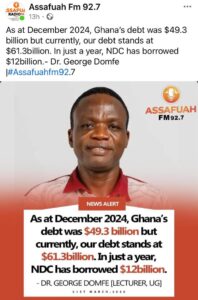
On March 21, 2026, a flyer circulated by Assafuah FM 92.7 reported that Dr George Domfe, a lecturer at the University of Ghana, claimed that the NDC government had borrowed $12 billion within a year.
The flyer stated: “As of December 2024, Ghana’s debt was $49.3 billion, but currently, our debt stands at $61.3 billion. In just a year, NDC has borrowed $12 billion.”
Verdict: Misleading
Explanation:
A careful review of official Bank of Ghana data by the EIB Research and Fact-Check Desk shows that while Ghana’s total public debt in US dollar terms rose from approximately $49.4 billion in December 2024 to $61.3 billion in March 2026, this increase does not reflect new borrowing of $12 billion.
The apparent rise in debt is largely due to exchange rate effects and other accounting adjustments rather than fresh loans.
External debt, which is the most reliable indicator of new borrowing in Ghana, increased only marginally during the same period. Data from the Bank of Ghana shows that external debt rose from $28.3 billion in 2024 to $29.4 billion in March 2026—an increase of about $1.1 billion, which is far below the $12 billion claimed.
Meanwhile, debt denominated in Ghana cedis fluctuated and even declined at times, dropping from GH¢726.7 billion in 2024 to between GH¢630 billion and GH¢641 billion in 2025–2026 before stabilising. This demonstrates that the government did not accumulate debt at the scale suggested by Dr. Domfe.
As of March 2026, Ghana’s total public debt stood at $61.3 billion, composed of both foreign currency and cedi-denominated obligations. Of this amount, external debt accounted for approximately $29.4 billion, while the remainder was primarily domestic debt in local currency.
Analysts note that the debt mix, combined with a weakening cedi, means that even without significant new borrowing, the dollar value of total debt rises when exchange rates shift.
This context is key to understanding why the headline figure of $61.3 billion might appear alarming, even though actual new borrowing has been relatively modest.
The main factor driving the higher dollar-denominated debt figures is the depreciation of the Ghana cedi against the US dollar.
Because Ghana’s public debt comprises both local currency and foreign currency components, changes in exchange rates can significantly alter the reported dollar value, even when no new borrowing occurs.
Although Ghana’s total public debt in dollar terms has risen since December 2024, the increase is primarily due to currency conversion effects and debt adjustments, not fresh borrowing of $12 billion within a year.
Bank of Ghana data shows that actual new borrowing remains modest, and an accurate interpretation of these figures is essential for informed public discussion on Ghana’s fiscal management and debt sustainability.
The claim made by Dr George Domfe exaggerates the scale of actual borrowing and is therefore misleading.
By: Isaac Azumah Abilla
EIB Research, Fact-Check and Investigative Desk