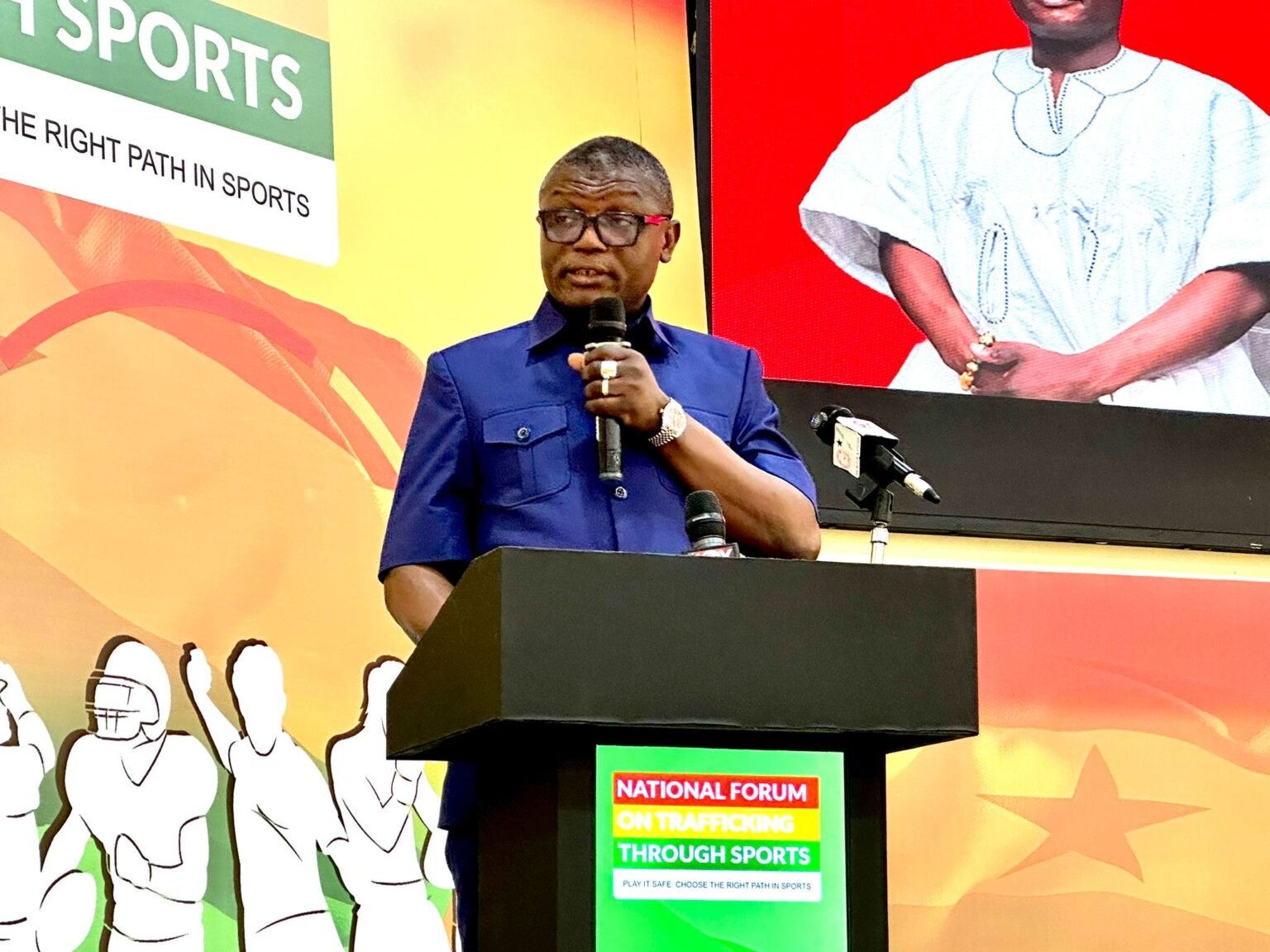
Ghana’s Sports Minister, Kofi Adams has sounded a strong warning over the growing menace of human trafficking through sports, describing it as a structured and dangerous system preying on the dreams of young athletes across West Africa.
Speaking at the National Forum on Trafficking Through Sports organised by the International Organization for Migration, the Minister acknowledged the deep ambition that drives many young people to pursue opportunities beyond Ghana’s borders.
“I have seen the ambition of our youth. I have seen the sacrifices families make. And I understand the urgency that drives young people to chase opportunity wherever they believe it exists,” he said.
He noted that across Ghana and the continent, thousands of young boys and girls grow up inspired by legends such as Abedi Pele, Roger Milla, Samuel Eto’o and Azumah Nelson, believing that talent and determination alone can secure a better future.
However, Kofi Adams warned that this dream is increasingly being exploited. “What we are dealing with today is not isolated incidents. It is a system,” the Minister stressed, pointing to evidence that human trafficking through sports; particularly football, has evolved into a structured informal economy across West Africa.
According to available data cited at the forum, more than 15,000 children are trafficked annually in the region, often under the pretext of football opportunities. A survey by global players’ union FIFPro further indicates that 70 percent of African players have been approached by agents promising opportunities abroad, yet 56 percent never receive trials and 44 percent fail to secure contracts.
In Ghana, the situation remains troubling. The Minister revealed that over 30 percent of aspiring athletes have encountered exploitative recruitment schemes, while nearly 96 percent express a strong desire to play abroad, largely driven by economic pressures.
“This is not random migration. This is a supply chain of vulnerability,” he said, attributing the trend to weak domestic structures, unregulated intermediaries, and financial strain on families.
The sector minister for sports also referenced a tragic case involving a young Senegalese goalkeeper, Cheikh Touré, who was lured with the promise of a football trial but was later kidnapped and killed after ransom demands were not met. The incident, he noted, highlights how trafficking within sports is evolving into organised criminal activity.
The Minister outlined measures being taken by the government under President John Dramani Mahama to address the issue at its root. He explained that the restructuring of government has led to the creation of two separate entities the Ministry of Sports and Recreation, and the Ministry of Youth Development and Empowerment to allow for more focused interventions in both youth welfare and sports development.
As part of efforts to strengthen the domestic sports economy, government has allocated one million Ghana cedis to each Premier League club this season to support operations and player welfare. Additionally, the league winner’s prize money has been increased from 500,000 Ghana cedis to 2 million Ghana cedis for the 2025/2026 season, with all clubs from first to fifteenth position set to receive financial rewards.
“This is a structural intervention,” he emphasised, noting that many talented players leave Ghana for less competitive environments simply due to financial constraints at home.
Beyond financial support, the government is also tightening regulations around player recruitment and transfers, while investing in grassroots and school sports systems to create clear development pathways.
While Ghana’s Human Trafficking Act, 2005 (Act 694) provides a solid legal framework, the Minister stressed that enforcement and coordination remain critical.
The minister further cautioned that the risks extend beyond athletes to fans, particularly as Ghana prepares for the FIFA World Cup 2026. He warned that fraudulent travel operators could exploit unsuspecting supporters and assured that government is working to ensure secure and verified travel arrangements.
“Our country may be known for gold and cocoa, but the greatest resource we have is our youth,” he said. “And increasingly, one of Africa’s most valuable exports is sports talent. But that talent must not be exported through exploitation.”
The Minister called for stronger collaboration and decisive action, urging stakeholders to move beyond dialogue and implement systems that ensure accountability.
He proposed key safeguards, including mandatory verification for young athletes travelling abroad, strict licensing and monitoring of agents, and the establishment of structured, transparent pathways for talent development.
“If we get this right, we will not only stop trafficking. We will build a future where the next Abedi Pele, the next Azumah Nelson, and the next generation of African greats emerge through dignity, structure, and protection,” he concluded.
“Let us protect the dream. Let us protect the future”.
Source: Starrfm.com.gh/Monica Bukari