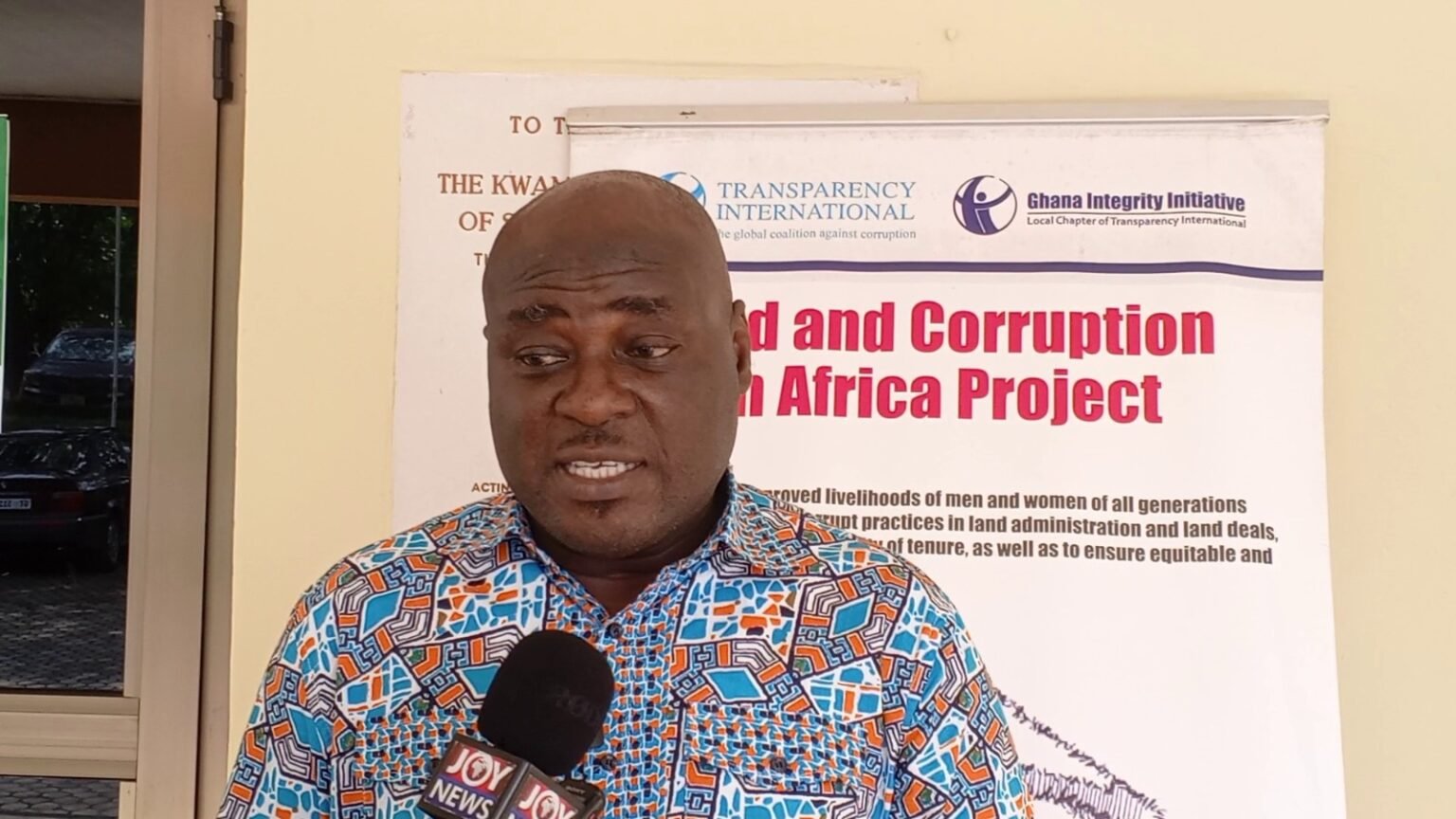
The Ghana Integrity Initiative (GII) has identified corruption as a major challenge hampering land administration and urban planning in Ghana.
As Ghana’s urban population soars, the anti-graft institution is worried the growing canker of corruption could retard the country’s development and drive already vulnerable persons into deeper poverty.
The local chapter of Transparency International (TI) highlighted these concerns when it met stakeholders in Kumasi to fashion out and deploy robust urban planning and land corruption modules
“People build without permits and field officers go and take money to allow them to continue building. That’s why when there is a heavy rain, you see flooding and buildings collapsing,” programs manager Michael Okai observed.
Land And Corruption
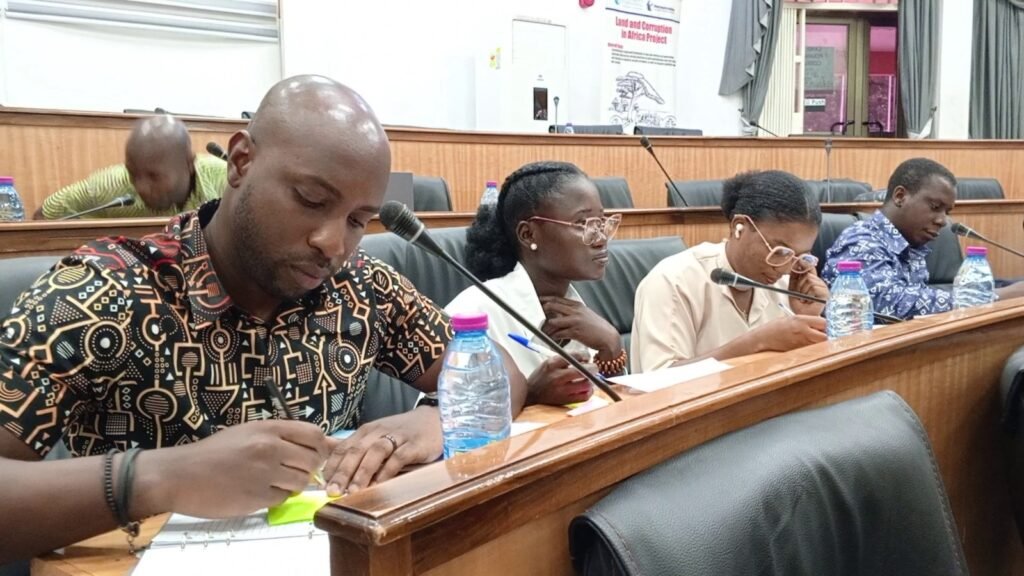
The Land and Corruption in Africa Project is tailored to equip practitioners comprising planners, surveyors, academics and officers drawn from land sector agencies; with the technical and ethical tools required to identify, avoid and combat corrupt practices in the sector.
To attain this feat in a well-coordinated, transparent and corruption free environment, GII put together a day’s confab of private, public and civic actors drawn from the Physical planning units of Assemblies, the Land Use and Spatial Planning Authority, Academics from the Kwame Nkrumah University of Science and Technology, officials from the lands commission, the Office of the Administrators of Stool Lands, the Media and the Ghana Institute of Professional Surveyors
Stakeholders considered several scenarios across the planning of urban spaces, land use, monitoring and compliance issues as well as land governance matters regarding the issuance and sale of land titles and how each stage could lend itself to the trappings of corruption.
Ghana’s Sprawling Cities
The United Nations Sustainable Development Goal (UNSDG) 11 enjoins Ghana to build safe, inclusive and resilient habitations and urban settlements to accommodate the growing urban population and its attendant needs for social amenities and infrastructure.
The country’s urban settlements notoriously the national capital Accra and the Ashanti Regional Capital Kumasi have grown into sprawling towns with huge commercial buildings, stalls, kiosks, makeshift structures, mobile carts, squatters and hawkers taking over almost every thinkable space in the Central Business Districts with little space for vehicular traffic and parking lots.
Fire disasters in Market centers have become a ritual with the perennial difficulty being the lack of access for emergency services including Fire Tenders and Ambulances to reach the fire scenes to fight the blaze.
Blocking of water ways have exacerbated flooding whenever it rains with areas hitherto known to be flood free, now having water gushing into their homes and work places at the slightest downpour.
Associate Professor with the Centre for Settlement Studies of the KNUST Prof Rudith King contended that though technocrats were well trained to draw up plans; compliance enforcement and the lack of political will, remains a major challenge.
“We have adequate laws but the implementation and enforcement of the laws is often the issue. The enforcement also requires having adequate capacity to engage in the enforcement,” She explained.
Corruption and Inequality
She warned that endemic corruption in the land administration and urban planning space had the potential to deepen inequalities and disproportionately affect the poor and vulnerable.
“We heard of the story where an investor decided to pay sitting allowances for a committee sitting on plans, to quickly look at his parcels to approve them for him to develop. The meeting came on and his proposal was approved. The developer had the means but how many ordinary citizens can pay sitting allowances like that?” she queried.
“Land is a finite asset and corruption can come in when you begin to change the plans. Since it is a supply and demand issue; someone can go in to pay a bribe to take lands at any price and the person who has no money will not be able to afford it”,” Prof. King emphasized.
The Land and Corruption in Africa project funded by BMZ is aimed at ensuring transparency and inclusivity in land administration; helping mistreated victims to seek redress and equipping all parties in land administration with the knowledge to perform their roles responsibly.