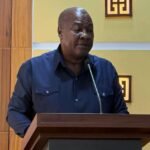
President John Dramani Mahama has announced a major reform in fiscal decentralization, revealing that district assemblies are now receiving 80 percent of their allocations directly, a sharp increase from the 40–50 percent that reached them in previous years.
Speaking at a media encounter at the Jubilee House on Wednesday, the President explained that the measure is part of his government’s commitment to strengthen local governance, empower metropolitan, municipal, and district assemblies (MMDAs), and improve service delivery at the grassroots level.
“In the past eight years, only 40 to 50 percent of the District Assemblies Common Fund was reaching the assemblies. Our government has reversed this trend. District assemblies are now receiving 80 percent of their allocation directly,” President Mahama said.
He disclosed that of the 7.57 billion Ghana Cedis allocated to the DACF this year, approximately 6.1 billion Cedis has already been disbursed directly to the assemblies, with each MMDA receiving a minimum of 25 million Cedis. The first-quarter release alone amounted to 987.97 million Cedis, which has been used to kick-start district-level development projects.
To ensure accountability and efficiency, Cabinet has approved expenditure guidelines for assemblies.
Under these guidelines, 25 percent of funds are to support the design and construction of 24-hour economy model markets, while 10 percent is reserved for health, with a minimum of two CHPS compounds per district.
Other allocations include investments in education infrastructure such as KGs, primary and secondary school blocks, provision of potable water through boreholes, environmental sanitation, school furniture, as well as the completion of legacy projects.
The President also stressed that all statutory funds, including 2.03 billion Cedis to the National Health Insurance Fund and 2.71 billion Cedis to the GETFund to cover arrears and Free SHS commitments, have been released in full.
This, he said, underscores his government’s dedication to equitable development and strengthening the foundations of decentralization.
“This approach ensures that development is not concentrated in Accra or the major cities, but is felt in every district, community, and household,” he emphasized.
Source: Starrfm.com.gh