At Sekondi’s Albert Bosomtwe-Sam Fishing Harbour, there is a fish some fishermen remember vividly but can no longer point to in their catches.
They call it “Ewura Efua”, broadly referred to as the grey triggerfish (Balistes capriscus).
For generations, the fish was familiar to fishermen along Ghana’s coast. Some remember catching it regularly and making money from it. Others remember its importance during the 1983 famine, when fish became a crucial source of food.
The Albert Bosomtwe-Sam Fishing Harbour at Sekondi, one of the major fishing centers in the Western Region
But today, fishermen at the Sekondi harbour say they hardly see it.
Ernest Commey, a fisherman at the harbour, remembers a time when “Ewura Efua” could help fishing families settle debts and make a living.
“Our forefathers used to make money from catching the ‘Ewura Efua’ fish to pay off their debts, but now we are unable to see them in our waters.”
His account raises a bigger question: what happened to Ewura Efua?
Has the fish become less abundant? Has it moved to different waters? Or are changes in Ghana’s marine ecosystem making some species increasingly difficult to find?
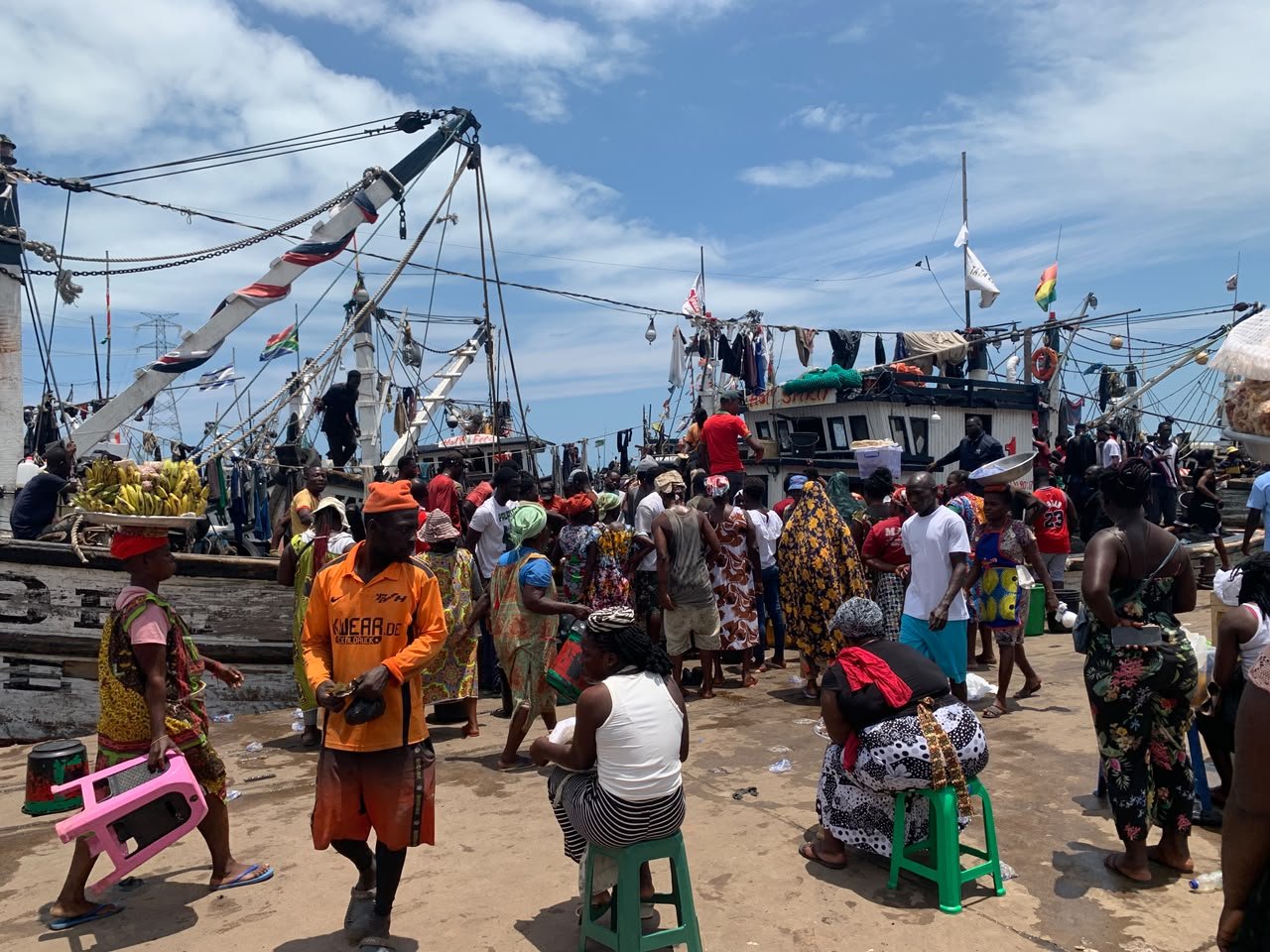
Fishers and traders go about their activities at the Albert Bosomtwe-Sam fishing Harbour at Sekondi
The available scientific record shows that the species was present in Ghanaian waters in the 1960s but occurred in relatively small quantities. During the 1963–64 Gulf of Guinea Trawler Survey it was encountered regularly but in small numbers, and before about 1969 it was described as practically absent from Ghana’s continental shelf. Its estimated biomass was only about 330 tonnes in 1963–64 and approximately 1,370 tonnes in 1969–70.
A remarkable change occurred from around 1970. The triggerfish population expanded rapidly and became one of the dominant components of Ghana’s demersal fish community. Reported landings increased from approximately 3,000 tonnes in 1972 to 8,600 tonnes in 1976. The 1976 FIOLENT survey estimated approximately 68,300 tonnes of triggerfish biomass on Ghana’s continental shelf. Most importantly for Greater Cape Three Points, B. capriscus accounted for approximately 65.6% of trawl catch weight east of Cape Three Points at 20–50 m depth, demonstrating that the area was historically an exceptionally important concentration of the species.
The expansion was followed by an equally dramatic collapse. Ghanaian landings exceeded 18,000 tonnes in 1986, but subsequently declined rapidly. The R/V Dr Fridtjof Nansen (a Norwegian Scientific Vessel that come to conduct fisheries scientific surveys in Ghana) estimated approximately 314,000 tonnes of triggerfish off Ghana in 1981, about 115,000 tonnes in 1986, and virtually zero by 1989. By the 1990s, the species had broadly returned to its former condition of sporadic occurrence at low abundance.
WHAT IS DRIVING THE DECLINE?
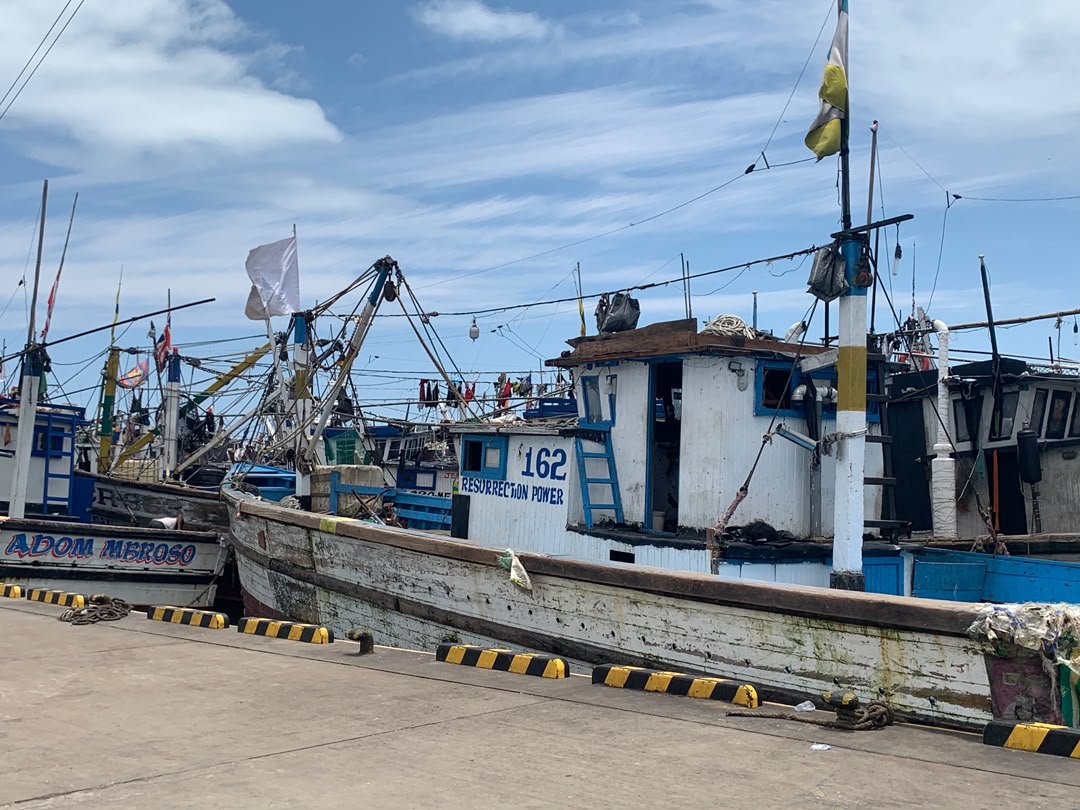
Fishing boats anchored along the shores of the Albert Bosomtwe-Sam fishing Harbour at Sekondi
Ernest Commey attributes the decline partly to destructive fishing practices, including the use of chemicals and unauthorized fishing nets.
He says such practices do not only affect the fish being targeted but can also disturb the wider marine environment.
“Our fellow fishers need to stop using chemicals for fishing because these fishes are from the deep waters and if fishers use the chemicals to fish, it tends to drive these fishes away.”
He also points to pollution associated with illegal mining. According to him, chemicals used in mining activities can eventually find their way into water bodies and the sea, affecting the marine environment.
“The chemicals used by the miners and washed into the sea are also driving the fish from our sea because they are too strong for these fish to survive, so they tend to travel to other marine waters where they can survive.”
But are these observations supported by wider evidence on Ghana’s fisheries?
According to Kofi Agbogah, Executive Director of Hɛn Mpoano, the decline in Ghana’s marine fish stocks cannot be attributed to a single factor.
He has identified overfishing, excess fishing capacity, illegal fishing, weak enforcement, poor fisheries management and climate change among the pressures affecting Ghana’s fisheries.
The Fisheries Commission and the Ministry of Fisheries and Aquaculture have also raised concerns about illegal, unreported and unregulated fishing, including practices such as light fishing and the use of harmful chemicals and explosives.
Fisheries Program Manager at Hen Mpoano, Kuusaana Peter Canicius, says the disappearance of the triggerfish cannot be explained by overfishing alone.
“The available evidence points to multiple interacting factors rather than a single cause,” he explains.
He says intense fishing pressure played a role, as the species became an important commercial resource and was heavily harvested. But its decline also coincided with major changes in the marine ecosystem, including the drastic decline of Sardinella aurita, locally known as eban.
Kuusaana also points to changes in oceanographic conditions, including sea-surface temperature, salinity and coastal winds.
“Historical evidence also suggests that fishing effort remained relatively stable during part of the later decline,” he notes, strengthening the case for looking beyond fishing pressure.
His conclusion is significant for Greater Cape Three Points, once a major concentration area for triggerfish.
“Its historical disappearance cannot scientifically be reduced to overfishing,” Kuusaana says.
Instead, he describes Ewura Efua as “a historical indicator of major ecosystem change and lost ecological productivity.”
THE CLOSED SEASON: CAN THE FISH COME BACK?
One of Ghana’s major responses to declining marine fish stocks is the Closed Fishing Season.
The measure is intended to temporarily reduce fishing pressure and give fish stocks an opportunity to reproduce and recover.
For 2026, the Ministry of Fisheries and Aquaculture and the Fisheries Commission implemented different closure periods for industrial and semi-industrial vessels, while marine artisanal canoe fishers were exempted from the closed season and continued to observe designated fishing holidays and existing fisheries regulations.
Hɛn Mpoano has described the closed season as an important fisheries management measure, while stressing that its effectiveness depends on compliance and enforcement.
In its 2026 assessment, the organization stated: “Illegal fishing practices undermine conservation efforts, deplete fish stocks, and ultimately threaten livelihoods.”
Kuusaana cautions that Ghana’s existing national closed season is primarily designed around small pelagic species such as sardinella, anchovy and mackerel.
“It would therefore be scientifically incorrect to assume that the existing national closed season is automatically an effective recovery measure for Balistes capriscus,” he says.
For Ewura Efua, he argues that any closure would have to be species and ecosystem-informed, with the protection of mature fish potentially leading to more spawning, improved recruitment and, eventually, higher fish abundance and catch rates.
But there is another warning.
“A closed season alone is unlikely to rebuild a species that has already undergone a severe historical collapse,” Kuusaana says.
He proposes combining a seasonal closure with spatial protection of important habitats, particularly spawning and nursery areas, under the new Marine Protected Area framework.
But for fishers, the question is not only whether the closed season works. It is also when and how it is implemented.
Solomon, one of the chief fishermen, fishers should have a greater role in discussions about the timing of the closure.
“The closed season has been helpful since its inception, but we fishers tend to be affected when it is shifted to August because that is when we get more fish catch. I think if the government collaborates more with fishers and includes us in the decision-making, the closed season policy will be more effective than it is now.”
The differing perspectives raise an important question: Can Ghana combine scientific recommendations with the knowledge and experiences of fishing communities to make fisheries management more effective?
CAN BIOLOGICAL MONITORING HELP?
The challenge, therefore, is not only finding Ewura Efua, but developing a way to know whether its population is actually returning.
Fisherfolk are uniquely positioned to provide the first signs of change, given their daily interaction with the sea. This is why the Environmental Justice Foundation’s efforts to train fishers in biological monitoring could be significant. By equipping fishers to systematically record information from their catches, their observations can contribute to a longer-term picture of what is happening beneath the surface.
At the Sekondi harbour, Vice president for the canoe fishers, Papa Solomon says the training has changed how he examines the fish he encounters.
“The training has really been helpful and I can now measure the size of the fish we catch and know the health of the fish through the skills of observing the fish to ensure they are safe for consumption.”
He believes the training should be extended to more fishers and processors.
For Ernest Commey, the knowledge is also something he can pass on to other fishers.
“I must say the training was a good one because it has helped me, and I always engage with my fellow fishers to explain about biological monitoring so they can use it when they go fishing.”
BOTTOM LINE
Fisher knowledge and fish landings can provide an early indication of changes in the triggerfish population, but systematic scientific surveys are needed to confirm these trends. Such monitoring would need to examine catch rates, fish size, reproductive condition, recruitment, as well as changes in habitat and environmental conditions.
The 2026 Greater Cape Three Points MPA also presents an opportunity to establish long-term monitoring of Balistes capriscus. Given the species’ historical abundance around the Cape Three Points shelf and its subsequent disappearance, sustained monitoring could help determine whether the population is showing signs of recovery and what factors may be influencing its return.
Source : Hajia Fati