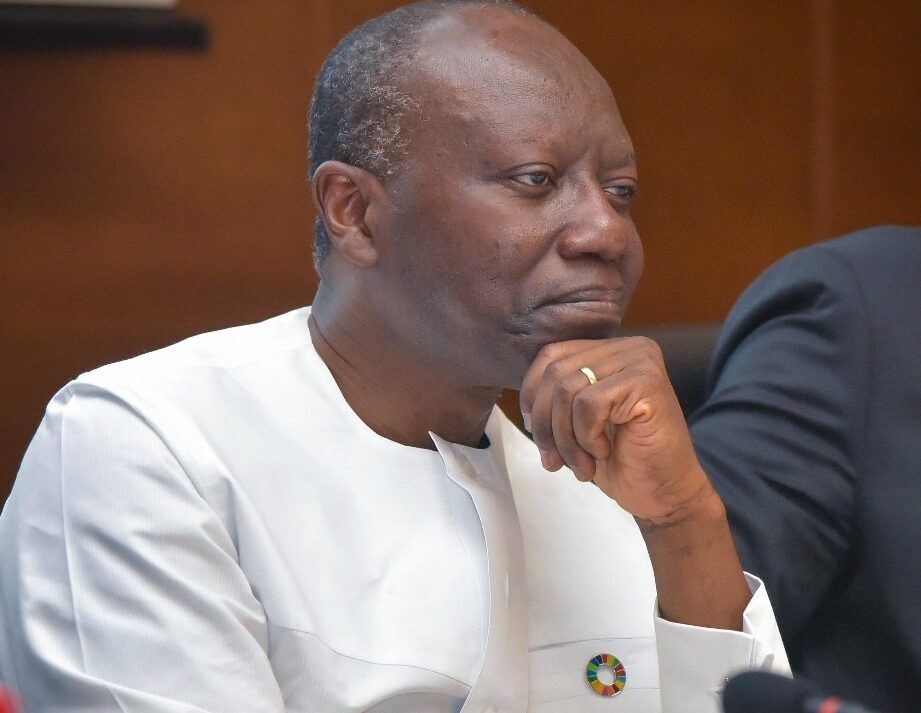
An open letter to the Hon. Minister for Finance and Economic Planning
Can we afford a Ghana with: no bad roads, decent homes for the working class, free quality tertiary education, an efficient free national health care system, clean cities, decentralized infrastructure, full employment, a social safety net for the vulnerable…? And this is not about politics; just a rethink of the economics we have always known.
25 years ago, our country started on a national vision 2020 development agenda to deliver a Ghana with a balanced economy, middle-income country status, a standard of living and a level of development close to the present level of development seen in Singapore. We soon wake up to the news of 2020’s arrival and oh did it come with baggage; a global pandemic that shook the world and claimed the lives of many; and Ghana, a lower-middle-income west African country with a debt to GDP ratio soared to about 63% as a macroeconomic response. Well, along with the rest of the world, our country has come far. Today we may have progressed from where we started, but we are nowhere near where we should be. This may be attributable to a myriad of factors. Key among the many is the fact that we just cannot seem to generate enough by ourselves to fund the level of national development we aspire to. Our development budget is constrained by how much tax we collect and ostensibly, how much the west is willing to lend to us. But what if these constraints are somewhat self-imposed?
Currently, governments are likened to households who need to earn income (mostly through taxes) for expenditure. And just like households, governments are to take on debt to make up for their budget deficits when they cannot generate the required income through taxes. When debt rates get too high, the debt alarm starts to beep and sounds danger for the economy. But is a sovereign government really like a household? A government can issue its own money; households cannot. A sovereign government is not like a household and does not need to raise taxes or borrow to spend the money it can create all on its own. The question of constraint is hence no more about whether we have the money for development, it is rather about how much and what kind of development we can spend on such that inflation and currency depreciation stay under control. This, in essence, is at the core of the Modern Monetary Theory.
What is the Modern Monetary Theory (MMT)?
MMT’s fundamental argument is; a sovereign government that issues its own currency and debt in its own currency, and does not practice a fixed exchange rate system, can spend as much as its economy needs and never go broke, run out of money, or default on its obligations.
The theory hinges on 3 main arguments.
• The government must spend before it can collect taxes.
• The government is an interest rate setter and not a taker.
• Fiscal policy tools have a greater monetary impact than current monetary policy tools.
These arguments give us further understanding of the true essence of taxes and government borrowing as follows:
• Tax is a fiscal tool to control inflation as it creates demand for the government’s currency. Taxes are a legal obligation and can only be settled in the government’s currency.
• Government borrowing can also be a fiscal tool used to create demand for its own currency. Thus, the issues of budget deficit or surplus are in themselves near meaningless to a sovereign government.
According to trading economics as of Dec 2019, Japan has a deficit of about 237% of GDP, Singapore 126%, USA 107%, France 98.1%, Egypt 90%, Canada 89.7%, UK 80.7%. Barbados 149%, Australia 124% the list goes on and on. Ghana is at 63%. And who else has less? Afghanistan 7.1%, Palestine 16.2%, Guatemala 27.8% Nigeria 17.5%, Burundi 13.6%, Burkina Faso 22.6%, Venezuela 23%, Liberia 32%. Why are the economies with the least debt to GDP ratios not necessarily the most robust?
The theory, formerly Mosler Economics, was founded and continuously developed by Warren Mosler; a 40 year veteran of monetary economics and monetary operations. Currently, it is an economic school of thought with strong proponents like professor of Economics at Bard College USA, Dr. L Randall Wray, Prof. Bill Mitchell, Economics professor at the University of Newcastle, Australia, and Dr. Stephanie Kelton, a professor of Economics and Public Policy at Stony Brook University who served as chief economist in the US Senate budget committee and as the Chief Economics Advisor for the 2016 Bernie Sanders presidential campaign.
The fundamental elements of the Modern Monetary Theory, which subsequently inspired post-Keynesian economics, Alfred Mitchell-Innes’ credit theory of money, and how current monetary operations work in many central banks, may not be particularly novel. However, the conclusions it reaches about how economies work today are definitely ‘modern’ to many.
MMT’s ideal economy
The most ideal situation for the MMT may probably be the USA. A sovereign nation, issues its own currency, issues debt only in USD, which is also the largest reserve currency of the world. The USA much like other developed economies Japan, Canada, Australia can never go broke no matter how large its debt to GDP ratio is, as long as it continues to meet the conditions outlined by the MMT. Contrary to what Obama said in 2009, the USA will never run out of money under these circumstances. Whether the USA knows it or not, they can issue their currency and spend as much on whatever development agenda they deem fit and never go broke.
Strawman arguments are made by citing developed nations such as Greece and Italy who defaulted on their debt obligations after ‘excessively’ borrowing. The simple clap back is; Greece and Italy do not issue their own currency. Much like other Eurozone states, they gave up their sovereign currencies (the Drachma and the Lira) for the regional Euro issued by the European Central Bank (ECB). This meant that their supply of money (the Euro) was limited by the ‘generosity’ of the ECB. This situation is well understood by MMT proponents. An appreciation of the policy space and options MMT can afford a nation will leave you with no surprises as to why Scandinavia Europe, one of the most developed and socially equitable regions in the world, had Sweden, Denmark, and Finland as part of the EU maintain the sovereignty of their currencies. Norway and Iceland on the other hand opted out of the Eurozone completely. The UK who has since left the EU also kept the sovereignty of their currency during their time there.
MMT in developing economies
I’ll hazard to say, that all traditional economic theories propounded by the West are designed to the structure of western society at the time the propositions were made. These mainstream economic theories underpin the way managers of most developing economies view their economies and the kind of economic policy options they believe are available to them today. While there is no doubt that the current state of developing economies includes serious self-imposed obstacles, albeit some more so than others, developing nations can, in any case, customize MMT’s understanding and insights to their peculiarities.
Prior to discussing what welcoming this economic school of thought means for Ghana, let’s first give some context to the issues of hyperinflation in Zimbabwe and Venezuela as they
have been used to misrepresent the substance of this theory. Firstly, even though the governments of these countries are known to have resorted to ‘printing’ cash to spend, their economics was not what an MMT proponent would recommend. Secondly, these two countries deal with distinct problems that Ghana does not have. Zimbabwe was slapped with trade sanctions, coupled with significantly lower levels of productivity that characterized the aftermath of the redistribution of farmlands from white owners to black Zimbabweans. This hurt the productive capacity of their economy and their ability to accumulate foreign exchange reserves they were using to support their currency. In the case of Venezuela, oil accounts for 95% of its export revenue. Thus, a plummet in oil prices as we have seen in recent times resulted in a huge fall in their foreign currency reserves resulting in political chaos and policy that exacerbated the depreciation of their currency causing hyperinflation and a shortage of essential goods that they do not produce locally.
What the MMT reveals about Ghana’s economy?
1. We have more fiscal space to pursue development than we know. Contrary to what traditional economics has taught us.
2. Interest rates on the cedi are not simply determined by demand and supply of the market. And that by understanding the government has a monopoly over the issuing of the cedi; it is an interest rate ‘setter’ and not the ‘taker’.
3. That debt to GDP ratio is a measure of the money supply, which is not an end in itself and that budget deficit ceilings are a self-imposed constraint, whose essence is to aid in keeping inflation and currency depreciation within manageable levels. In any case, history and current examples have shown us that a large budget deficit does not necessarily translate to high levels of inflation and currency depreciation. Thus, the ‘how do we pay for it?’ question does not matter as much as the ‘what are we paying for?’
Does this mean Ghana is not as broke as we believe we are?
Yes, we are not broke. We may be able to afford more economically strategic government spending than we know, without necessarily borrowing at a cost. For example, we do not need to use foreign exchange income from oil exports or borrow long at high-interest rates against our tax receipts to fund most parts of our current social interventions such as the Free SHS and NHIS. Since the majority of these obligations are cedi denominated and can be funded by ‘printing the money’.
Does this mean the Government of Ghana should print Cedis and spend on whatever they deem fit with no economic repercussions?
Of course not. The wrong type and level of spending can ultimately result in hyperinflation. Imposing the wrong type and level of tax obligation will not create the necessary demand for the cedi to keep inflation under control. Also, increasing our debt obligations in foreign currency whiles spending locally can threaten higher than normal levels of currency depreciation.
Ghana…where do we begin?
Along the way as a country, we have accumulated a pile of foreign-denominated debt, which has to be serviced with foreign currency. That, coupled with our skewed dependence on imported goods and services, obliges us to increase our forex reserves to protect the Cedi’s value and position with the major trading currencies. So yes, while we are not as broke as we think, we have significant obstacles to overcome if we are to fully utilise the opportunities we have as a nation with a sovereign currency.
Ghana is estimated to have spent GHS 3.6billion, approx. $600million of our oil revenue on free SHS; $600million that could have otherwise gone into other developmental projects that require the importation of capital goods and services or been saved in our national reserve account to support of our currency. Free SHS is an obligation that is largely cedi denominated and should not cost us forex to finance. Other national obligations that will not require long
and/expensive borrowing to finance are public sector salaries, NHIS claims, GetFund related debts etc. Again, the majority of these obligations do not require forex to settle, thus very cheap borrowing or zero expense borrowing (BoG crediting bank reserve accounts) should be used to settle them. This will free the forex income we make from exports to be deployed towards projects that increase the productive capacity of the economy (local industries, transport infrastructure, new technology etc.)
We can start by re-purposing our forex reserves; spend Cedis for Cedi denominated projects and reserve forex for foreign-currency-denominated obligations. With that said, in the not too distant future, we should have budgetary space to among other solutions, assiduously employ our real resources to increase our productive capacity to reduce our over-dependence on imports and the cyclical externalization of dollars. Over time, we will be better positioned to take more control of the cedi, put more of it into Ghanaian pockets and drive our own development with little interruptions from our foreign lenders.
In conclusion, the Modern Monetary Theory puts more policy options on the table. Options, which hitherto, were not imagined feasible. Additionally, it reasons us to re-orient our understanding of the term “the size of the public purse”, as not being how much money (revenue mobilization constraint) we have as a country to spend on development. Instead, we come to know that, it is how big the purse (economy’s real resources and productive capacity constraint) is, to hold the unlimited amount of cash (government spending & economic growth) such that the purse (economy) does not fall apart (uncontrollable levels of depreciation & inflation).
The “the government is like a household” metaphorical understanding of monetary economics may have cost us far more than just creating a public alarm about our rising debt. It has cost us and probably will continue to cost us the ability to make bigger strides towards national development, the ability to keep our growing youthful population skilled and gainfully employed, the ability to sustainably reduce the housing and transport infrastructure deficit, the ability to provide quality affordable healthcare and education for our people, the ability to invest into research and development, the ability to give Ghanaians a dignified life.
Co-authored by:
Papa Sam Blankson, MSc. Economics (Money, Banking & Finance)/ over 8 Years Combined Experience in Banking & Asset Management.
&
Anita Yankey, MSc. Finance/ BSc. Economics & Finance/ over 8 Years combined experience in Asset Management and Corporate Communication.
Corresponding Author:
Papa Sam Blankson / 0244928624/ psblankson0121@gmail.com