For more than a decade, 31-year-old health advocate Esenam Amuzu has traveled to underserved communities across Ghana, helping women and young people navigate questions about contraception, menstruation, puberty, healthy relationships and sexual and reproductive health.
She has also connected young people to HIV and sexually transmitted infection testing, pregnancy services and other reproductive healthcare.
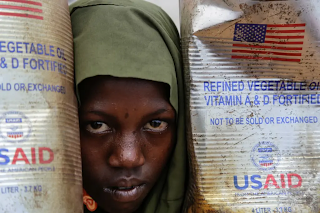
Much of that work was supported by USAID-funded programs.
So, when US funding began disappearing under President Donald Trump’s “America First” policy, Amuzu said it felt like a devastating blow to work she had spent years building.
“If anyone says USAID being dismantled has not affected any lives, it’s a lie,” she said.
Ghana still faces significant gaps in family planning, HIV treatment and support for survivors of gender-based violence. The abrupt US cuts have not only disrupted services, but closed facilities and contributed to medicine shortages, even as other major donors, including Britain, France and Germany, are also reducing aid.
The scale of the current disruption is potentially enormous. A study published in The Lancet warns that cuts in global funding could result in at least 9.4 million additional deaths by 2030, including 2.5 million children under the age of five.
But in Taifa, a sprawling neighborhood on the outskirts of the capital Accra, 32-year-old doctor of herbal medicine Perez Osei-Owusu sees foreign aid cuts differently.
“What if USAID never started?” he asked. “What would we have done?”
Osei-Owusu argued that prolonged dependence on foreign assistance can allow governments to avoid taking full responsibility for services that should ultimately be financed and managed domestically.
“Ghana is a blessed country. We just need to channel our resources properly and cut the monies entering into people’s personal pockets,” he said, referring to some corrupt practices.
Osei-Owusu’s argument is echoed in a new survey of nearly 5,000 young people across 16 African countries.
About 46% said the closure of USAID would hurt their countries. But roughly a quarter said it could actually have a positive impact.
“We wanted to give young Africans a voice,” said Ivor Ichikowitz, founder and commissioner of the South Africa-based Ichikowitz Family Foundation, which commissioned the survey.
The findings, he said, show young Africans recognize the immediate risks of losing foreign assistance while questioning why governments have relied on donors to finance programs they should support themselves.
In Ghana, nearly half of respondents said they believe the dismantling of USAID could eventually be a good thing, Ichikowitz said.
“Part of the reason,” he explained, is that they understand many of the activities that USAID supported “were activities that their governments should have been responsible for anyway.”
But wanting self-reliance is one thing. Paying for it is another.
In 2001, African leaders meeting in Abuja, Nigeria, pledged to spend at least 15% of their national budgets on health.
More than two decades later, most countries have not consistently met that target, leaving health systems vulnerable to shifts in donor priorities.
For Ghana and other African countries, the challenge is therefore not simply replacing money that has disappeared.
It is building systems capable of financing essential healthcare for the long term.
“Young Africans see this as a short-term problem,” Ichikowitz said, “but a short-term problem that will inevitably force long-term solutions.”
Africa’s young population makes that debate particularly urgent.
About 70% of people in sub-Saharan Africa are under the age of 30, according to the United Nations. They are the generation that will inherit the continent’s health challenges and, eventually, shape how those systems are financed.
At the Accra Technical University, 24-year-old marketing student Abigail Kumi sees the argument as generational.
“We want a sustainable future,” she said. “I would rather see Ghana build its own health system than depend on another country to keep it running.”
Analysts say that desire for ownership is understandable but self-reliance is expensive.
Justice Nonvignon, a professor of health economics at the University of Ghana, said his country needs to increase domestic health spending, make difficult choices about its priorities and raise more revenue at home.
“Our tax revenue to GDP ratio is so low,” he said. “So, many people are not paying taxes.”
Ghana’s tax-to-GDP ratio was about 14% in 2025, according to recent fiscal data, still below the average for sub-Saharan Africa and short of the country’s revenue ambitions.
Nonvignon said the answer is not necessarily new taxes, but broadening the tax base and finding ways to bring more people and businesses into the system.
But raising more revenue is only part of the challenge.
Nigel James, a Zimbabwean global health assistant professor at the University of Richmond, Virginia, said African countries must also improve how they manage existing resources.
“It’s not just a question of ‘let’s increase money, let’s increase budgets, let’s increase appropriation,’” he said. But countries also need to improve procurement, reduce waste and strengthen supply chains so medicines, vaccines and other essential services reach communities — including people in the most remote villages.
He added that Africa can pursue greater self-reliance without shutting the door on international partners.
The biggest danger may, therefore, lie not in the idea of self-reliance itself, but in an abrupt transition that leaves health systems without the resources needed to keep people alive today.
A transition becomes dangerous, James explained, when the pace of donor withdrawal outstrips a country’s ability to protect essential services.
Back in Accra, the medical herbalist Perez Osei-Owusu said African leaders need to make the right choices.
“We have a nation to build. Things won’t come easy,” he said. “We need our leaders to have the nation’s interest at heart.”
By: Ridwan Karim Dini-Osman