


It is another football season and Ghana has missed out on a great opportunity to sell HIV preventive messages to its teaming youth who will be watching the game from different devices and on various platforms. It appears the country no more wants to “protect the goal” – a UNAIDS initiative that harnesses the power of football and culture to raise awareness of HIV and mobilize young people to commit to HIV prevention. The reality is that Ghanaian youths 21 years and below have little to no appreciation of the debilitating nature of the virus and the devastation it has caused the world over. And yet they live in Sub-Sahara Africa, a region that has faced the harshest brunt of HIV. They have had very little exposure to the massive preventive and educational media campaigns that took Ghana by storm two decades ago. “When was the last time you saw an HIV advert or billboard in the streets?” quizzed Rev. John Azumah, an HIV role model who has been living with the condition for the past 22 years. Rev. Azumah is deeply concerned over what he describes as the neglect of HIV by the government.
As the country reneges on its commitment to HIV the results are revealing. In the first half of this year alone more than twenty-three thousand people have tested positive for HIV. An assessment of HIV prevalence for the past four decades shows that Ghana has the slowest decreasing rate among its four neighbors. For instance, a 10-year interval prevalence from 1990 to 2020 for adults shows that Cote D’Ivoire and Burkina Faso had the steepest declines while Ghana had the slowest. Between 2020 and last year (2021) all three neighbouring countries reduced their prevalence rate for adults except Ghana which stagnated. Ghana maintained its rate at 1.7% (0.0% reduction); Cote D’Ivoire saw a reduction from 2.1% to 1.9% (10.0% reduction; Togo reduced from 2.0% to 1.9% (5.0% reduction), and Burkina Faso saw a reduction from 0.7% to 0.6% (14.0% reduction).
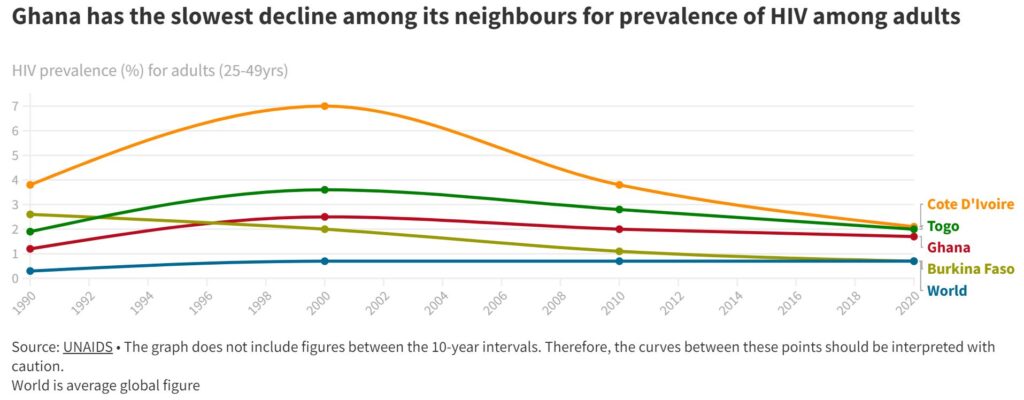
Link to chart: https://flo.uri.sh/visualisation/7900965/embed?auto=1%27
The impact of the lack of exposure of the youth to HIV messages can be explained by the figures. In 2020, there were an estimated 14,000 MSM (men who sleep with other men) new HIV cases among people 15-49 years. Out of that number, 5,200, representing over 37%, were youths 15-24 years. This is higher than what pertained to some years ago. For instance, in 2016 about 35% of new infections were from the youth. New infections among young Ghanaian women are particularly scary because four out of five infections among young people are young women. Compared with its neighbors, young women in Ghana have the slowest rate of decline in HIV prevalence. Even though young women in Ghana had the lowest prevalence rate in the 1990s compared to its neighbors their current rate of 1% is the highest.
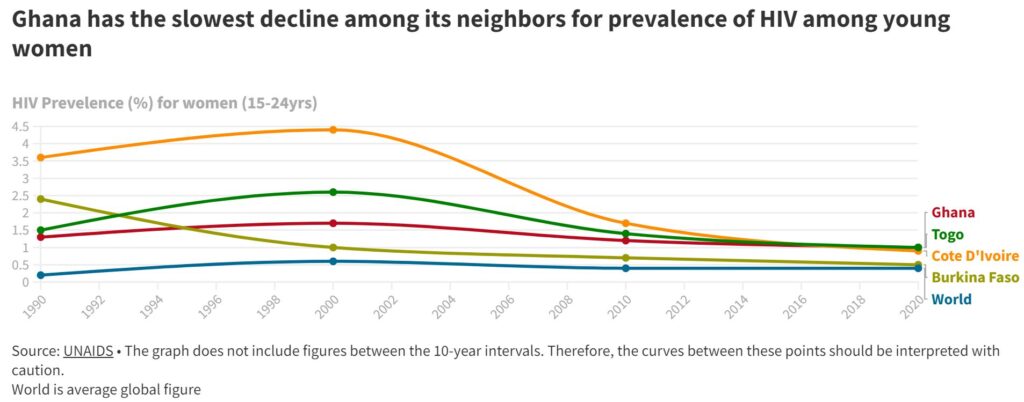
Link:https://flo.uri.sh/visualisation/7901687/embed?auto=1%27
Between 2020 and last year (2021) while all neighbouring countries reduced the prevalence rate for young women, (Cote D’Ivoire from 0.9 to 0.8%, Burkina Faso from 0.5 to 0.3%, and Togo from 1.0 to 0.9%) Ghana, again, stagnated at 1%.
The Challenge
There is a consensus among various stakeholders that the decline in preventive and strategic media campaigns is the major reason for Ghana’s slow pace, especially in the past decade. “Most people who heard about HIV did so 10 to 20 years ago,” notes a professor of epidemiology at the School of Public Health, University of Ghana, Ernest Kenu, “and that is why the infection rate among young people is very high.” The adage goes that prevention is always better than cure, but Dr. Kenu observes that the government is prioritizing curative measures over preventive methods. For someone living with HIV, Rev. Azumah’s preference for preventive measures over curative measures seems quite selfless, but he makes an analogy that makes total sense from his position. “HIV is like a tro-tro,1” he intimated, adding that “the tro-tro is full and we don’t want any more passengers on board.” As more new cases are detected more people living with HIV/AIDS would have to scramble for a limited medication supply. Rev. Azumah’s fears are supported by the data. Last year alone Ghana recorded 17,000 new HIV cases compared with 1,700 for Burkina Faso, 5,500 for Cote D’Ivoire, and 3,100 for Togo.
These are absolute figures that do not factor in population sizes. Comparing incidence-prevalence which takes care of population effects, Ghana still leads its neighbors by a huge margin. Ghana’s incidence of 0.57 means that for every 100,000 uninfected people in Ghana there are 57 infected people compared to, say, Burkina Faso which has 8 infected persons per every 100,000 uninfected persons.
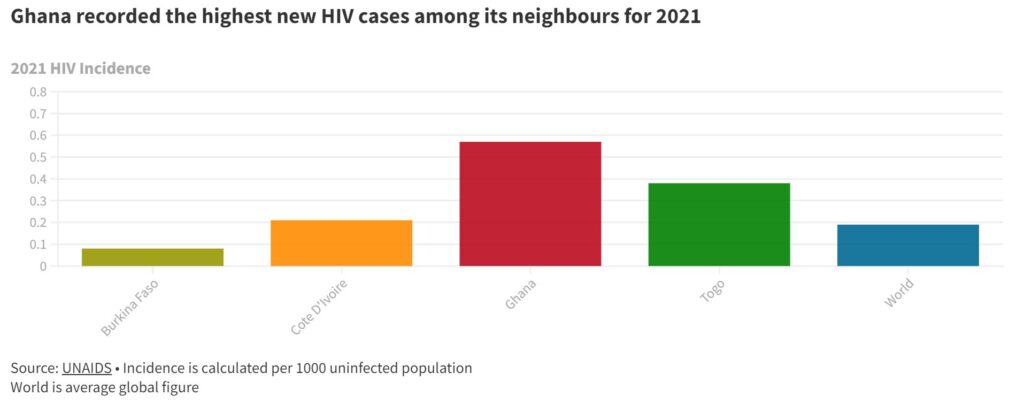
Link: https://flo.uri.sh/visualisation/7902275/embed?auto=1%27
Professor Ernest Kenu believes the difference between Ghana and its neighbours all boils down to strategic preventive campaigns. “If there is a time to invest in preventive and educational HIV campaigns, it is now”, because the youth “form the workforce for tomorrow, and we would be destroying the future of this country if the youth are unattended to”, he lamented.
Funding
Development partners have historically fully funded HIV through a three-year funding cycle. But as time went by there has been pressure on local governments to step in and contribute as global funding is gradually fading. The current funding regime, the New Funding Model (NFM) expects local governments to contribute at least 20% towards HIV. In Ghana global funding has been capped at providing care and treatment for the at-high-risk populations (i.e., MSM and commercial sex workers). That takes care of about 125,000 out of the 320,000 people on treatment leaving the government with no alternative but to absorb the remainder. The strain on the government’s purse would further be stretched as it is estimated that the number of people on treatment would be increased to 250,000 this year. That number will include pregnant women on antiretroviral treatment (ART) whose coverage is 87%, one of the lowest among neighbouring countries.
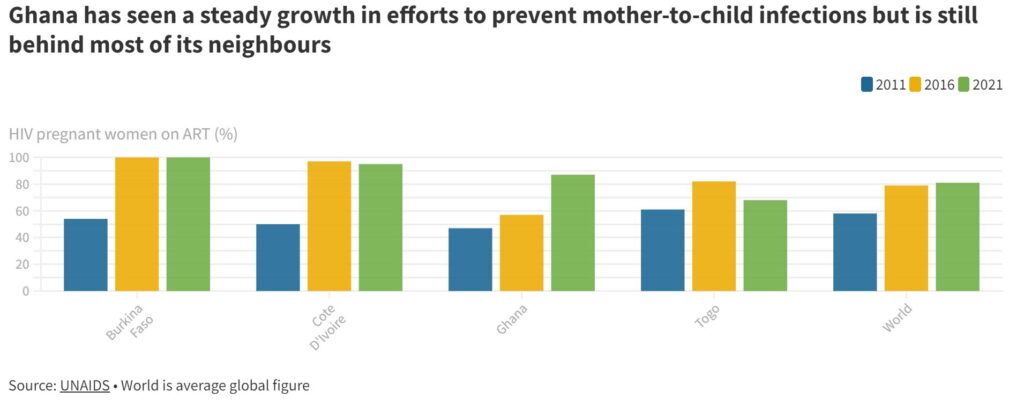
Link: https://flo.uri.sh/visualisation/7904554/embed?auto=1%27
The availability of global funds is influenced by several factors including the burden of disease, and the World Bank’s per capita Gross National Income classification. Thus, the declaration of Ghana as a lower middle-income country in 2007 and the lower burden of HIV compared with other sub-Saharan countries significantly dwindles Ghana’s global funding. The country’s case has been worsened by the government’s declaration of “Ghana Beyond Aid” in 2017. The Program Manager of the National STIs and HIV/AIDS Control Program, Ghana’s HIV technical lead agency, Dr. Stephen Ayisi Addo notes that the government has stepped up to the challenge by increasing funding within the last three years. For instance, the government has been the sole financier of all HIV test kits for about 1.2 million people annually, he added. He disclosed that for the 2021-2023 funding cycle government is making 14 million dollars available for the purchase of commodities alone. But these funding efforts are largely geared toward treatment, thus putting preventive campaigns on the back burner. Dr. Ayisi Addo explained that for the past 10 years the global fund has withdrawn funding for preventive campaigns and the government has not been able to fill that gap. Another way of looking at it is that the government’s limited funding has prioritized treatment efforts over preventive endeavors. And this is where neighboring francophone countries may have an edge. Aside from the historically higher burden which Cote D’Ivoire has had compared to Ghana, which meant they may get more in terms of global funding, francophone countries get more resources from the French Initiative due to their ties with Paris. The National AIDS Spending Assessment (NASA) report shows that Cote D’Ivoire has been consistent in raising more money than Ghana for HIV. For instance, in the 2009 NASA report (the latest made available by the UNAIDS for Ghana) Cote D’Ivoire raised over 117 million dollars while Ghana raised less than half of that amount (a little over 54 million dollars).
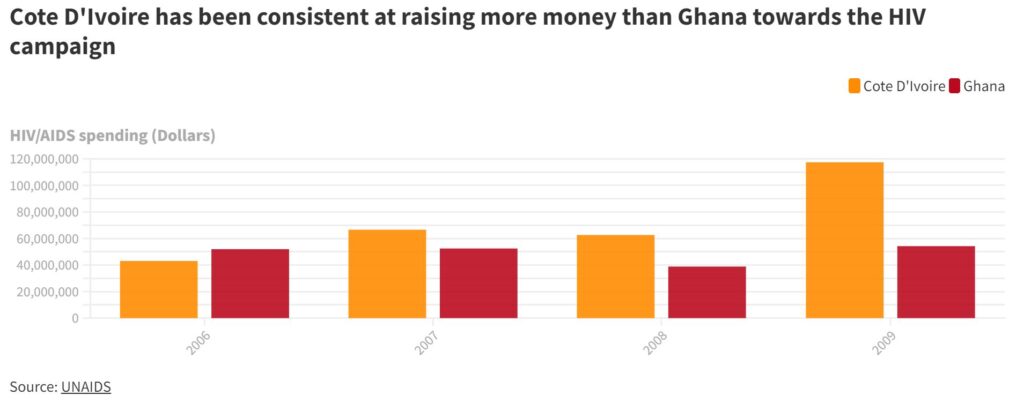
Link: https://flo.uri.sh/visualisation/7905415/embed?auto=1%27
To address this funding gap the National HIV and AIDS Fund was established within the Ghana AIDS Commission Act 2016. But the fund is yet to be set into motion. Speaking to Dr. Ayisi Addo ahead of last year’s World AIDS Day celebration, I asked him what he expected from the president who was billed to launch the program. “All I need now is that there must be an announcement of an initial seed capital from the government to kick start the AIDS fund,” he said. The president did mention the government’s acceptance of “the challenge to increase domestic resources through operationalization of the National HIV and AIDS Fund,” but he was short of announcing a seed capital to kick it started except to mention that paper works needed for cabinet’s consideration will be brought before it “shortly.”
Targets and gains
Despite the slow-paced progress, Ghana has made significant gains in some areas. Dr. Ayisi Addo noted that the country has been able to reduce the prevalence among pregnant women from as high as 4.6% to 2.0% with a target of 1.0% in the next 4 years. Another area that has seen tremendous gains is among female sex workers who as of last year had a prevalence of 4.6% from a rate as high as 11.0%. Prevalence among MSM has however stagnated around 18.0% but Dr. Ayisi Addo notes that routine survey data are showing a significant decrease in the regions of 5.0%. He believes that this year’s estimates among MSM will be drastically reduced. With the president launching a 5-year HIV/AIDS Strategic Plan Ghana seems poised to reduce HIV rates within the shortest possible time. For instance, the plan has a goal of reducing new infections by 85% and achieving a 95-95-95 fast-track testing and treatment by 2025. This 95-95-95 target is 5% higher than the UNAIDS target of 90-90-90 which expired in 2020 with Ghana unable to meet the target. The 90-90-90 target required nations to achieve the following by 2020:
- 90% of all persons living with HIV/AIDS (PLWA) must be diagnosed;
- 90% of the people diagnosed must be placed on anti-retroviral treatment (ART); and
- 90% of people on ART must reach viral suppression (i.e., levels where the viral load is so small that it cannot be transmitted)
Available data by the UNAIDS show that by 2020 Ghana had diagnosed only 63% of all PLWA – the first 90. Ghana’s 63% coverage is the lowest among its neighbors as shown in the chart below.
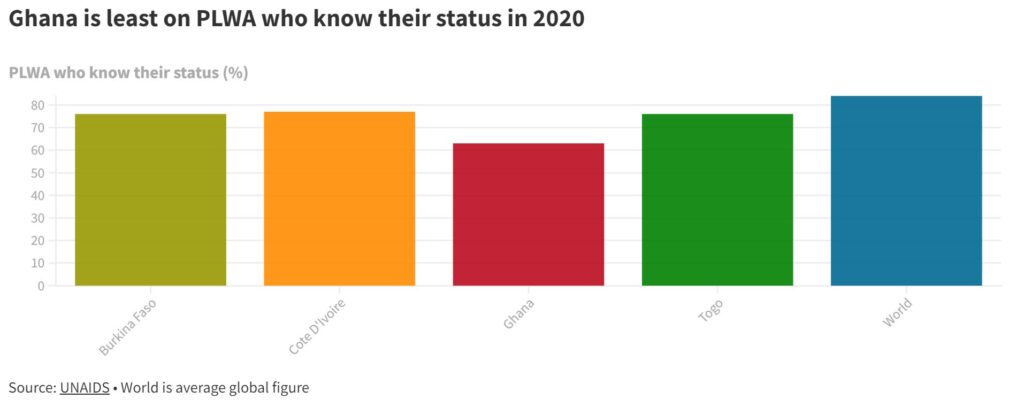
Link: https://flo.uri.sh/visualisation/7903370/embed?auto=1%27
Currently, Ghana stands at 71-99-79. To compare, Togo stands at 80-96-89 while Cote D’Ivoire stands at 80-96-84. Ghana needs to do more if it is to meet the 95% target at each level by 2025 looking at its failure to achieve previous targets.
Achieving the goals set out in the new strategic plan will not come easy, especially the preventive 85% reduction of new infections. Dr. Ayisi Addo observes that complacency seems to have slipped into the Ghanaian attitude towards HIV mainly because the availability of antiretroviral medication means that people are no more seen to be stark HIV sick. “Every now and then I go round, people say we think that the disease is not there again”, he said. That complacency includes older people on ART who slack in taking their medication thinking they are alright. They would then go around infecting younger people. The Director-General of the Ghana AIDS Commission Mr. Kyeremeh Atuahene described actions by such men as deliberate and has asked young women to watch out. Professor Kenu believes it will take more than occasional cautions to make the youth aware of the debilitating nature of HIV. Strategic media campaigns are an unending effort, he says adding that the youths have to be constantly reminded of the history of HIV/AIDS and the fact that a lot of healthy-looking people are on ART and can transmit the virus.
COVID-19 over HIV
One big blow to the HIV fight is the COVID-19 pandemic which seems to have taken the shine. Restricted movement meant that visits to health centers for ART and community visits for such endeavors ceased. Disruption in the supply chain due to the pandemic might have affected even condom supply. “Do you know that there are no condoms in the country?” asked Rev. Azuma who decried that on a day as important as the World AIDS Day commemoration “there were virtually no condoms to give out.” The pandemic also meant that funds needed for the fight against HIV were diverted toward COVID-19. The establishment and operationalization of the COVID-19 Fund ahead of the long-awaited AIDS Fund is a testimony of the Government’s commitment, or lack thereof, towards HIV. “Today, if government wants to set up the AIDS fund it would be done by close of day,” fumed Rev. Azumah.
There is an estimated 350,000 people living with HIV. Whether that number will increase or decrease in the coming years depend on how we approach prevent measures. The government needs to be committed to the fight against HIV/AIDS. Media campaigns should be a continuous effort to achieve results. Periods of slaking and complacency only go to derail years of hard work. Advancement in research and the multiplicity of media platforms has offered the opportunity to create tailored, target, and culturally sensitive messages to reach the youth many of whom are at the mercy of HIV. We missed the opportunity to do that during this football season.
Kwaku Botwe is a Strategic Health Communication Specialist.
Email: krufibotwe@gmail.com


