The 65 most climate-vulnerable countries are spending nearly 25 times more on debt repayments than on climate action, according to a new report by ActionAid International.
The report, “Debt fuels the Climate Crisis: How the Finance Flows,” says debt servicing is absorbing 65% of the combined government revenue of the countries most vulnerable to climate change, leaving them with fewer resources to respond to worsening floods, droughts, heat and hunger.
Released on September 16, the report analyses public revenues, debt repayments, national budgets and climate plans across 65 of the most climate-vulnerable countries.
It found that 93.5% of these countries are either in debt distress or at significant risk of debt distress.
ActionAid said the Global South is also paying approximately 225 times more in debt repayments than it receives in grant-based climate finance.
According to the report, the Global South is expected to make US$8.8 trillion in debt repayments in 2026, compared with the latest available figure of US$39 billion in climate grants received in 2024.
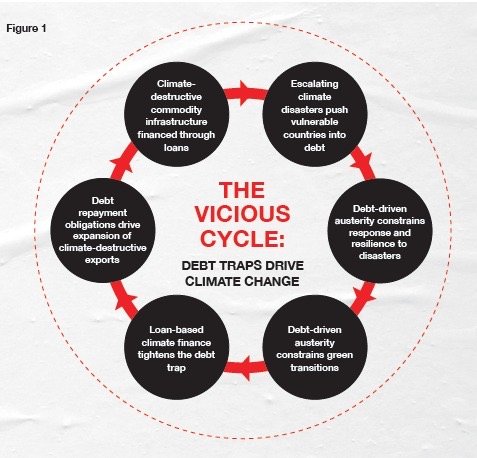
The report argues that debt and climate crises are locked in a “vicious cycle”, with climate disasters forcing countries to take on new loans for recovery, while debt repayments and austerity measures constrain spending on climate response, resilience, essential public services and a just transition.
It further says pressure to generate foreign currency to repay lenders can encourage governments to expand fossil fuel extraction and industrial agriculture, contributing to emissions, ecological damage and further climate-related disasters.
‘Debt and climate crises are tightly connected’
Arthur Larok, Secretary-General of ActionAid International, said the report demonstrates the close relationship between the two crises.
“For too long, the debt and climate crises have been treated separately. This research exposes how tightly they are connected and quantifies the devastating cost involved,” he said.
READ: Govt supports 1,432 human trafficking victims with rehabilitation and reintegration support
Mr Larok said action on debt could release domestic resources for climate action and help protect communities affected by climate change.
The report also argues that the nature of climate finance is contributing to the debt problem, noting that two-thirds of what wealthy countries classify as climate finance arrives in the form of loans rather than grants.
ActionAid said some of these loans carry high commercial interest rates, which it argues can deepen the debt burden of recipient countries.
Teresa Anderson, Global Lead on Climate Justice at ActionAid International and one of the report’s authors, described debt as a “triple whammy” for climate-vulnerable countries because it drives fossil fuel and industrial agriculture expansion, restricts climate action and leaves communities exposed when disasters occur.
She called for the cancellation of what ActionAid considers unjust and unsustainable debt and for climate finance to be provided as grants rather than loans.
Senegal example
The report highlights Senegal as an example of how debt servicing can constrain climate spending.
It says Senegal’s debt servicing in 2026 is projected to be more than 600 times its budgeted spending on climate action and to exceed 96% of government revenue.
According to ActionAid Senegal Country Director, Khaita Sylla, Senegal is spending US$605 on debt servicing for every US$1 allocated to climate action.
She said the situation creates difficult choices between debt repayment and investment in agroecology, public services and climate resilience, with women and girls disproportionately affected by reductions in public services.
ActionAid Ghana calls for debt reform
ActionAid Ghana Country Director John Nkaw said the current international debt system requires fundamental reform to enable climate-vulnerable countries to invest in resilience and sustainable development.
He called for what he described as semi-automatic debt cancellation for countries spending more than 10 to 15% of their revenue on unjust debt servicing.
“The current debt architecture looks colonial,” Mr Nkaw said, arguing that debt relief would free public resources for climate-resilient agriculture, renewable energy, a just transition and investment in the care sector.
He also called for increased adaptation finance for developing countries.
Calls for international action
As part of its advocacy during the Global Week of Climate Action, which runs from September 14 to 20, ActionAid and its allies are calling for reforms to the international debt and climate-finance system.
Among the proposals are the cancellation of unpayable or unjust debt for countries spending more than 10% of their revenues on external debt repayments, and a universal mechanism to suspend debt payments for countries hit by climate disasters.
The organisation is also calling for a UN Framework Convention on Sovereign Debt, legislation in London and New York requiring private creditors to participate meaningfully in debt restructuring, and reforms to credit-rating systems.
It further wants climate finance to be provided as grants rather than loans or other debt-creating instruments, alongside reforms to debt-sustainability assessments to ensure climate responses, public services and human rights are considered when determining what countries can afford to repay.
ActionAid is also advocating public debt and climate audits in countries facing debt crises to examine how domestic and external debt contribute to climate impacts, poverty and exclusion, particularly among women and girls.
The advocacy forms part of ActionAid’s #FundOurFuture campaign, which calls for debt cancellation, a fossil-free future and grant-based financing for climate adaptation, a just transition and community-led solutions such as agroecology.