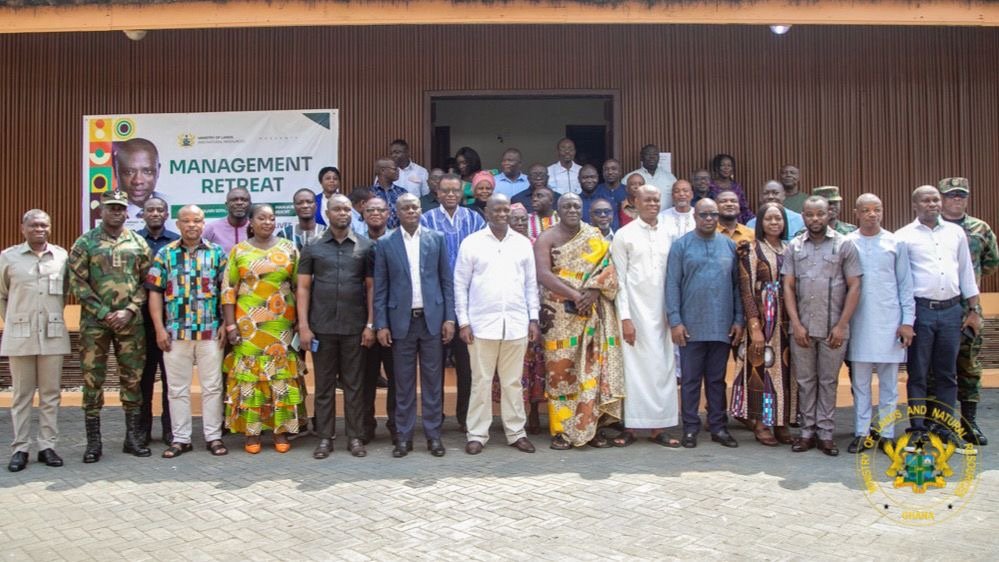
The Minister for Lands and Natural Resources, Emmanuel Armah-Kofi Buah, has charged staff and CEOs of the ministry to enhance their output in 2026.
According to him, the government’s second year in office is a decisive period that requires greater commitment and progress in line with President Mahama’s reset agenda.
Speaking at the ministry’s start-of-year retreat on Friday, January 30, he explained that the Lands Ministry represents the “heartbeat of the country”, and therefore all stakeholders must be zealous about the ministry’s vision and objectives.
Addressing a gathering of directors, CEOs and heads of agencies under the ministry, he called for greater collaboration among all appointees to maximise output across the lands, mines and forestry sub-sectors.
“This year, 2026, is a decisive year. Ghanaians have been patient with us, but this is the year our dear citizens will begin to demand more answers, and we can’t afford to fail them,” the Minister stressed.
“The only way we can achieve what we all plan to do is to strategise,” he added.
“Every quarter, this is the plan; this is what we are going to do. Everybody must commit to it, and at the end of each quarter we must check our KPIs and hold ourselves accountable, so that by the end of the year we can say with confidence that we delivered.”
The retreat also touched on ecotourism and climate action as growth areas, with the Minister pointing to the vast, largely untapped potential of Western Region forests such as Ankasa, among others.
Speaking at the event, President of the Western Regional House of Chiefs, Nana Kobina Nketsia V, commended the ministry’s leadership and urged participants to ground their strategies in history, culture and mindset.
Nana Nketsia stressed that land and natural resources are communal assets, warning that legal frameworks borrowed from foreign systems continue to fuel disputes.
He called for genuine decentralisation and digitalisation of land administration, noting that communities should not have to travel long distances to register land in an era of modern technology.
He also challenged participants to rethink poverty and value in the extractive sector.
“The person who truly needs my resources is not me; it is the one sitting abroad who depends on them,” he said.
The three-day retreat, which brought together CEOs, directors and heads of agencies, paved the way for honest assessments of 2025 and new strategic planning for the year, 2026.