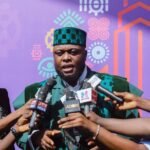
Veteran Ghanaian sound engineer and music producer, Fred Kyei Mensah, popularly known as Fredyma, has stated that Ghana’s political landscape will continue to be dominated by the two major political parties, the National Democratic Congress (NDC) and the New Patriotic Party (NPP), despite emerging movements seeking to break the duopoly.
Speaking on Starr Showbiz with Feeling Daddy on Starr 103.5 FM on Saturday, April 18, 2026, Fredyma dismissed the sustainability of new political movements, insisting that the existing two-party structure remains firmly entrenched.
“Ghana for now is NDC, NPP. Forget it… and that’s what’s going to stay for a very long time,” he said.
His remarks come against the backdrop of discussions around the emerging “The Base” movement, linked to veteran actor Alexander Kofi Adu, popularly known as Agya Koo, who recently announced plans to launch the Ghana First Party as a third political force to challenge the dominance of the NDC and NPP.
But Fredyma expressed scepticism about the viability of such political ventures, suggesting they lack the structural depth to survive in Ghana’s political system.
“The Base… Those were the days when we in school doing Science… acid, base and salt. That’s what I see. Combination of a lot of this… it will not end anywhere,” he remarked.
He further argued that the political space has remained largely unchanged since the Fourth Republic, with power alternating between the two dominant parties.
“For the last 34 years… NDC, NPP… that is what is going to stay for a very long time,” he said, adding that smaller movements often emerge but fail to sustain themselves.
READ: The Base will not end anywhere – Fredyma dismisses Agya Koo’s new political movement
Fredyma suggested that many of the new political groupings may be driven more by positioning and influence than by genuine long-term political restructuring.
“It is a facade… maybe they want to have a strategic position… so anytime there’s an election, you have to come and negotiate with them,” he noted.
He also questioned the durability of leadership within such movements, implying that they often lack strong foundational structures capable of competing with established parties.
“If you look at the leaders… in the near future, where would they be?” he asked.
Source: Starrfm.com.gh