President John Dramani Mahama has called on African countries to take greater responsibility for financing and strengthening their healthcare systems, warning that declining external support signals an urgent need for health sovereignty across the continent.
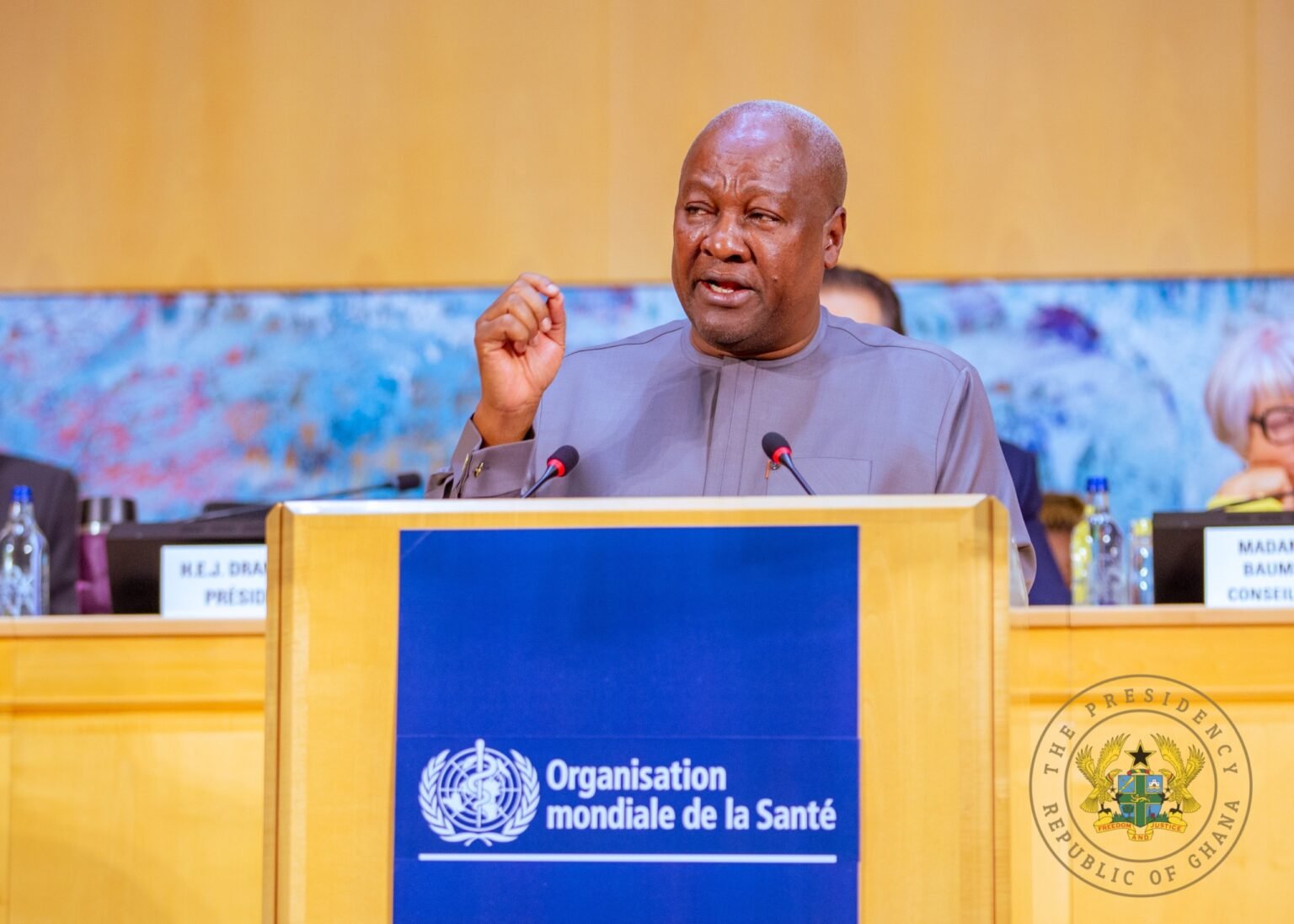
Addressing the 79th World Health Assembly (WHA) in Geneva, the Ghanaian President said Africa can no longer rely heavily on donor funding to sustain critical health programmes, insisting that health spending must now be seen as a strategic investment in national development rather than a social burden.
“We are witnessing the end of an era, and we must have the courage to build the next one,” he told global health leaders, pointing to shrinking international aid and shifting geopolitical priorities as evidence that the traditional donor-dependent model is no longer sustainable.
President Mahama cited a 40% drop in global humanitarian assistance and cuts in overseas development aid by major Western economies, including the withdrawal of United States support that has forced the World Health Organisation (WHO) to scale down programmes and reduce staff.
He further noted that Ghana alone lost about $78 million in health financing following the closure of USAID-supported programmes in 2025, affecting malaria control, maternal and child health, nutrition, and HIV/AIDS interventions, including access to antiretroviral treatment.
Across the continent, he warned, similar funding disruptions are threatening essential health services. He referenced reports that abrupt cuts to PEPFAR funding in South Africa have led to clinic closures and disrupted care for more than one million people living with HIV.
“These shifts serve as the final, clear signal that the old system of donor-dependency is past its sell-by date,” President Mahama said, stressing the need for African leaders to urgently rethink how healthcare is financed and delivered.
He argued that Africa must move towards “health sovereignty,” where countries are able to independently finance core health services, regulate quality, produce essential medicines, and build resilient health systems that are not vulnerable to external shocks.
“We come to Geneva not to mourn the past, but to build a future where a country’s health is not a byproduct of charity, but a result of sovereign capability,” he said.
President Mahama highlighted Ghana’s ongoing reforms as an example of this shift, citing the expansion of the National Health Insurance Scheme (NHIS), which now covers an estimated 66% of the population, as well as the rollout of the Free Primary Health Care Programme aimed at eliminating financial barriers to basic healthcare access.
He also pointed to reforms that have unlocked an additional GHS 3 billion (about $300 million) for health financing by removing funding caps, alongside the use of digital systems and artificial intelligence to improve efficiency and reduce fraud within the NHIS.
Additionally, he referenced the Ghana Medical Trust Fund, also known as “MahamaCares,” which he said is providing support for patients suffering from non-communicable diseases such as cancer, cardiovascular conditions, liver disease, and kidney failure.
According to him, Ghana is also positioning itself to transition away from donor dependence in vaccine procurement by 2030.
President Mahama urged African governments to prioritise domestic health financing, strengthen accountability, and invest in preventive care, stressing that sustainable health systems require long-term national commitment.
“Africa must see health spending as an investment rather than just an obligation,” he said. “A healthy population is indispensable to economic progress.”
He further called for reforms in global health governance, warning against institutional rigidity and arguing that reform processes must not protect existing structures at the expense of effectiveness.
President Mahama also outlined key components of Ghana’s “Accra Reset Initiative,” including mechanisms to improve coordination of global health programmes and unlock investment in local manufacturing and bio-innovation.
He is expected to continue bilateral engagements on the sidelines of the Assembly, where global health leaders are discussing strategies to strengthen health systems and respond to emerging global health challenges.
Source: Starrfm.com.gh