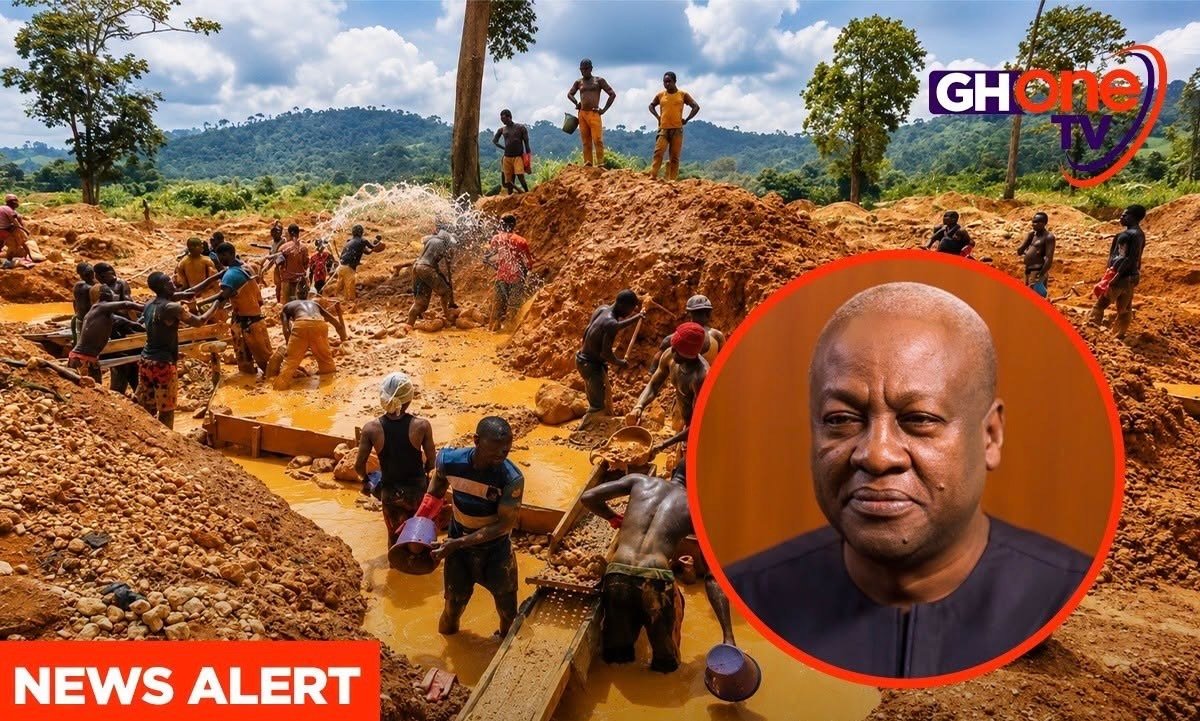
President John Dramani Mahama has announced an additional GH¢400 million allocation in the 2027 national budget to recruit more Blue Water Guards as part of efforts to intensify the fight against illegal mining and protect Ghana’s water bodies and forest reserves.
The funding, provided for by the Minister of Finance, Dr. Cassiel Ato Forson in next year’s budget, is expected to strengthen surveillance along rivers and other water bodies affected by illegal mining activities, popularly known as galamsey.
Mahama made the announcement at the Jubilee House during a courtesy call by the Western Regional House of Chiefs, where he urged traditional authorities to support the government’s efforts to tackle illegal mining in their communities.
He said the involvement of chiefs was critical to the success of the campaign, particularly as some communities had resisted anti-galamsey operations conducted by the National Anti-Illegal Mining Operations Secretariat (NAIMOS).
“We need the help of our chiefs in the fights against Galamsey because you live in the community with the people and sometimes NAIMOS is doing a good job, but sometimes we go into some communities and the youth and the traditional authorities and everybody, you know, fights back at NAIMOS,” he said.
The President expressed concern about violent confrontations during some operations, which he said had resulted in fatalities involving security personnel.
“And there are a few incidents where the soldiers have had to, you know, discharge firearms, resulted in a few deaths. We want to avoid that and so if we can get the collaboration of our chiefs to help in the fight against illegal mining, especially in our forest reserves and in our water bodies,” he added.
President Mahama said the additional funding would enable the recruitment of more Blue Water Guards to patrol water bodies and prevent illegal miners from continuing their activities.
He explained that the guards had been instructed to destroy changfan machines, which are commonly used in illegal mining operations on rivers.
“So in next year’s budget, the Minister of Finance has provided another 400 million cedis to employ more of the blue water guards to patrol the water bodies and any time they come across shamfan machines, they’ve been given instructions to destroy them and so they set them on fire,” he said.
The President noted that the government had already destroyed several of the machines, helping to clear major river channels of equipment used for illegal mining.
However, he cautioned that clearing the main channels alone would not resolve the problem, as polluted water and sediment continued to flow from smaller tributaries into the rivers.
“We’ve destroyed a lot of shamfan machines.
And so in many cases, the main water channels have been relieved of these shamfan machines, but there are also tributaries and the tributaries can go for, you know, hundreds of kilometers,” he said.
“And so while you have cleared the main channel of the river, you have mud and silt coming down from the tributaries.”
His remarks highlight the challenges facing efforts to restore water bodies affected by illegal mining, even where major river channels have been cleared of mining equipment.
The government has repeatedly faced calls to intensify measures against illegal mining because of its impact on rivers, forest reserves and the environment.