



By Peter Anti, IFEST – Ghana
Introduction
Policy evaluation is an integral part of the policy formulation process. Summative evaluation of policies and programmes occurs at the end of the policy implementation process. In Ghana, the Free SHS policy can be said to have run its full course after three years (2017-2020) of implementation. Throughout the implementation phase, one issue that gained traction and is still being discussed by policy analysts and stakeholders in the sector is the model of financing adopted. The government decided to use wholesale financing, which meant that, they decided to absorb the fees of all students; a principle termed “Equality” instead of the Equity that was touted as one of the themes for the policy. The government going by their preferred mode has spent around 7.6 billion Ghana cedis on the policy out of which 3.4 billion Ghana cedis is from the ABFA. The Annual Budget Funding Account (ABFA) is the account set up by the government that receives an allocation from oil and gas revenue in support of Government budgets. This source can be described as finite. A source characterized by uncertainty due to the nature of the oil market.
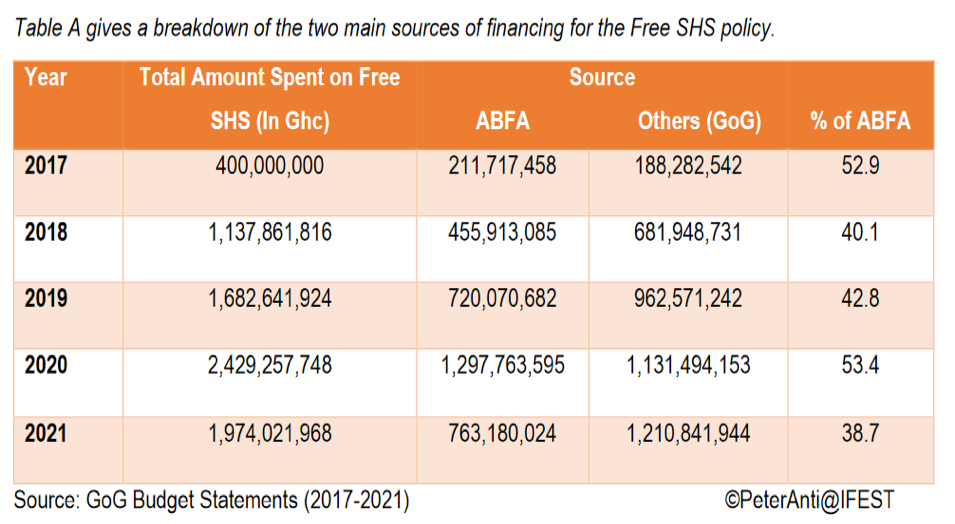
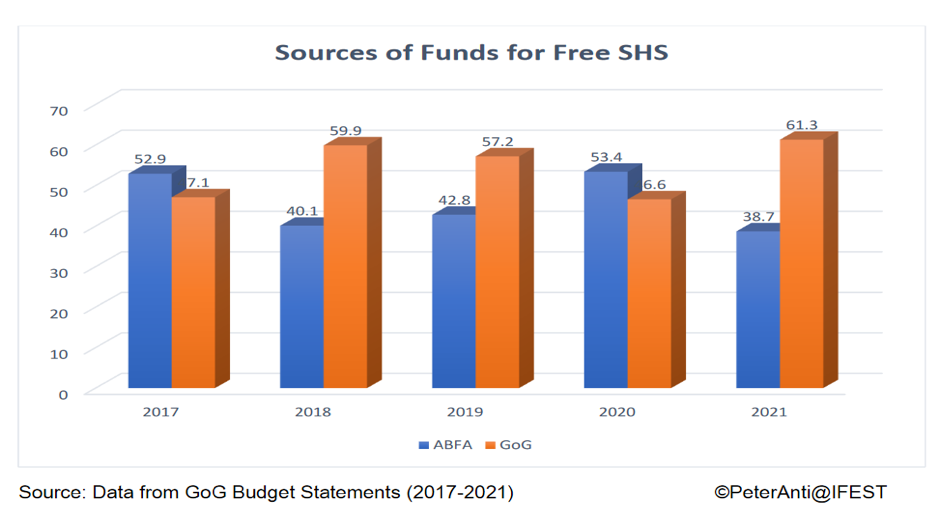
Table A, indicates that on average, 45.58% of the money used to finance the policy is from the ABFA, one is not far from right to conclude that, almost half of funds supporting the policy is from the ABFA.
It is an undeniable fact that the sustainability of policies mostly depends on a reliable source of funding, a position shared by many policy analysts. For example, the National Health Insurance policy has a source of funding which is the NHIL. This is to ensure that, at least, there is a constant stream of revenue coming into government coffers to support the health delivery agenda of the government. Even with that, we are not oblivious to the challenges facing the insurance scheme. Since the same cannot be said for the Free SHS policy, sustainability and efficient use of the scarce funds are pressing issues that need urgent attention if the policy would be able to achieve its broad aim of transforming the human capital base of this country.
Again, looking at the education sector appropriation acts over the years, there are about six areas where budgetary allocations are made. These are Management and Administration, Basic Education, Second Cycle Education, Non-Formal, Inclusive and Special Education, and Tertiary Education. Technical and Vocational Education and Training (TVET) is considered under Second Cycle education. Although a majority of the allocation goes into compensation, further analysis indicates an increasing trend in the allocation for second cycle education with Free SHS being the ultimate beneficiary. Even with this, the TVET component receives between 5% to 10% of the allocation for the second cycle education. By implication, though we are spending more in the education sector, a sizeable amount goes into Free SHS leaving the other five (5) areas to struggle for the little left.
These obvious facts strengthen the call for a relook at the financing model adopted for the policy. This was the import of the question posed by Francis Abban, the journalist from GhOne TV when he interviewed the Minister of Education, Hon. Dr. Yaw Osei Adutwum. In responding to the question of calls by people for the government to adopt a more efficient funding mechanism, the minister retorted “What are you using for means testing?” any suggestions?
This is therefore an attempt to explain the rationale behind the call for a targeted model of financing the policy and propose a model that will ensure equity in the financing aspect of the policy leading to efficient and effective utilization of the scarce resources at the disposal of the Ministry.
Proposed Targeting Model
There is enough evidence in the literature that proves that targeting public spending in the social sectors can yield better results in terms of enhancing equity than the wholesale provision of services. A variety of methods are available for targeting.
- Self-targeting: Self-targeting is to use people’s judgments and decisions to distribute targeted benefits
- Means testing: means testing is an administrative mechanism for assessing a person’s or a family’s eligibility to receive benefits, based on income or other income-related characteristics of an individual or family
- Categorical: categorical targeting usually uses indicators including the location of the residence, age, etc;
- Community-based selection: community-based selection involves community people including community officials and members in decisions of allocating the targeted subsidies.
It must be indicated that a call for targeting does not imply the adoption of the same models used in other areas without modification. It is a call for a modification of various targeting models to suit our unique circumstances. Therefore, combining two or three of these types of targeting should not be beyond the capabilities of a technical team tasked to work on a targeting model for financing the free SHS policy.
Again, if we decide to use only means-testing, it should be stated that there are three types of means-testing. Curiously, at the mention of means-testing, people quickly jump to throw in the income variable which to them is difficult to obtain accurate data on. That should not be a challenge if we are ready to design a comprehensive selection criterion. We may decide to use:
- Simple Means test: which is based on household income (occupation as proxy), size, and composition.
- Sophisticated means test: which takes into consideration variables such as adjusted family income according to family size, seasonality, costs of major items such as housing, major medical expenses, etc.
- Proxy means test: this involves using selected variables to develop an index. These variables might include housing characteristics and location, family structure, occupation, education, gender of head of household, ownership of durable goods, etc.
Our unique challenge in obtaining accurate data on household incomes would require that we adopt the Proxy Means Test. We develop a set of criteria that will group our students into three categories: Full, Partial, and No Scholarship Student. There will be benchmarks that would indicate which category a student would belong to according to specific weights that will be assigned to the various variables identified to enable the system to profile each student in terms of their ability to pay.
The next question that demands an answer is: “How do you get the data?” For me, this is the easiest aspect of the whole process. Every year, students in JHS fill forms to select schools for their secondary education. An extended questionnaire could be developed and added to that form for students to fill with the aid of their guardians or parents. This section of the form will be detached and sent to a special unit set up to collate data which will be used to classify the students into any of the three categories based on the benchmark set by the index.
The other alternative is to adopt a transparent 80-20 Day-Boarding Policy which will ensure that, more students are encouraged to select schools within a certain radius around their habitation while the rest are reserved for special cases with a published criterion for admission into a boarding school system.
Conclusion
Several reports have pointed to the fact that the problem with education financing in Sub-Saharan Africa is not the allocation of funds but rather the inefficient utilization of the allocated funds. Such inefficiencies and waste negate the investments being made in the sector resulting in zero returns in the long run. Therefore, any model of education financing that ignores the variable “ability to pay” is problematic and not an economically prudent model to implement. It is not beyond our capabilities to model a robust financing mechanism that will ensure efficiency and effectiveness and save money for other areas within the sector.
I have said that the Free SHS policy is political and not an economic policy. This makes it difficult to win when one argues from an economic point of view.
***The writer is an Education Economist, Researcher, and Curriculum Expert. He is currently the Acting Executive Director, The Institute for Education Studies (IFEST), an educational policy think tank in Ghana.


