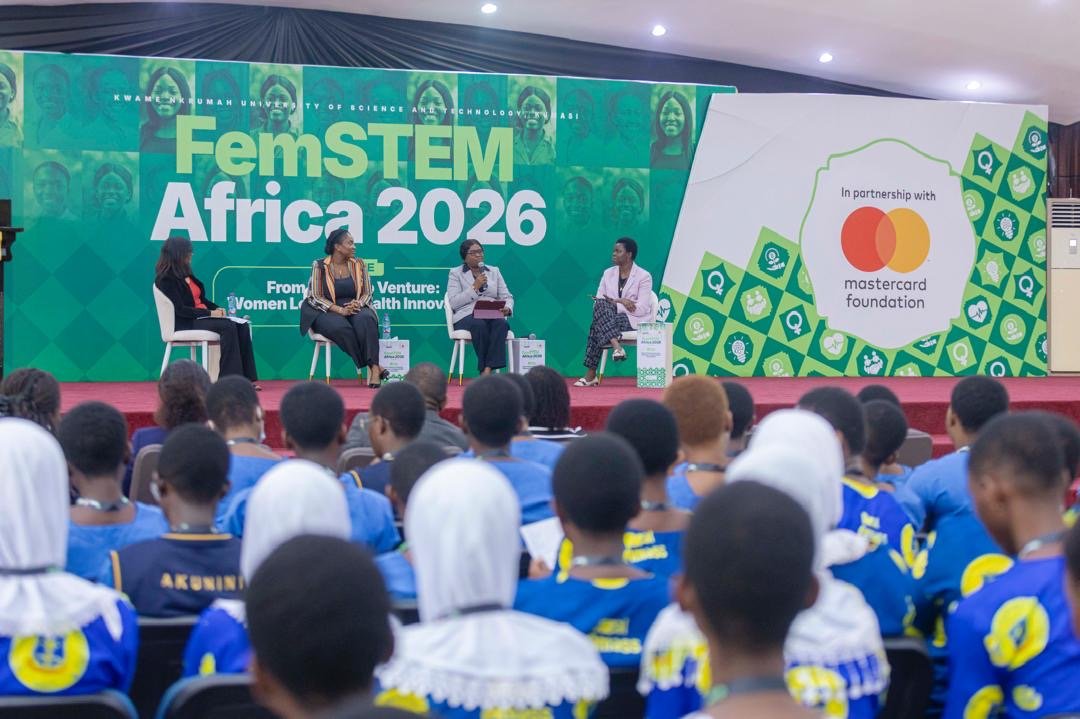
The Kwame Nkrumah University of Science and Technology (KNUST), in partnership with the Africa Health Collaborative (AHC) and the Mastercard Foundation, has hosted the maiden edition of FemSTEM Africa 2026. This transformative initiative aims to nurture the next generation of women leaders in health innovation and entrepreneurship across Africa.
Held under the theme “From Vision to Venture: Women Leading Health Innovation,” the two-day conference is expected to bring together over 300 female students from STEM-focused Senior High Schools across the Ashanti Region, as well as university students and emerging entrepreneurs seeking to scale their health-related ventures.
Speaking at the opening ceremony, the Principal Investigator of the Africa Health Collaborative at KNUST, Professor Ellis Owusu Dabo, explained that FemSTEM Africa was established to expose young women to entrepreneurship, innovation, and leadership opportunities at an early stage of their academic and professional journeys. He observed that, although women constitute a significant proportion of the global health workforce, they remain underrepresented among founders, innovators, and investors in the health sector.
“Women bring unique perspectives and solutions to some of the most pressing healthcare challenges facing our communities. By increasing female participation in innovation and entrepreneurship, we can unlock transformative ideas that improve lives and strengthen health systems,” he stated.
Professor Owusu Dabo challenged participants to view societal and health-related challenges as opportunities for innovation and enterprise development. He encouraged them to cultivate curiosity, strengthen their digital competencies, seek mentorship, and embrace Science, Technology, Engineering and Mathematics (STEM) disciplines as powerful tools for solving real-world problems.
The Head of the Africa Health Collaborative Secretariat and Senior Director of International Relations at the University of Toronto, Dr. Penina Lam, highlighted the life-changing potential of entrepreneurship and urged participants to pursue their ideas boldly, regardless of how modest they may appear.
“There is no business idea too small. Go forth, test it, refine it, and learn from the process. Even if it fails the first time, the lessons gained will prepare you for future opportunities,” she advised.
Dr. Lam encouraged the students to remain alert to opportunities within their homes, schools, and communities, stressing that many impactful innovations originate from everyday experiences and observations.
Also addressing the gathering, Professor Mrs. Ibok Oduro of the Department of Food Science and Technology at KNUST called for a fundamental shift in perceptions surrounding women’s participation in STEM fields.
She emphasised that science is deeply rooted in curiosity, observation, creativity, and problem-solving, urging the students to recognise themselves as capable scientists and innovators with the power to create meaningful change.
“Science is our observation; it is our world. We are all scientists in one way or another because we observe, question, and seek solutions,” she remarked.
Professor Oduro challenged participants to reject stereotypes that portray science, technology, engineering, and innovation as male-dominated domains.
“The only limits in our lives are those we impose on ourselves. STEM is our field, not their field. It is not merely a discipline we enter; it is a world we are helping to build, and you and I are its architects,” she stated.
She further underscored the importance of collaboration in driving innovation, urging young innovators to build multidisciplinary teams and strategic partnerships capable of addressing complex healthcare challenges, urging participants to move beyond siloed thinking and adopt systems-based approaches to solve the multifaceted problems confronting our societies.
Commending the Africa Health Collaborative for its mentorship and venture development programmes, Professor Oduro described the initiative as a critical platform for supporting young innovators on the often-challenging journey from idea generation to implementation.
“The Africa Health Collaborative is creating pathways for young people to transform scientific discoveries into practical solutions. Through mentorship, networking opportunities and business support, it is helping bridge the gap between vision and venture,” she said.
Professor Oduro encouraged participants to fully leverage the opportunities offered through the programme and to pursue innovative solutions capable of improving healthcare delivery and outcomes across the continent.
As part of the conference, participants engaged in an interactive panel discussion featuring accomplished women entrepreneurs and industry leaders who shared their experiences, challenges, and lessons learned in building successful enterprises.
The panel featured Ms. Mary Asante-Asamoah, Executive Director of Barbex Africa Projects Limited; Mrs. Joyce Owusu-Dabo, Chief Executive Officer of Sinapi Aba Trust; and Dr. Bhavana Singh, Clinician and Chief Medical Officer at the KNUST Hospital.
The speakers encouraged participants to embrace resilience, innovation, and perseverance in their entrepreneurial journeys.
FemSTEM was established by Health Innovation Hub (H2i) in 2017 to engage, inspire, and celebrate women entrepreneurs in the health innovation ecosystem.
Supported through the Temerty Foundation, the programme operates as a multi-event series, with annual editions held in both Canada and Africa.
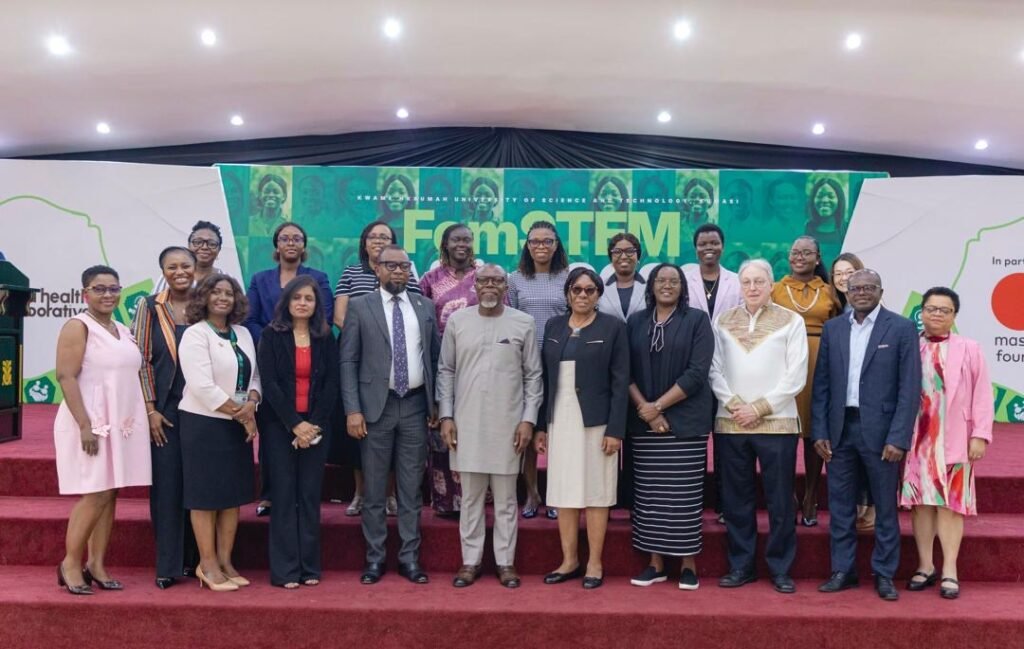
The launch of FemSTEM Africa 2026 at KNUST marks a significant milestone in efforts to strengthen women’s participation in health innovation, entrepreneurship, and STEM leadership, while creating pathways for young African women to transform bold ideas into sustainable ventures that address the continent’s most pressing healthcare challenges.
Source: Starrfm.com.gh/Isaac Justice Bediako