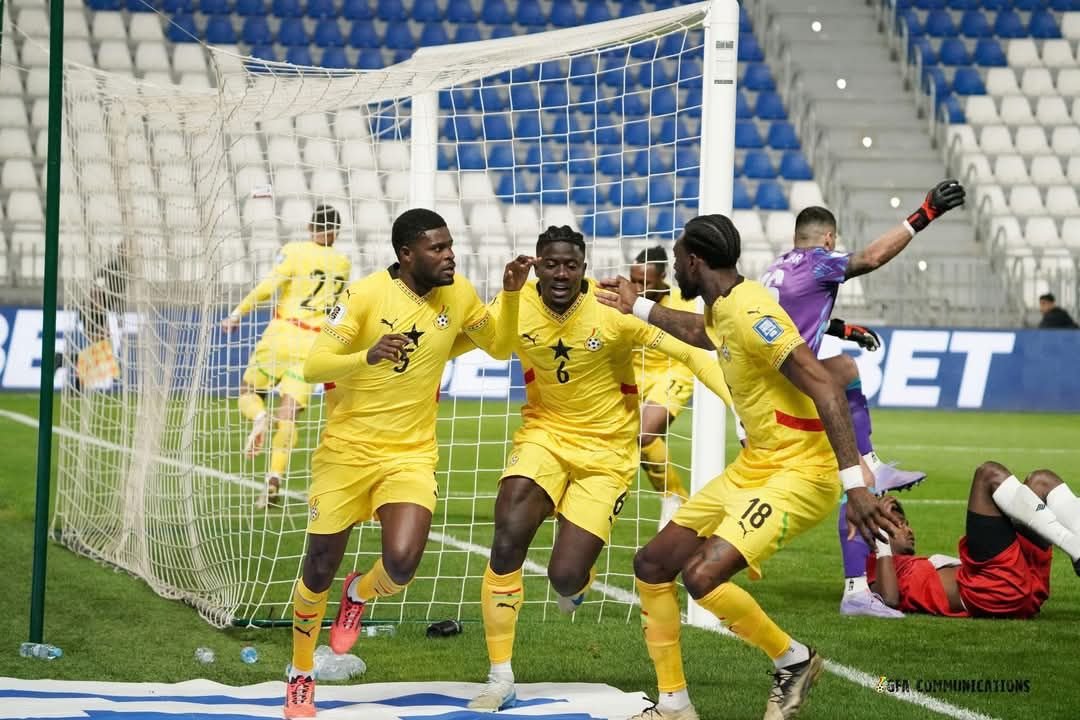
Ghana’s participation at the 2026 FIFA World Cup offered another opportunity for the Black Stars to restore it’s reputation as one of Africa’s most competitive football nations.
After missing the 2025 Africa Cup of Nations, qualification for the expanded 48-team FIFA World Cup was a welcome boost, but the tournament ultimately exposed both the promise and the limitations of the current Ghanaian side.
The Black Stars reached the knockout stage, but their campaign ended in the Round of 32 following a narrow 1-0 defeat to Colombia. The result meant Ghana’s return to the World Cup ended earlier than many supporters had hoped, but the tournament still provided valuable evidence of where the team is making progress and where significant work still remains.
One of Ghana’s biggest strengths at the tournament was the physical quality of the squad. The Black Stars possessed players capable of competing at a high tempo, pressing opponents and transitioning quickly from defence into attack.
Ghana’s midfield and wide areas offered pace and mobility, while the team’s ability to move the ball forward quickly made them dangerous when opponents left spaces behind. The squad also showed a willingness to compete, with the players demonstrating intensity and commitment throughout the tournament. A clear testament to a very effective job done on the team by the coaching department led by Carlos Queiroz.
The Black Stars were particularly effective when they played with urgency. Their best moments came when the team pressed higher, won the ball in advanced areas, and attacked with speed rather than allowing opponents to settle into their defensive shape.
This suggests that Ghana’s most natural identity is one built around energy, athleticism, directness, and quick transitions.
Ghana also benefited from having players with the technical ability to change matches.
The presence of talented individuals capable of creating opportunities, carrying the ball forward, and producing moments of individual brilliance gave the Black Stars an attacking threat, i.e., Thomas Partey, Brandon Thomas Asante, and Fatawu Ishahaku.
However, the tournament also demonstrated that Ghanacan not depend solely on individual quality.
At the highest level, successful teams require their best players to function within a clear collective structure. Ghana sometimes looked at its most dangerous when individual talent was combined with coordinated movement, a clear example being the goal against Panama but on other occasions the team appeared to rely too heavily on players producing something special on their own.
That balance between individual freedom and tactical discipline will be crucial for the next generation of the Black Stars.
Perhaps the most obvious weakness was Ghana’s inability to consistently turn promising situations into clear-cut chances.
The Black Stars could move the ball into dangerous areas but often struggled with the final pass, decision-making in the attacking third and clinical finishing.
Possession and attacking momentum did not always translate into goals.
Against top-level opposition, the margin for error is extremely small. A team may dominate periods of a match, but if it can not punish opponents when opportunities arise, it risks being eliminated by a single moment.
That was evident in Ghana’s eventual defeat to Colombia. The Black Stars were competitive, but they could not find the goal required to extend their World Cup journey.
The lesson is clear: Ghana needs to become more ruthless and decisive in attack, especially with players likeCaptainn Jordan Ayew.
Another area that requires attention is defensive organisation.
While Ghana had physically strong defenders and goalkeeping options, there were moments when the team appeared vulnerable when opponents changed the tempo of the game or attacked quickly.
The modern international game demands more than individual defending. The entire team must understand when to press, when to drop, and how to close spaces between the defensive and midfield lines. Admittedly, Ghana missed its regularcentre-backk pair at this World Cup in Alexander Djiku and Mohammed Salisu due to injuries.
Ghana’s defensive improvement must be collective. The midfield must offer greater protection to the backline, while the full-backs and wide players must maintain better positional discipline.
A strong defensive structure would give Ghana a more stable platform from which to attack.
The 2026 World Cup suggested that Ghana’s best football identity is moving towards a more energetic and transitional style.
The Black Stars are at their best when they play quickly, win the ball, and attack before the opposition can reorganise.
Their athleticism makes them capable of competing with technically superior teams, particularly when the match becomes open.
However, Ghana must also learn to control games.
There were moments when the team needed to slow the game down, keep possession, and dictate the tempo, but the Black Stars sometimes appeared more comfortable and lost the possession easily.
That is perhaps the next major step in Ghana’s development, learning to combine transition football with possession and game management.
The best teams at the international level can do both.
Despite the disappointment of elimination, the Black Stars have reasons for optimism.
The team has a group of talented players with experience at high levels of European football, alongside younger players who can potentially become important figures for the national team in the coming years.
The challenge for Ghana is to create continuity.
The national team has experienced too many periods of rebuilding, tactical changes, and uncertainty.
The 2026 World Cup should, therefore, be viewed as part of a longer project rather than an isolated tournament.
The objective must be to build a team with a clearly defined football philosophy and a stable core of players who understand exactly what is expected of them.
THE VERDICT
Ghana’s 2026 World Cup campaign was neither a failure nor a complete success. Reaching the knockout stage represented progress after the disappointment of the 2022 tournament, but the narrow elimination by Colombia also showed how far the Black Stars still have to go to compete consistently with the world’s elite.
The strengths are clear: athleticism, pace, individual talent, energy, and the ability to transition quickly.
The weaknesses are equally obvious, inconsistency in attack, a lack of clinical finishing, defensive vulnerabilities, and an occasional inability to control the tempo of matches.
The Black Stars now face a crucial period. Ghana has the talent to become a formidable international side, but talent alone will not be enough. The next stage of development must focus on tactical identity, consistency, defensive organisation, and, above all, the ability to convert good performances into decisive results.
The 2026 World Cup has shown that Ghana can compete.
The next challenge is proving that the Black Stars can consistently win.
BY: BENJAMIN DANIEL AKOI YAMOAH